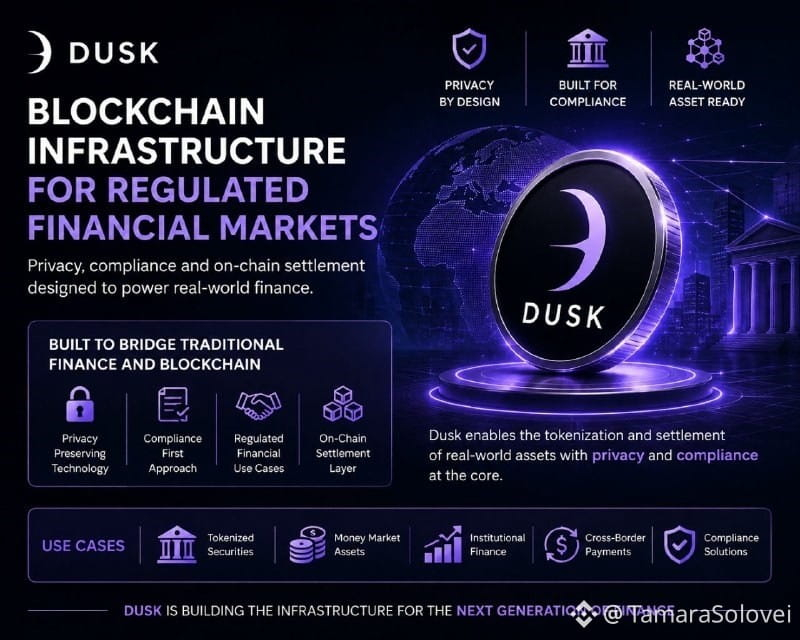
#dusk $DUSK @Dusk
Most people hear “RWA” and immediately think about tokenizing government bonds or putting real estate onchain.
But I think the more interesting opportunity is much broader.
Private markets.
A huge amount of economic activity happens outside public markets.
Private companies need financing.
Investors need access to opportunities.
Ownership needs to be recorded.
Transfers need to be controlled.
Payments and settlement need to happen.
And every participant needs to know who is actually allowed to do what.
Today, a lot of this infrastructure is fragmented across issuers, banks, custodians, administrators, brokers and other intermediaries.
Tokenization doesn't automatically solve that.
Putting an asset on a blockchain doesn't magically create liquidity, demand or legal certainty.
The interesting part is what happens when the entire lifecycle of an asset can be represented digitally.
Issuance.
Investor eligibility.
Ownership.
Transfers.
Dividends.
Voting.
Settlement.
That's where @Dusk _Foundation is taking an interesting approach.
Dusk isn't simply saying “let's put more assets onchain.”
It's trying to build infrastructure where regulated assets can exist onchain while still dealing with the requirements that financial markets can't ignore.
Privacy.
Selective disclosure.
Access controls.
Compliance.
Deterministic settlement.
And that's particularly important for private markets.
A public blockchain gives you transparency by default.
Financial markets often need the opposite: controlled visibility.
An investor may need to prove they're eligible without exposing every piece of personal information.
A company may need to keep sensitive positions private.
A regulated venue may need to know exactly who can hold or transfer an asset.
That doesn't mean blockchain has to choose between transparency and privacy.
It means the infrastructure needs to be designed for both.
This is why I'm paying attention to Dusk.
The interesting question isn't whether we can tokenize another asset.
Most people hear “RWA” and immediately think about tokenizing government bonds or putting real estate onchain.
But I think the more interesting opportunity is much broader.
Private markets.
A huge amount of economic activity happens outside public markets.
Private companies need financing.
Investors need access to opportunities.
Ownership needs to be recorded.
Transfers need to be controlled.
Payments and settlement need to happen.
And every participant needs to know who is actually allowed to do what.
Today, a lot of this infrastructure is fragmented across issuers, banks, custodians, administrators, brokers and other intermediaries.
Tokenization doesn't automatically solve that.
Putting an asset on a blockchain doesn't magically create liquidity, demand or legal certainty.
The interesting part is what happens when the entire lifecycle of an asset can be represented digitally.
Issuance.
Investor eligibility.
Ownership.
Transfers.
Dividends.
Voting.
Settlement.
That's where @Dusk _Foundation is taking an interesting approach.
Dusk isn't simply saying “let's put more assets onchain.”
It's trying to build infrastructure where regulated assets can exist onchain while still dealing with the requirements that financial markets can't ignore.
Privacy.
Selective disclosure.
Access controls.
Compliance.
Deterministic settlement.
And that's particularly important for private markets.
A public blockchain gives you transparency by default.
Financial markets often need the opposite: controlled visibility.
An investor may need to prove they're eligible without exposing every piece of personal information.
A company may need to keep sensitive positions private.
A regulated venue may need to know exactly who can hold or transfer an asset.
That doesn't mean blockchain has to choose between transparency and privacy.
It means the infrastructure needs to be designed for both.
This is why I'm paying attention to Dusk.
The interesting question isn't whether we can tokenize another asset.