
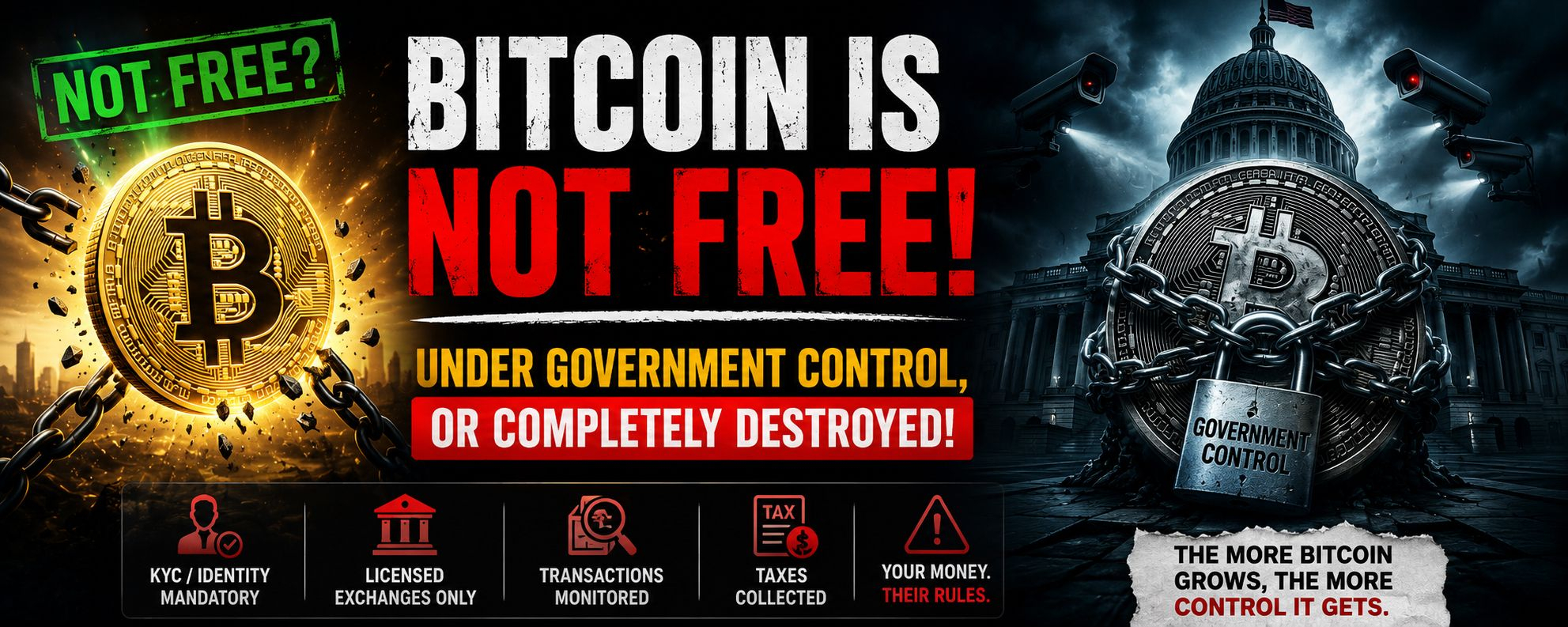
If the whole world eventually accepts Bitcoin, where does Bitcoin’s promise of freedom go?
Bitcoin was built around a simple idea: money should move without asking a government, central bank, or financial institution for permission.
That was the attraction.
But imagine the opposite future.
Imagine governments around the world fully recognize Bitcoin. Exchanges become licensed. Users must verify their identity. Transactions are monitored. Taxes are collected. Suspicious transfers are reported. Banks connect Bitcoin to the traditional financial system. Governments build rules around who can buy it, sell it, move it, and convert it.
Bitcoin may still exist.
It may even become more valuable.
But then comes the contradiction:
How can Bitcoin remain a truly independent financial system if almost every practical door to Bitcoin is controlled by the state?
And that leads to the second question.
Today, Bitcoin can operate relatively freely in many parts of the world. Some countries welcome it, some regulate it, and others restrict it. But can governments really accept a future in which a decentralized asset becomes powerful enough to influence national currencies, capital flows, taxation, and the financial behavior of millions of citizens?
That is where I see the real tension.
Governments do not necessarily need to destroy Bitcoin.
They can regulate it.
They can license the exchanges.
They can track the money entering and leaving the system.
They can collect taxes.
They can enforce anti-money-laundering rules.
They can control the legal points where Bitcoin meets the banking system.
And if that happens globally, Bitcoin may face its biggest paradox:
The more successful it becomes, the more government attention it receives. And the more government attention it receives, the more its original promise of financial freedom may be reduced.
So perhaps the biggest question about Bitcoin is not:
“Can Bitcoin survive?”
Maybe it is:
“Can Bitcoin become globally accepted without becoming globally controlled?”
Because if the answer is no, then Bitcoin may win the adoption battle while losing the very idea that made it revolutionary.
That, to me, is a much more serious question than whether Bitcoin can reach $500,000, $1 million, or even $2 million.$BTC
