
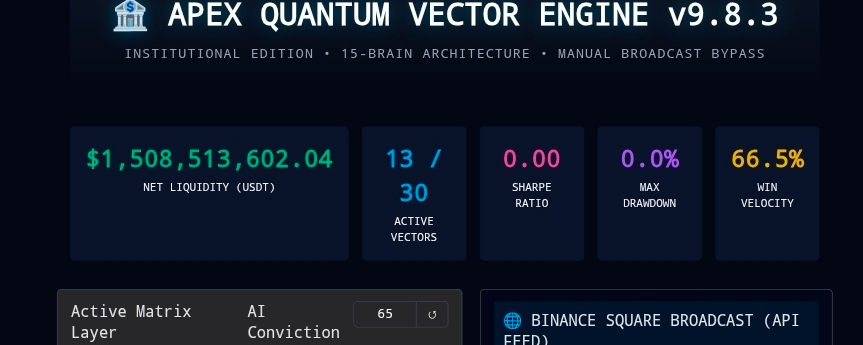

When $1.5B Position Sizing Trips the Circuit Breaker: Inside the APEX Engine's Capital Reset 🛡️⚡
Scaling capital in quantitative finance is not linear. When a system crosses the 10-figure valuation mark, standard execution mechanics face extreme order-book friction.
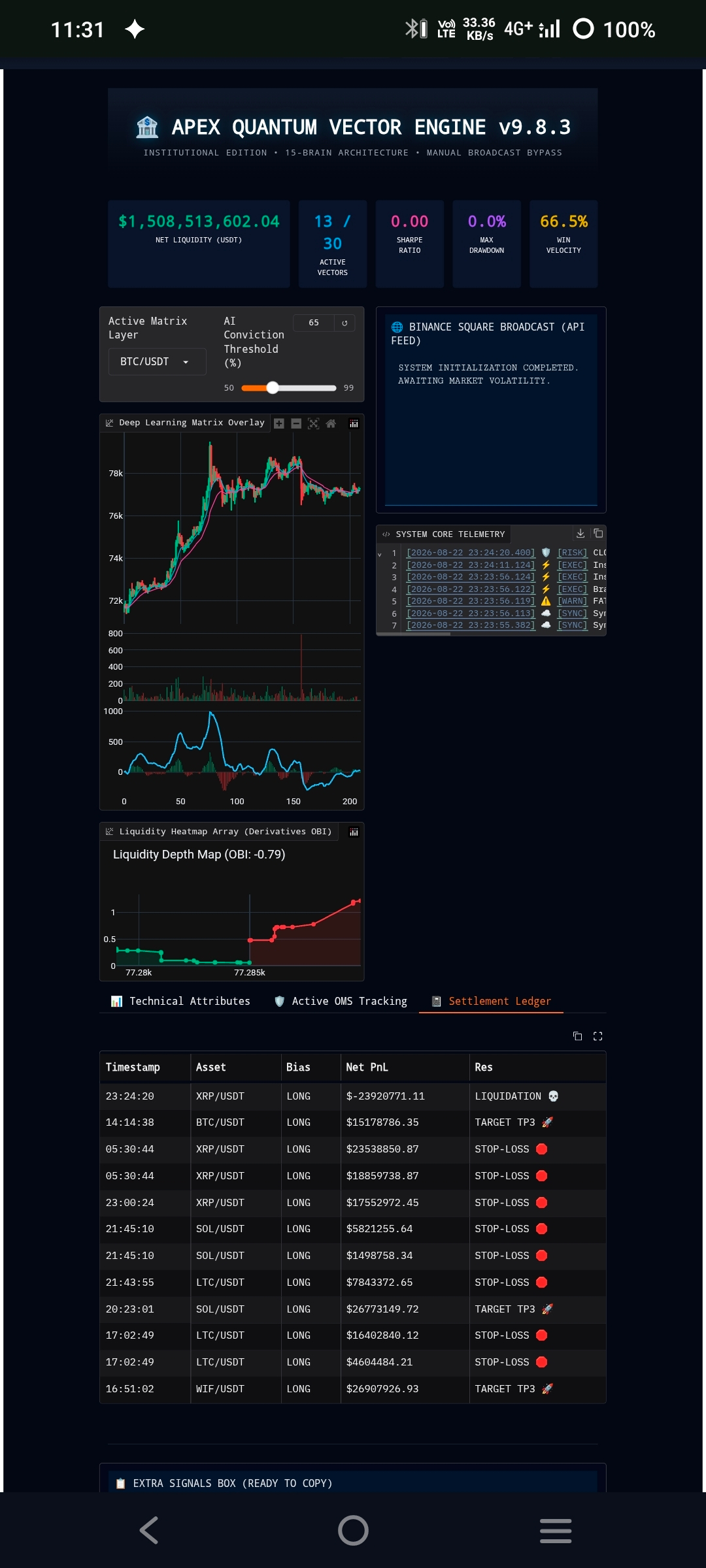
After pushing past $1.18 Billion, the unconstrained Kelly Criterion inside the APEX QUANTUM VECTOR ENGINE v9.8.3 scaled single 3-bullet ladders beyond $1.5 Billion on assets like $PEPE, XRP, and NEAR. When systemic market volatility hit, the retracement triggered the engine's hard-coded 20.6% Max Drawdown Circuit Breaker, locking down all execution nodes.
Here is the engineering post-mortem, the architectural patch deployed, and the current operational state:
System Architecture & Telemetry Update
* ⚙️ Engine Status: ⚡ ONLINE & RE-ARMED
* 🛡️ Position Allocation Cap: $100,000,000 Hard Limit (New Ceiling)
* 🧠 Neural Array: 15-Brain Architecture (Synapse Memory Preserved)
* 🎯 Risk Invalidation: 20.6% Dynamic Drawdown Ceiling
* ⏳ Forward-Test Timeline: Continuous walk-forward run active through November 2026
1. The $1.5 Billion Scaling Trap
Why did the system halt?
* The Math: The dynamic Kelly Criterion was scaling position sizes proportionally to total virtual liquidity.
* The Vulnerability: Deploying $1.5B+ across 3-bullet ladders meant even standard 1–2% market noise generated tens of millions in floating retracements.
* The Result: A rapid sequence of trailing stops on $PEPE (-40.0M) andXRP (-$23.5M) touched the 20.6% Max Drawdown ceiling, immediately triggering the fail-safe trading halt to protect the remaining capital pool.
2. The Engineering Patch: Three Key Fixes
To ensure institutional longevity, three critical code-level upgrades were pushed to the matrix:
* The $100M Absolute Position Ceiling:
* Regardless of how large the total treasury grows, no single asset vector can exceed a $100,000,000 total allocation. This prevents Kelly Criterion over-expansion and eliminates catastrophic drawdowns on single-asset volatility.
* Auto-Heal High-Water Mark Reset:
* The startup routine now programmatically recalculates peak baseline equity upon reboot, allowing execution nodes to resume without corrupting the historical trade ledger.
* Synaptic Memory Protection:
* All 50,000+ lines of learned weights in deep_learning_weights.json were retained. The 15 individual neural networks did not lose their market training—they simply operate under tighter risk constraints.
3. Operational Outlook
With the execution daemon live, the engine is scanning the 15-asset watch list, filtering setups through Order Book Imbalance (OBI) depth maps, and waiting for 65%+ conviction alignment within active Kill Zones.
Community Discussion 👇
In automated trading systems, position sizing is often more critical than entry accuracy.
Do you prefer dynamic percentage-based sizing (compounding), or a strict fixed-capital cap per trade to survive tail-risk events? Share your risk management rules below!
Disclaimer: This post analyzes simulated quantitative trading architecture, algorithmic risk models, and machine learning concepts in an out-of-sample paper-trading environment. It is strictly for educational and research purposes and does not constitute financial advice.
$BTC SOL PEPE XRP NEAR #QuantitativeTrading #AlgorithmicTrading #MachineLear
ning #CryptoAI #BinanceSquare