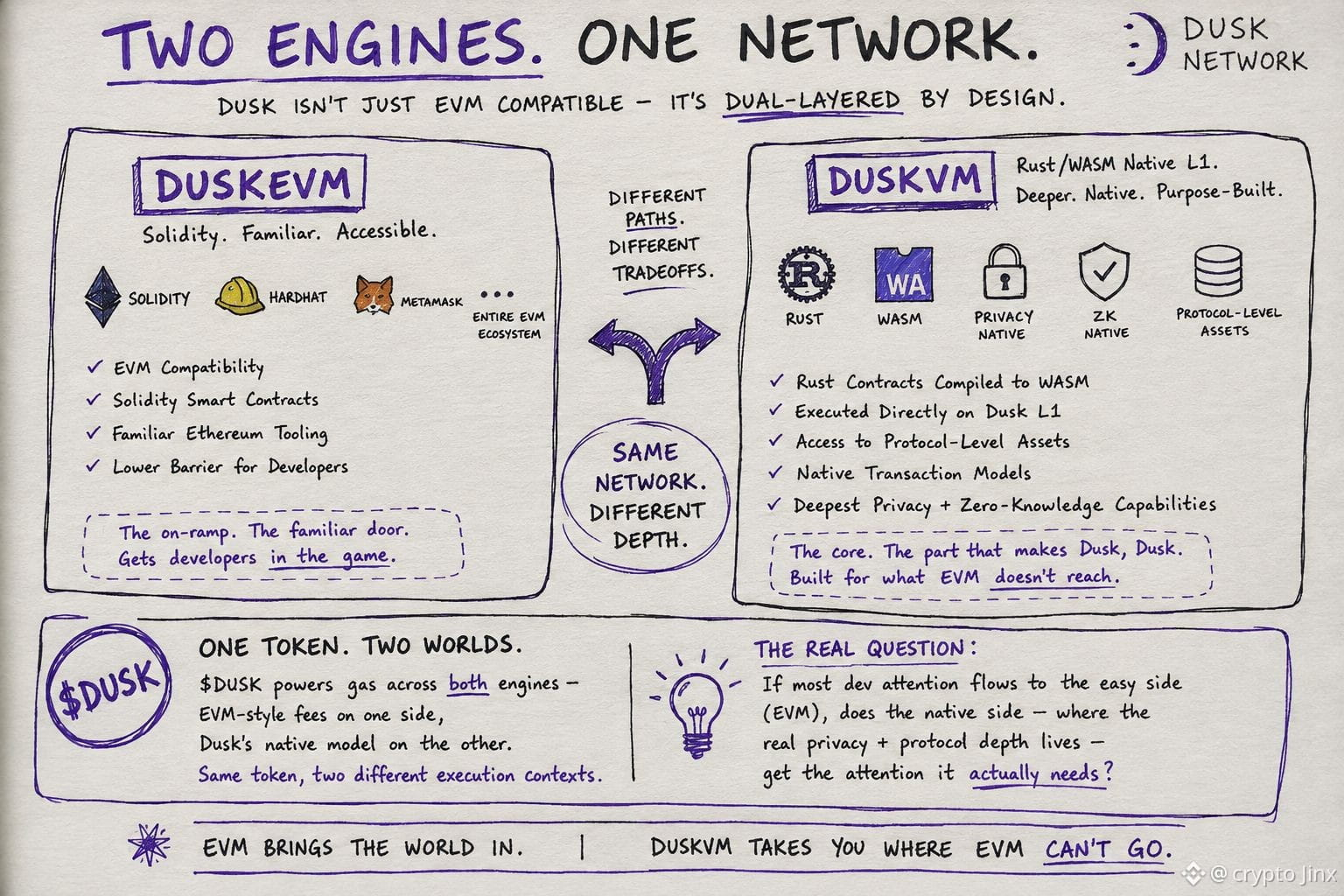
Assumed for a while that @Dusk 's constant "EVM compatibility" messaging was the whole story — get Solidity devs onboarded, done. Then I actually read the developer docs instead of the announcements, and found a second execution path sitting right next to it that barely gets mentioned: DuskVM, running Rust/WASM contracts directly on the L1, explicitly built for protocol-level assets, native transaction models, and the deepest privacy and zero-knowledge work.
Here's the split as documented: DuskEVM gives you Solidity, Hardhat, MetaMask — the entire familiar Ethereum toolchain. DuskVM gives you contracts compiled to WASM, executed directly on Dusk's own L1, with direct access to protocol-level assets and transaction models DuskEVM doesn't touch. The docs are explicit these aren't two flavors of the same thing — one buys you the whole EVM ecosystem, the other buys native access to the parts of Dusk that make it Dusk.
What struck me is that $DUSK has to function as gas across both, following EVM-style fee logic on one side and Dusk's native transaction model on the other. Same token, two completely different execution contexts it has to behave correctly in.
I don't read this as Dusk hiding the "real" chain behind a friendlier front door — it reads more like they're not pretending EVM-compatibility and native execution are interchangeable, when a lot of multi-chain projects blur that line to sound simpler than it is.
Still, if most developer attention flows toward the easier EVM side, does the DuskVM side — where the actual privacy and protocol-asset depth lives — end up under-resourced by comparison? Not a conclusion, just the question I'm sitting with now.
@Dusk $DUSK #dusk
Here's the split as documented: DuskEVM gives you Solidity, Hardhat, MetaMask — the entire familiar Ethereum toolchain. DuskVM gives you contracts compiled to WASM, executed directly on Dusk's own L1, with direct access to protocol-level assets and transaction models DuskEVM doesn't touch. The docs are explicit these aren't two flavors of the same thing — one buys you the whole EVM ecosystem, the other buys native access to the parts of Dusk that make it Dusk.
What struck me is that $DUSK has to function as gas across both, following EVM-style fee logic on one side and Dusk's native transaction model on the other. Same token, two completely different execution contexts it has to behave correctly in.
I don't read this as Dusk hiding the "real" chain behind a friendlier front door — it reads more like they're not pretending EVM-compatibility and native execution are interchangeable, when a lot of multi-chain projects blur that line to sound simpler than it is.
Still, if most developer attention flows toward the easier EVM side, does the DuskVM side — where the actual privacy and protocol-asset depth lives — end up under-resourced by comparison? Not a conclusion, just the question I'm sitting with now.
@Dusk $DUSK #dusk