RWA doesn’t lack blockchains. What RWA lacks is infrastructure that actually fits the way financial markets work.
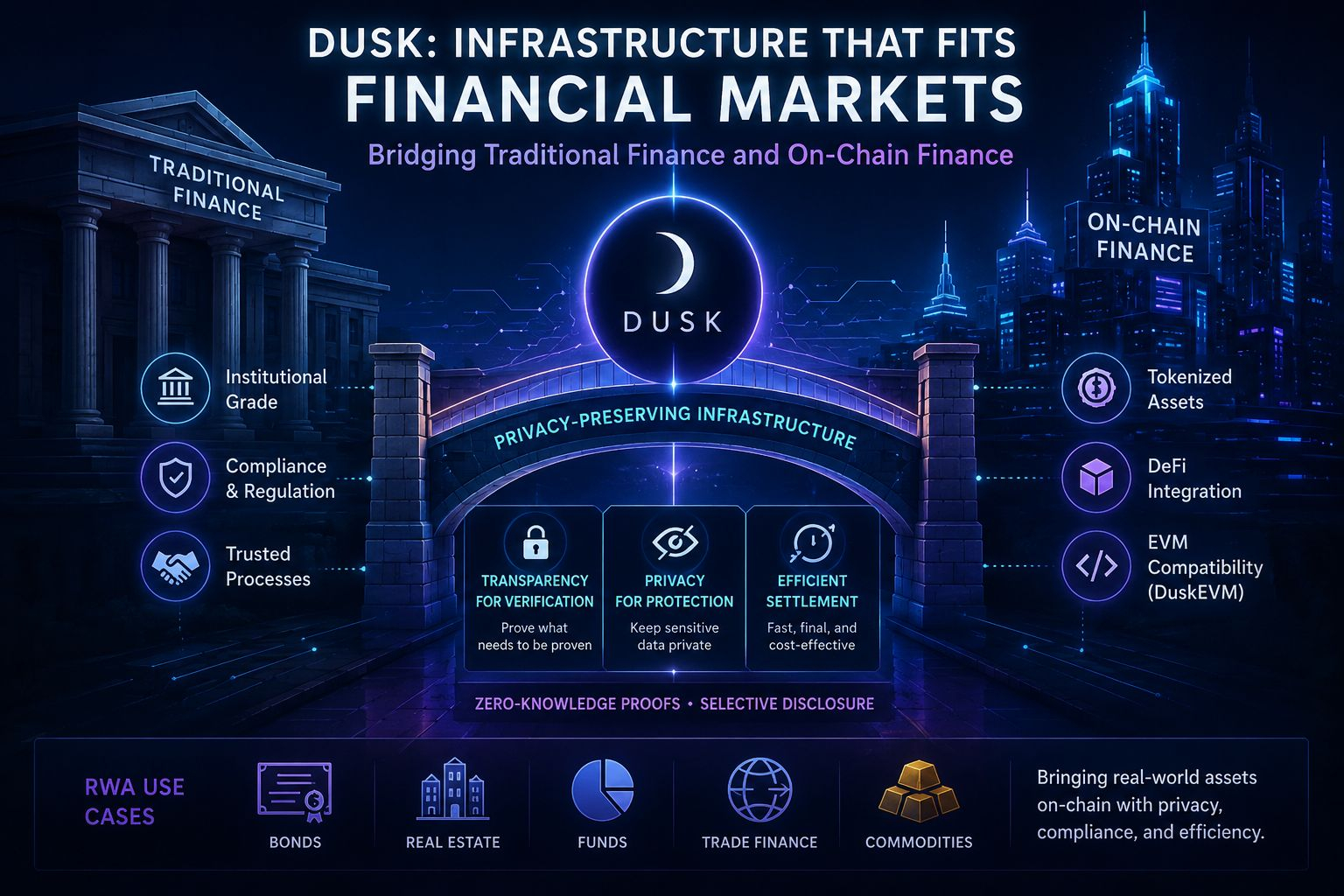
When I look at Dusk, what stands out to me is not simply the idea of “putting assets on-chain.” The harder problem is figuring out how tokenized assets can satisfy three requirements that often conflict with each other: transparency for verification, privacy for data protection, and settlement that is efficient enough for real financial activity.
This is where @Dusk becomes interesting.
In traditional finance, not every piece of information needs to be visible to everyone. A transaction may need to prove that a participant is eligible, an asset is valid, or a transaction meets certain conditions. That does not mean the participant’s entire financial and personal data should be exposed on a public ledger.
Dusk approaches this problem through zero-knowledge technology and selective disclosure, allowing certain conditions to be proven without necessarily revealing all of the underlying information. If RWA is going to move beyond experiments and into real financial markets, this could become an important requirement rather than simply another privacy feature.
Another aspect worth watching is the combination of DuskEVM and Dusk’s settlement architecture. The approach is relatively practical: developers can work with the familiar EVM environment while the network is designed around financial requirements such as compliance, settlement, and privacy.
So the question I’m asking about Dusk isn’t simply:
“Can RWAs run on a blockchain?”
The more difficult question is:
“Can blockchain become part of financial infrastructure without forcing financial markets to give up the privacy, compliance, and settlement requirements they already depend on?”
That is the part of Dusk I find worth watching.#dusk $DUSK
When I look at Dusk, what stands out to me is not simply the idea of “putting assets on-chain.” The harder problem is figuring out how tokenized assets can satisfy three requirements that often conflict with each other: transparency for verification, privacy for data protection, and settlement that is efficient enough for real financial activity.
This is where @Dusk becomes interesting.
In traditional finance, not every piece of information needs to be visible to everyone. A transaction may need to prove that a participant is eligible, an asset is valid, or a transaction meets certain conditions. That does not mean the participant’s entire financial and personal data should be exposed on a public ledger.
Dusk approaches this problem through zero-knowledge technology and selective disclosure, allowing certain conditions to be proven without necessarily revealing all of the underlying information. If RWA is going to move beyond experiments and into real financial markets, this could become an important requirement rather than simply another privacy feature.
Another aspect worth watching is the combination of DuskEVM and Dusk’s settlement architecture. The approach is relatively practical: developers can work with the familiar EVM environment while the network is designed around financial requirements such as compliance, settlement, and privacy.
So the question I’m asking about Dusk isn’t simply:
“Can RWAs run on a blockchain?”
The more difficult question is:
“Can blockchain become part of financial infrastructure without forcing financial markets to give up the privacy, compliance, and settlement requirements they already depend on?”
That is the part of Dusk I find worth watching.#dusk $DUSK