Spent my afternoon in the Citadel docs for Dusk ($DUSK ), reading about selective disclosure — the idea that you decide what identity data leaves your wallet and what stays hidden. Nice pitch. Then I checked the explorer and saw something that didn't quite match the pitch.
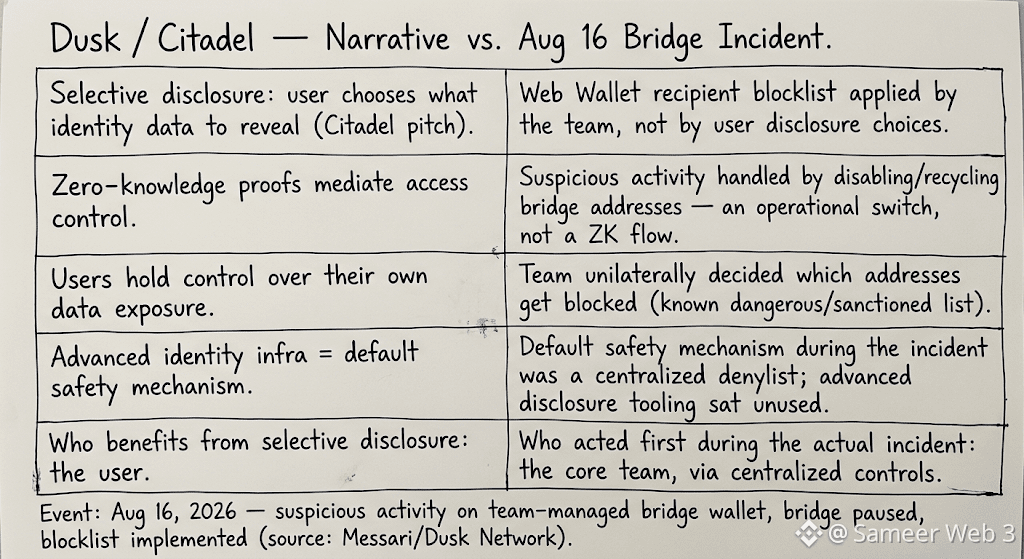
On Aug 16, the team flagged suspicious activity on a bridge-linked wallet. Response wasn't some elegant on-chain proof-selection dance — it was a Web Wallet recipient blocklist, pushed centrally, plus disabled/recycled bridge addresses. #dusk @Dusk handled it fast, to be fair. But it's the team deciding who gets blocked, not users selectively disclosing anything.
That's the part that stuck with me. Citadel markets "you control what you reveal." In practice, the safety net that actually got used during a real incident was a denylist someone maintains off to the side. Advanced disclosure tooling sits there, unused, while the boring centralized switch does the real work when it matters.
Made me second-guess how much of "selective disclosure" is live infrastructure vs. a feature waiting for its first real user. Maybe that's fine for now — maybe compliance-grade privacy just needs a human backstop early on. Still... if the blocklist is what saves you during an incident, what's the ZK layer actually protecting against, day to day?
@Dusk
#dusk
$DUSK
On Aug 16, the team flagged suspicious activity on a bridge-linked wallet. Response wasn't some elegant on-chain proof-selection dance — it was a Web Wallet recipient blocklist, pushed centrally, plus disabled/recycled bridge addresses. #dusk @Dusk handled it fast, to be fair. But it's the team deciding who gets blocked, not users selectively disclosing anything.
That's the part that stuck with me. Citadel markets "you control what you reveal." In practice, the safety net that actually got used during a real incident was a denylist someone maintains off to the side. Advanced disclosure tooling sits there, unused, while the boring centralized switch does the real work when it matters.
Made me second-guess how much of "selective disclosure" is live infrastructure vs. a feature waiting for its first real user. Maybe that's fine for now — maybe compliance-grade privacy just needs a human backstop early on. Still... if the blocklist is what saves you during an incident, what's the ZK layer actually protecting against, day to day?
@Dusk
#dusk
$DUSK