Dusk’s Core Idea Is Privacy With Proof, Not Privacy Alone
Dusk Network’s most important idea is not simply making blockchain activity private. It is separating verification from disclosure.
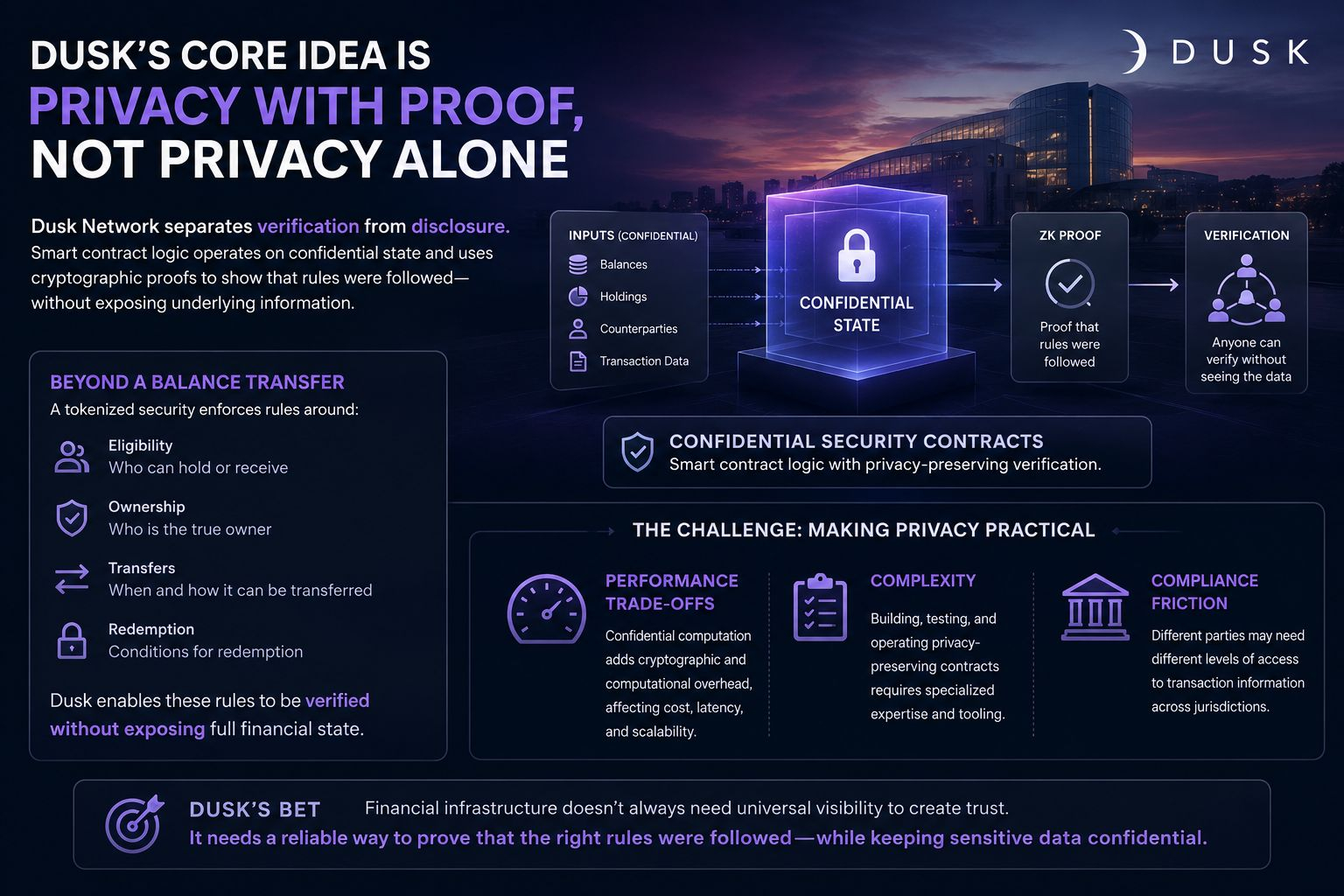
Its Confidential Security Contract standard allows smart contract logic to operate on confidential state, using cryptographic proofs to show that rules were followed without exposing all of the underlying information. That distinction matters for financial assets, where transaction data, holdings, and counterparties can be commercially sensitive, but ownership and transfer rules still need to be enforced.
A tokenized security, for example, is more than a balance moving between addresses. It may have restrictions around eligibility, ownership, transfers, or redemption. Dusk’s approach is designed to let those rules be verified without making the full financial state visible to every participant.
The challenge is making this practical. Confidential computation adds cryptographic and computational overhead, which can affect cost, latency, and operational complexity. Compliance also creates friction because different parties may need different levels of access to transaction information.
That is Dusk’s actual bet: financial infrastructure does not always need universal visibility to create trust. It needs a reliable way to prove that the right rules were followed while keeping sensitive data confidential.
#dusk
$DUSK @Dusk
Dusk Network’s most important idea is not simply making blockchain activity private. It is separating verification from disclosure.
Its Confidential Security Contract standard allows smart contract logic to operate on confidential state, using cryptographic proofs to show that rules were followed without exposing all of the underlying information. That distinction matters for financial assets, where transaction data, holdings, and counterparties can be commercially sensitive, but ownership and transfer rules still need to be enforced.
A tokenized security, for example, is more than a balance moving between addresses. It may have restrictions around eligibility, ownership, transfers, or redemption. Dusk’s approach is designed to let those rules be verified without making the full financial state visible to every participant.
The challenge is making this practical. Confidential computation adds cryptographic and computational overhead, which can affect cost, latency, and operational complexity. Compliance also creates friction because different parties may need different levels of access to transaction information.
That is Dusk’s actual bet: financial infrastructure does not always need universal visibility to create trust. It needs a reliable way to prove that the right rules were followed while keeping sensitive data confidential.
#dusk
$DUSK @Dusk