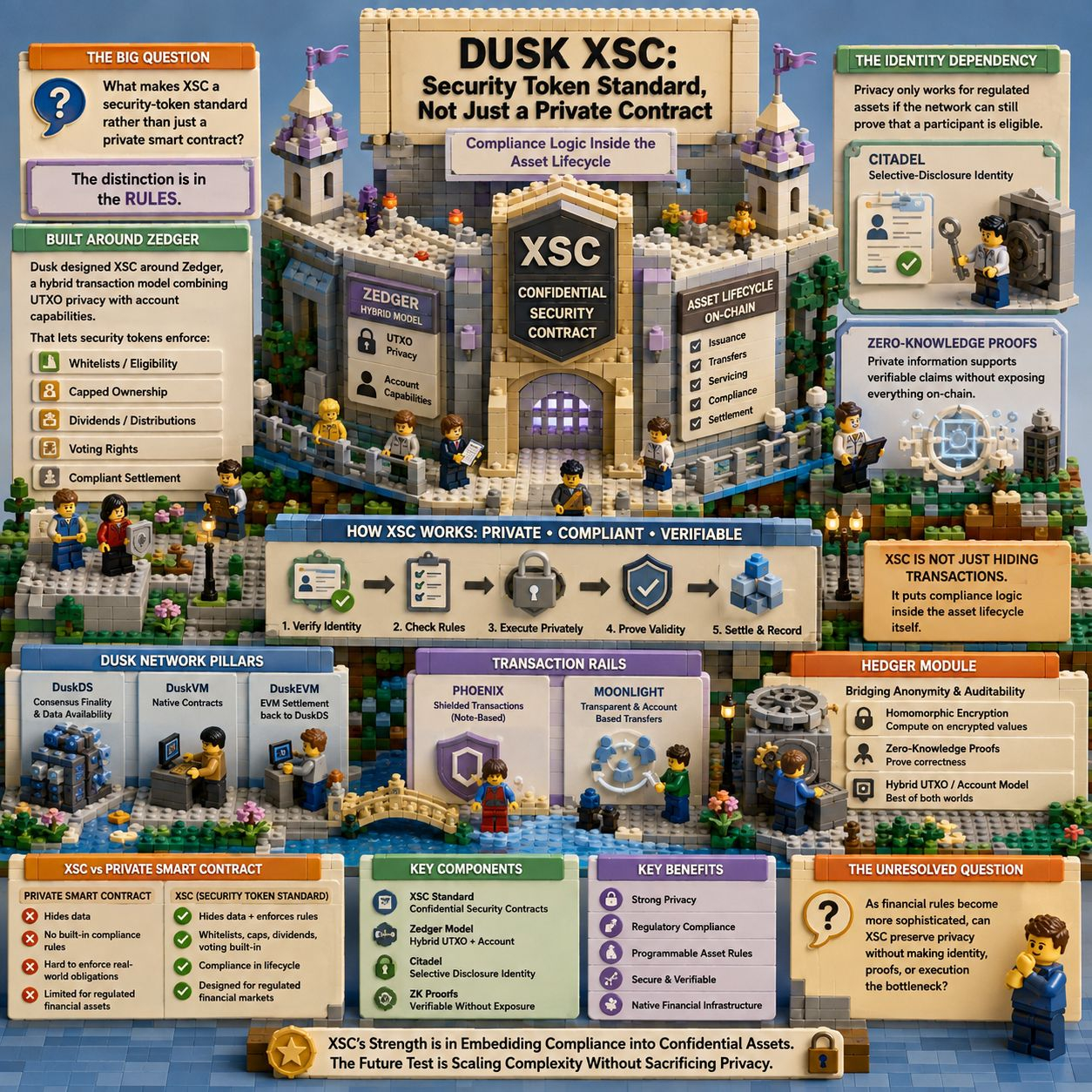
I kept coming back to one question while studying Dusk: what exactly makes XSC a security token standard rather than just a private smart contract?
The distinction is in the rules.
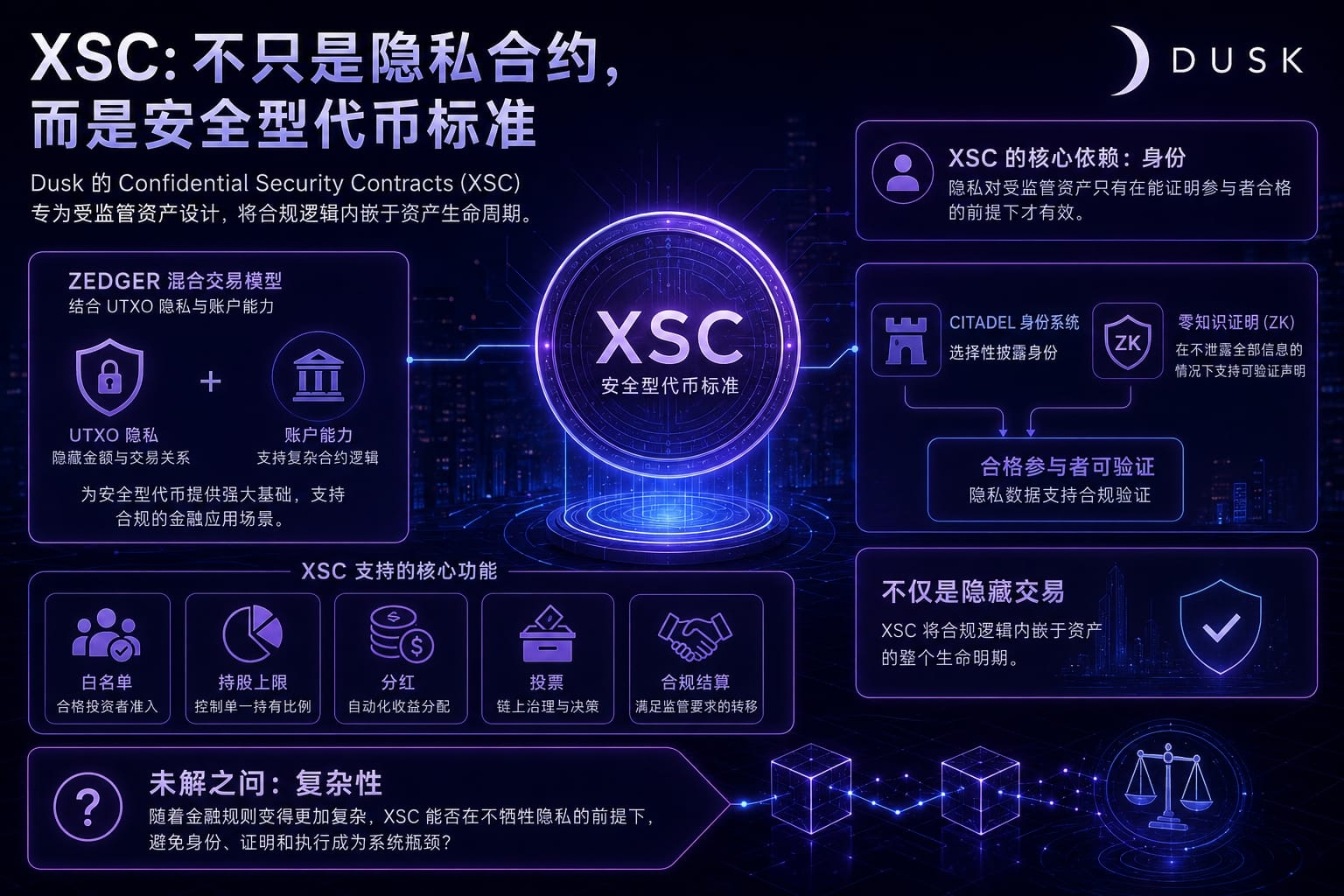
Dusk designed XSC around Zedger a hybrid transaction model combining UTXO privacy with account capabilities. That lets security tokens enforce things like whitelists capped ownership, dividends, voting and compliant settlement.
The interesting dependency is identity.
Privacy only works for regulated assets if the network can still prove that a participant is eligible. Dusk’s Citadel provides selective disclosure identity, while zero knowledge proofs allow private information to support verifiable claims without exposing everything on chain.
So XSC is not simply hiding transactions. It tries to put compliance logic inside the asset lifecycle itself.
That is the strength.
But the unresolved question is complexity: as financial rules become more sophisticated can XSC preserve privacy without making identity proofs or execution the bottleneck?#dusk @Dusk $DUSK
The distinction is in the rules.
Dusk designed XSC around Zedger a hybrid transaction model combining UTXO privacy with account capabilities. That lets security tokens enforce things like whitelists capped ownership, dividends, voting and compliant settlement.
The interesting dependency is identity.
Privacy only works for regulated assets if the network can still prove that a participant is eligible. Dusk’s Citadel provides selective disclosure identity, while zero knowledge proofs allow private information to support verifiable claims without exposing everything on chain.
So XSC is not simply hiding transactions. It tries to put compliance logic inside the asset lifecycle itself.
That is the strength.
But the unresolved question is complexity: as financial rules become more sophisticated can XSC preserve privacy without making identity proofs or execution the bottleneck?#dusk @Dusk $DUSK