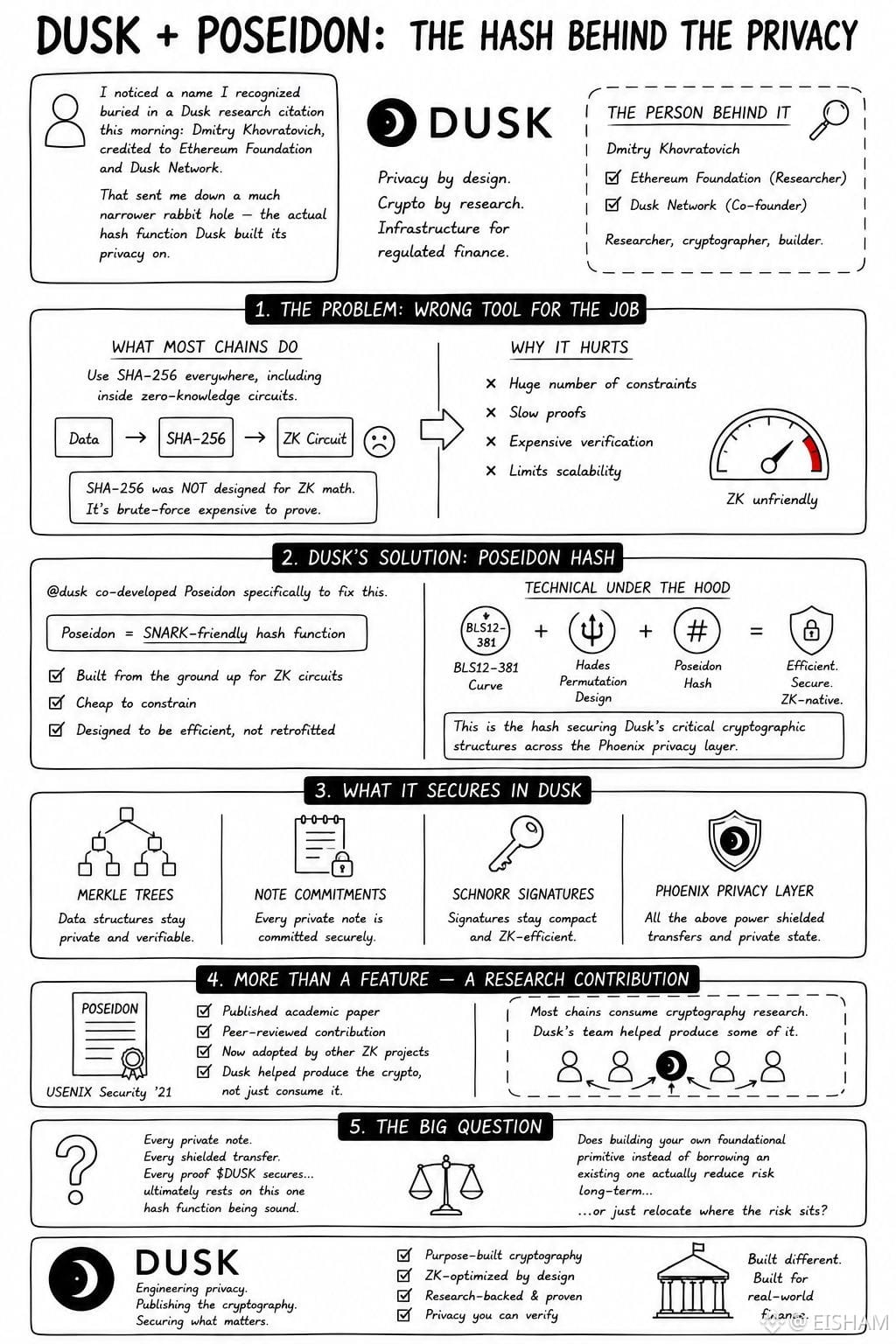
i noticed a name I recognized buried in a Dusk research citation this morning: Dmitry Khovratovich, credited both to Ethereum Foundation and Dusk Network. That sent me down a much narrower rabbit hole than usual — the actual hash function Dusk built its privacy on.
most chains reach for SHA-256 everywhere, including inside zero-knowledge circuits. The problem is SHA-256 is brutally expensive to prove inside a ZK circuit, since it wasn't designed for that math at all.
@Dusk Foundation co-developed Poseidon specifically to fix this: a hash function built from the ground up to be "SNARK-friendly," cheap to constrain inside a circuit instead of fighting against it. It runs over the BLS12-381 curve using something called the Hades permutation design, and it's the actual hash securing Dusk's Merkle trees, note commitments, and Schnorr signatures across Phoenix.
what surprised me is how foundational this really is — it isn't just a Dusk feature, it's a published academic contribution (USENIX Security '21) that other ZK projects across the industry have since adopted. That's rare. Most chains consume cryptography research. Dusk's team helped produce some of it.
small technical choice, big consequence: every private note, every shielded transfer, every proof $DUSK secures ultimately rests on this one hash function being sound. Does building your own foundational primitive instead of borrowing an existing one actually reduce risk long-term, or just relocate where the risk sits? #dusk $DUSK @Dusk
most chains reach for SHA-256 everywhere, including inside zero-knowledge circuits. The problem is SHA-256 is brutally expensive to prove inside a ZK circuit, since it wasn't designed for that math at all.
@Dusk Foundation co-developed Poseidon specifically to fix this: a hash function built from the ground up to be "SNARK-friendly," cheap to constrain inside a circuit instead of fighting against it. It runs over the BLS12-381 curve using something called the Hades permutation design, and it's the actual hash securing Dusk's Merkle trees, note commitments, and Schnorr signatures across Phoenix.
what surprised me is how foundational this really is — it isn't just a Dusk feature, it's a published academic contribution (USENIX Security '21) that other ZK projects across the industry have since adopted. That's rare. Most chains consume cryptography research. Dusk's team helped produce some of it.
small technical choice, big consequence: every private note, every shielded transfer, every proof $DUSK secures ultimately rests on this one hash function being sound. Does building your own foundational primitive instead of borrowing an existing one actually reduce risk long-term, or just relocate where the risk sits? #dusk $DUSK @Dusk