

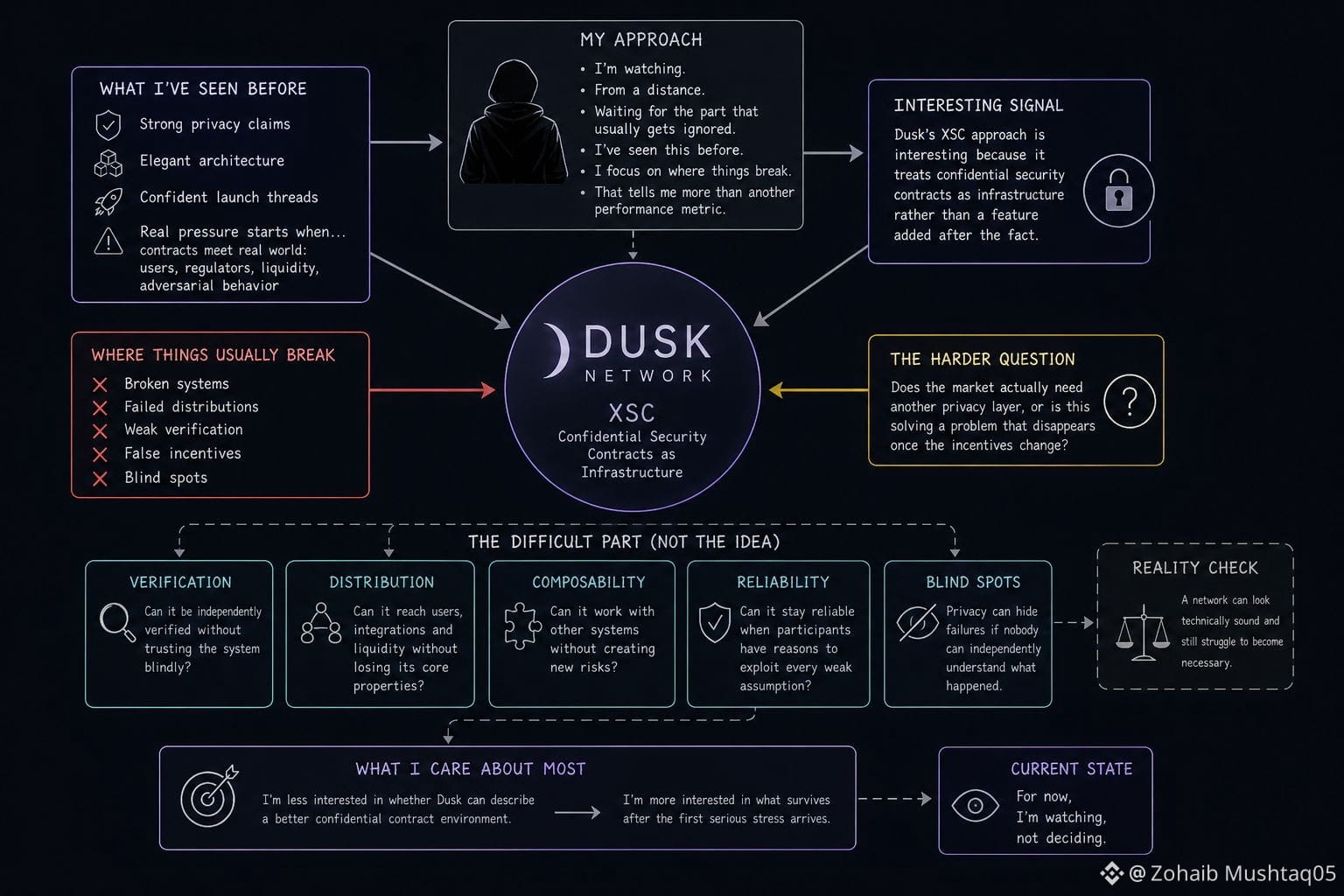
Dusk Network the way I watch most privacy projects now: from a distance, waiting for the part that usually gets ignored. I’ve seen this before. Strong privacy claims, elegant architecture, confident launch threads, and then the real pressure starts when contracts meet actual users, regulators, liquidity, and adversarial behavior. I focus on where things break, because that usually tells me more than another performance metric. Dusk’s XSC approach is interesting mainly because it treats confidential security contracts as infrastructure rather than a feature added after the fact. But that raises a harder question: does the market actually need another privacy layer, or is this solving a problem that disappears once the incentives change? The difficult part isn’t proving that private transactions are useful. Everyone already knows that. The difficult part is verification, distribution, composability, and keeping the system reliable when participants have reasons to exploit every weak assumption. Privacy can also create its own blind spots if nobody can independently understand what happened when something fails. That is where I’m still cautious. A network can look technically sound and still struggle to become necessary. I’m less interested in whether Dusk can describe a better confidential contract environment and more interested in what survives after the first serious stress arrives.#dusk $DUSK @Dusk

Veröffentlichen
Haftungsausschluss: Enthält Meinungen von Drittanbietern. Keine Beratung. Binance AI wird ohne Gewähr bereitgestellt. Siehe AGB.