I kept coming back to one question while studying @Dusk: can strong privacy actually carry institutional finance on its own?
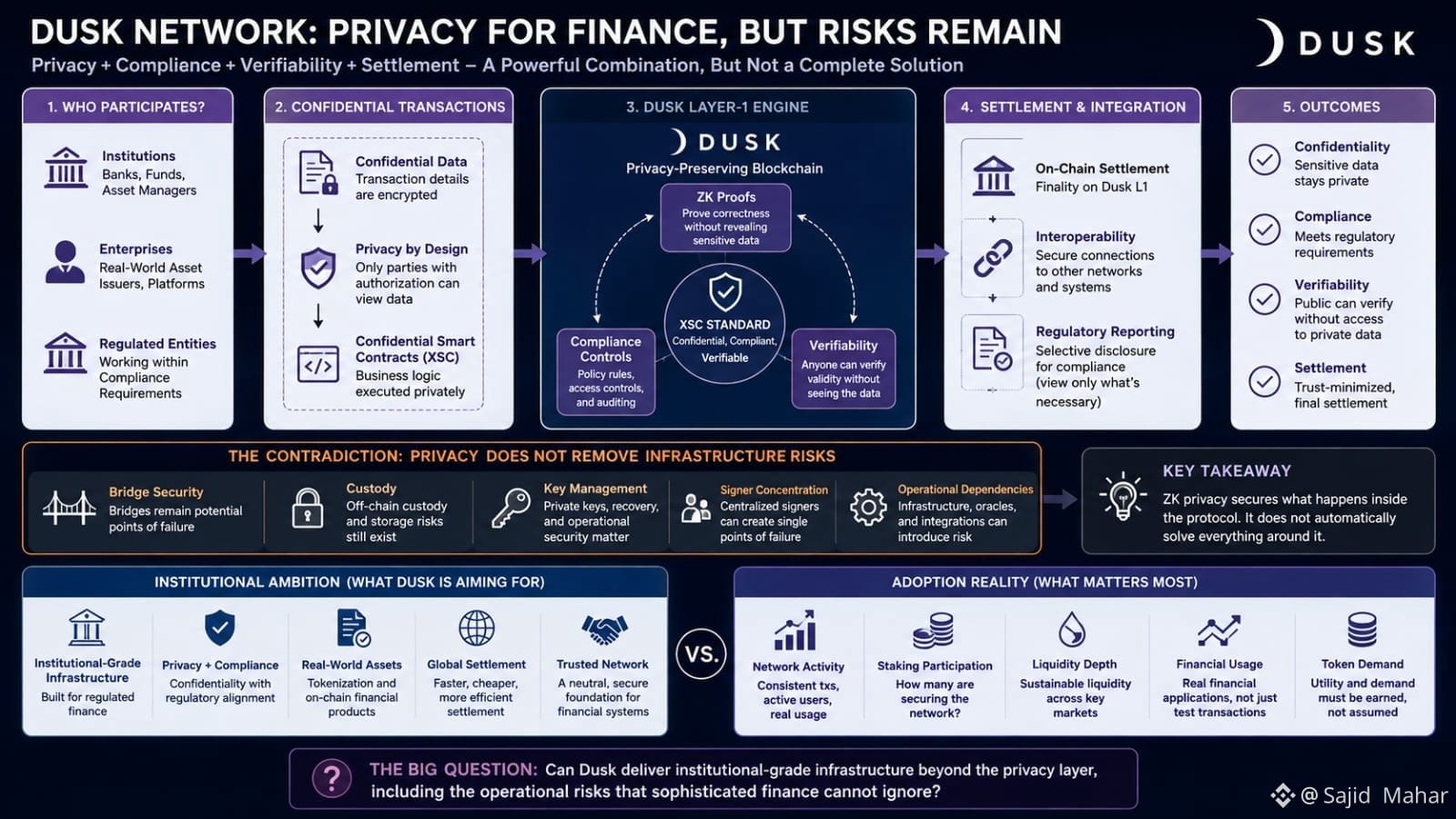
What I find interesting is the contradiction. Dusk is building a Layer-1 around privacy, compliance, verifiability, and settlement, with its Confidential Security Contract (XSC) approach aimed at financial applications. The architecture makes sense: regulated institutions need confidentiality without giving up the ability to prove that rules were followed.
But sophisticated zero-knowledge privacy does not remove the older risks around infrastructure.
Bridges can still fail. Custody still matters. Key management still matters. Signer concentration can still create operational dependencies. In other words, cryptography can strengthen what happens inside the protocol without automatically solving everything around it.
That is where I become more cautious about Dusk's institutional ambitions.
The technology is interesting, but adoption has to show up beyond architecture. I want to see sustained network activity, meaningful staking participation, deeper liquidity, and actual financial usage—not simply a compelling technical design.
I also think it is important to separate network utility from $DUSK demand. A strong protocol does not automatically create strong token demand.
For me, Dusk's real test is whether privacy + compliance + verifiability can translate into reliable institutional settlement.
Can Dusk deliver institutional-grade infrastructure beyond the privacy layer, including the operational risks that sophisticated finance cannot ignore
@Dusk #dusk $DUSK
What I find interesting is the contradiction. Dusk is building a Layer-1 around privacy, compliance, verifiability, and settlement, with its Confidential Security Contract (XSC) approach aimed at financial applications. The architecture makes sense: regulated institutions need confidentiality without giving up the ability to prove that rules were followed.
But sophisticated zero-knowledge privacy does not remove the older risks around infrastructure.
Bridges can still fail. Custody still matters. Key management still matters. Signer concentration can still create operational dependencies. In other words, cryptography can strengthen what happens inside the protocol without automatically solving everything around it.
That is where I become more cautious about Dusk's institutional ambitions.
The technology is interesting, but adoption has to show up beyond architecture. I want to see sustained network activity, meaningful staking participation, deeper liquidity, and actual financial usage—not simply a compelling technical design.
I also think it is important to separate network utility from $DUSK demand. A strong protocol does not automatically create strong token demand.
For me, Dusk's real test is whether privacy + compliance + verifiability can translate into reliable institutional settlement.
Can Dusk deliver institutional-grade infrastructure beyond the privacy layer, including the operational risks that sophisticated finance cannot ignore
@Dusk #dusk $DUSK