If I had to delete everything, forget everything I know about crypto, and open Binance for the very first time again, I would do things very differently.
I wouldn't start by searching for the next 100X coin. I wouldn't open Futures because I saw someone post a $5,000 profit screenshot. I wouldn't buy something simply because it was trending. And I definitely wouldn't put money into an asset before understanding what I was actually buying. My journey would be much simpler:
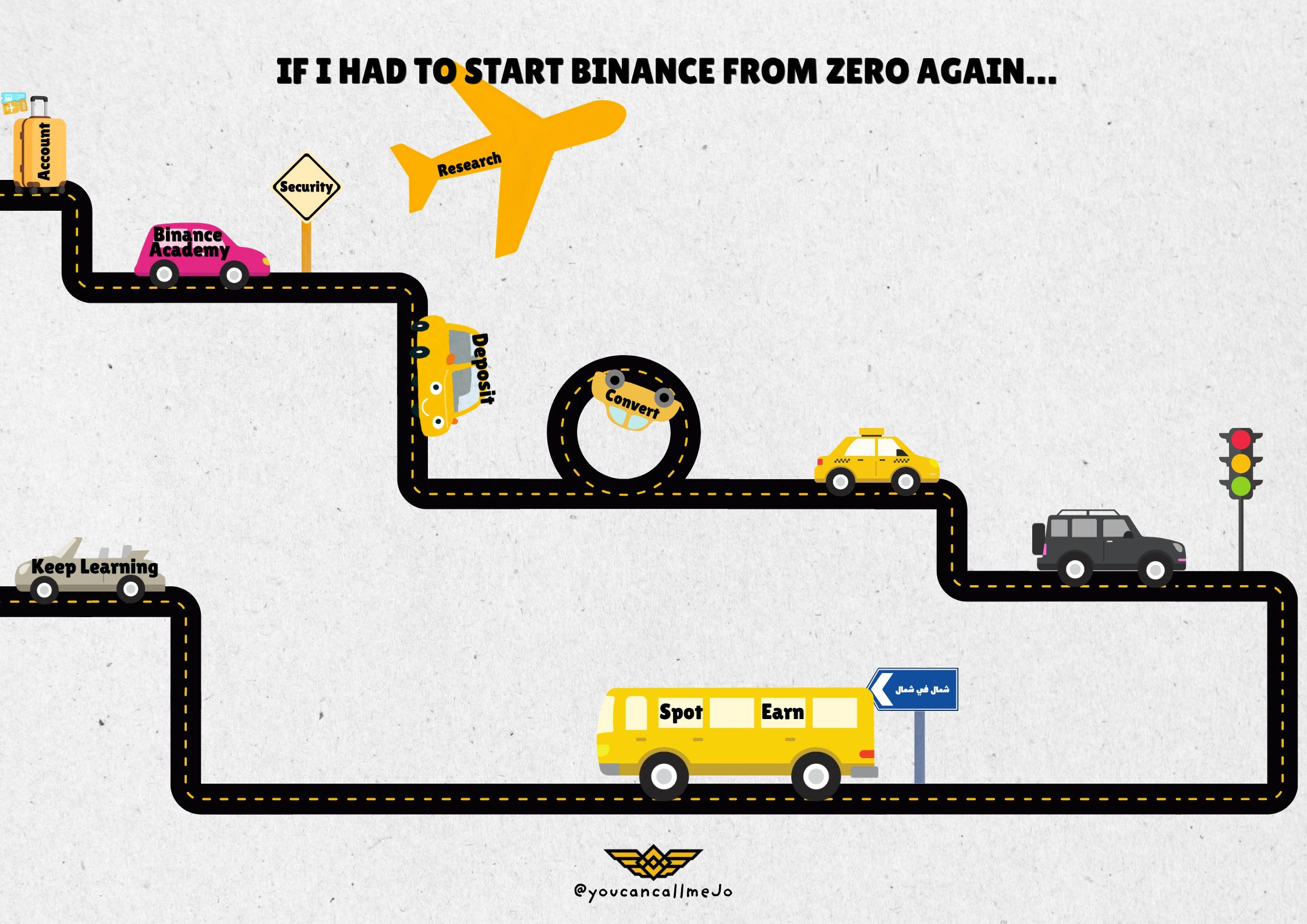
Account → Security → Research → Binance Academy → Deposit → Convert → Spot → Earn → Keep Learning
That would be my roadmap if I were starting from zero today.
Step 1: Create your Account
The first step is obviously creating a Binance account, but I would treat the account itself as the beginning of my financial setup, not just a registration form. Depending on your jurisdiction and the services you want to use, Binance may require identity verification before you can access certain features. Binance's current beginner guide places account creation and identity verification among the first steps before buying and trading crypto.
I would also make sure I am using the official Binance platform and not clicking some random link sent to me through Telegram, X, Instagram, or a private message. Crypto has enough risks without accidentally creating an account on a fake website. Once the account exists, I would stop. Yes, stop. Because the next step is not buying Bitcoin.
Step 2: Secure the Account Before Putting Money Into It
This is probably the step I would take more seriously than anything else. Before depositing even $10, I would secure the account with a strong, unique password and enable two-factor authentication. Binance currently supports several authentication methods, including authenticator apps, SMS-based authentication, and passkeys, while hardware security keys can provide another layer of protection.
I would also set up an anti-phishing code so I can distinguish legitimate Binance communications from messages pretending to come from Binance. Binance recommends reviewing devices and account activity as well, and withdrawal-address whitelisting can add another layer of protection.
And this part is extremely important: I would learn how phishing works before I ever start moving money around. If someone sends me a link saying, “Your Binance account will be suspended, click here immediately,” I don't click it. If someone messages me pretending to be Binance Support, I don't send them my password, verification codes, or private information. If someone promises me a special investment opportunity in a private message, I don't suddenly forget everything I learned about scams. 😂
Your account security is not something you fix after losing money. You build it before the money arrives.
Step 3: Research Before Buying Anything
Now I have an account and it is secured. Still no buying. This is where I would start asking the most important question: What exactly am I putting my money into?
Before buying Bitcoin, BNB, Ethereum, Solana, or any other asset, I would research what the asset is, what problem it is designed to solve, how its ecosystem works, what its token is used for, its supply and market capitalization, its liquidity, its historical volatility, and the major risks associated with it. And I would not use one TikTok, one X post, or one influencer as my research department. If I see someone saying, “This coin is going to 100X,” my next question isn't “Where do I buy?” It's “Why?”
Research should help me build a thesis and, just as importantly, identify what could make that thesis wrong. If I cannot explain to someone in simple words why I own an asset, I probably haven't researched it enough.
Step 4: Open Binance Academy
This is where I would spend a serious amount of time. Binance Academy provides educational material covering Bitcoin, blockchain, wallets, trading, security, DeFi, stablecoins, technical analysis, stocks, personal finance, and many other areas of the crypto ecosystem. It also organizes content by difficulty, including beginner, intermediate, and advanced material.
If I were completely new, I would start with the basics instead of jumping directly into advanced trading. I would learn what blockchain actually is. I would understand the difference between a wallet and an exchange. I would learn what market capitalization means, what liquidity means, what a market order and limit order are, how transaction fees work, what stablecoins are, and why leverage can dramatically increase risk. I would also learn the difference between Spot and Futures before ever touching a Futures interface.
This is the part that can feel boring when you're excited about crypto, but trust me: the more you understand before you trade, the fewer things you have to learn through expensive mistakes. And I've already paid for enough lessons with my own mistakes. 🤣
Step 5: Deposit Only What You Can Afford to Lose
Now, and only now, I would consider depositing money. Binance provides different ways to fund an account depending on the user's location and available services, including methods such as card payments, bank deposits, fiat gateways, and P2P. But the most important decision isn't which deposit method I choose. It's how much I deposit. If I have $1,000 available in my bank account, that does not mean I should deposit $1,000 into crypto. My rent is not trading capital. My grocery budget is not trading capital. Emergency money is not trading capital. I would decide on an amount that I could genuinely afford to lose without putting my everyday life in danger. Starting with $50 and learning properly is far better than starting with $5,000 and learning through panic.
Step 6: Convert If I Want Simplicity
Once I have funds on Binance, I wouldn't immediately jump into complicated charts. If my goal was simply to exchange one cryptocurrency for another, I would consider Binance Convert. Convert is designed to make crypto-to-crypto exchanges simpler by allowing users to select the asset they want to convert and the asset they want to receive, preview the current quote, and confirm the conversion without navigating a traditional order book. For example, if I already had USDT and wanted to obtain BTC, Convert could provide a straightforward way to make that exchange. But I would still check the quote before confirming. Simple does not mean “don't pay attention.” If I'm converting $20, I want to know what I'm receiving. If I'm converting $2,000, I definitely want to know what I'm receiving.
Step 7: Move to Spot When I'm Ready to Actually Trade
Once I understood the basics, I would move into Spot trading. Spot is where I would want to learn how actual market trading works: market orders, limit orders, price movements, order books, liquidity, fees, and execution. Binance describes Spot trading as the direct buying and selling of assets, without borrowed funds or leverage by default. Compared with leveraged products, it is generally a more straightforward starting point for beginners.
For example, if BTC is trading at $100,000 and I have $100 allocated to it, I don't need to buy one whole Bitcoin. I can purchase a fraction of it. And I wouldn't make my first trade with the objective of becoming rich. My first objective would be learning. I would rather make a small trade, understand exactly what happened, see how the order was executed, understand the fees, and learn from the experience than put a huge amount of money at risk simply because I am excited.
Step 8: Understand Earn Before Using Earn
After learning how buying and holding works, I would explore Binance Earn. Binance Earn includes different products that may allow eligible users to receive rewards on certain crypto holdings. These include products under Simple Earn as well as other, more advanced opportunities, each with different structures and risk considerations. But I would not look at an APR or APY and immediately think, “Free money.” I would first understand what I am subscribing to. Is it flexible or locked? What are the conditions? What risks exist? When can I redeem my assets? Is the reward fixed or variable? What happens to the underlying asset if its market price falls? A 10% return on an asset that falls 30% is still a losing position. That's why I would treat Earn as another financial tool to understand, not a magical button that generates money while I sleep.
Step 9: Keep Researching
And this is where the cycle doesn't actually end.
Account → Security → Research → Academy → Deposit → Convert → Spot → Earn → Research again.
Notice something? Research is both near the beginning and the end. Because learning about crypto isn't something you complete once and tick off a checklist. Markets change. Projects evolve. Products change. New technologies appear. Risks change. Your own financial situation changes. If I were starting from zero again, I would want to build the habit of returning to education and research instead of constantly searching for the next trade. I would also learn from my own activity. Why did I buy? What was my thesis? What happened afterward? Was I following my strategy or my emotions? Did I understand the risk before entering? That's how I would turn individual trades into experience instead of simply collecting wins and losses.
If I Had to Start Again…
Looking back, I think the biggest mistake beginners can make is believing that their crypto journey starts when they buy their first coin. It doesn't. It starts when they decide to learn. If I were opening Binance for the first time today, I would secure the account before depositing anything, research before buying anything, use Binance Academy to build my foundation, start with an amount I could afford to lose, use simple tools such as Convert when appropriate, learn Spot trading before considering more complex products, understand Earn before subscribing to anything, and keep researching throughout the entire journey. I wouldn't try to become a professional trader in one week. I wouldn't chase every new narrative. I wouldn't use leverage just because it exists. I wouldn't copy somebody else's portfolio. I would build my knowledge first and let my experience grow alongside it. Because if I had to start Binance from zero again, I wouldn't ask myself, “What should I buy first?” I'd ask something much more important: “What should I learn first?”
#Binance #CryptoEducation💡🚀 #BinanceAcademy #CryptoBeginners #BinanceSquare