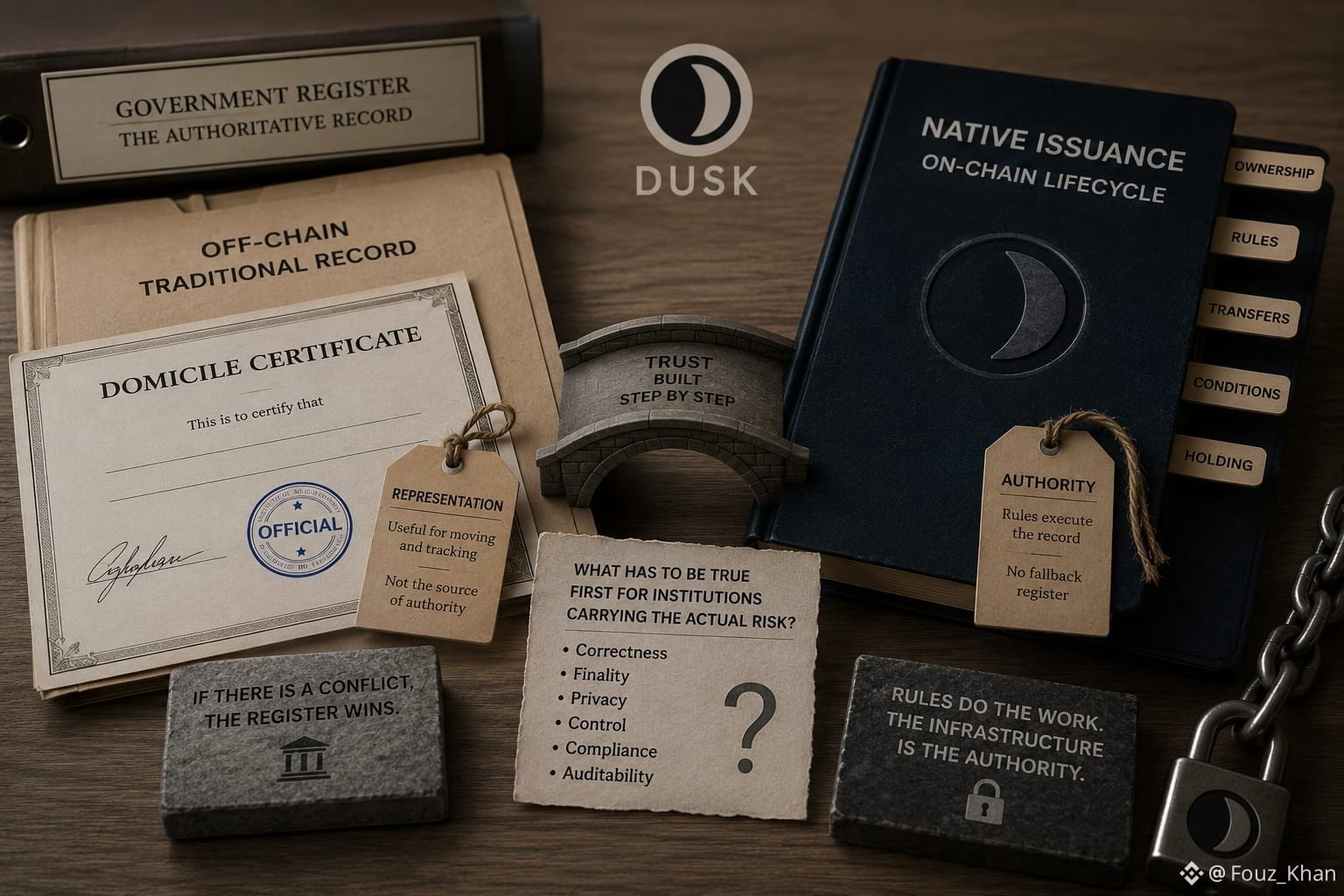
A few months ago I got my domicile certificate renewed. Stamped, signed, looks official. But it isn't the actual record that lives in a government register somewhere else. If the two ever disagree, the register wins.
That's what came to mind reading about @Dusk and the difference between tokenization and native issuance.
A tokenized bond or fund unit works a bit like my certificate. It represents an asset whose legal or registry processes may still sit off-chain. Useful for moving and tracking, but not necessarily where the authority lives.
Native issuance starts from a different place. Parts of the asset's lifecycle ownership, transfer conditions, how it's held can originate directly within the onchain environment, rather than being copied there after the fact. Not the whole legal picture. Just the part that now begins there.
That's where Dusk's separation of execution and settlement caught my attention. The lifecycle doesn't have to sit in one layer.
Here's the part I keep sitting with. A representation usually has an external system to fall back on when something breaks. Native issuance shifts more of that responsibility onto the infrastructure itself the rules doing the work, not a backup register correcting them later.
An institution can pilot that kind of system long before it's willing to treat it as authoritative. Testing something and depending on it for a real financial record aren't the same decision.
I still have that certificate somewhere. It looked convincing. But the register was always the thing that mattered.
If a blockchain eventually becomes part of the authoritative record instead of just pointing to it, what has to be true first for the institutions carrying the actual risk?
#dusk $DUSK @Dusk
$BTC $ETH
That's what came to mind reading about @Dusk and the difference between tokenization and native issuance.
A tokenized bond or fund unit works a bit like my certificate. It represents an asset whose legal or registry processes may still sit off-chain. Useful for moving and tracking, but not necessarily where the authority lives.
Native issuance starts from a different place. Parts of the asset's lifecycle ownership, transfer conditions, how it's held can originate directly within the onchain environment, rather than being copied there after the fact. Not the whole legal picture. Just the part that now begins there.
That's where Dusk's separation of execution and settlement caught my attention. The lifecycle doesn't have to sit in one layer.
Here's the part I keep sitting with. A representation usually has an external system to fall back on when something breaks. Native issuance shifts more of that responsibility onto the infrastructure itself the rules doing the work, not a backup register correcting them later.
An institution can pilot that kind of system long before it's willing to treat it as authoritative. Testing something and depending on it for a real financial record aren't the same decision.
I still have that certificate somewhere. It looked convincing. But the register was always the thing that mattered.
If a blockchain eventually becomes part of the authoritative record instead of just pointing to it, what has to be true first for the institutions carrying the actual risk?
#dusk $DUSK @Dusk
$BTC $ETH