DuskDS speichert nicht, was passiert ist. Es speichert den Beweis, dass es passiert ist."
Die angenommene Basisschicht jeder Blockchain muss die vollständige Historie vorhalten — jede Transaktion, jede Zustandsänderung, dort für jeden, um sie von Grund auf neu zu verifizieren. DuskDS funktioniert nicht so.
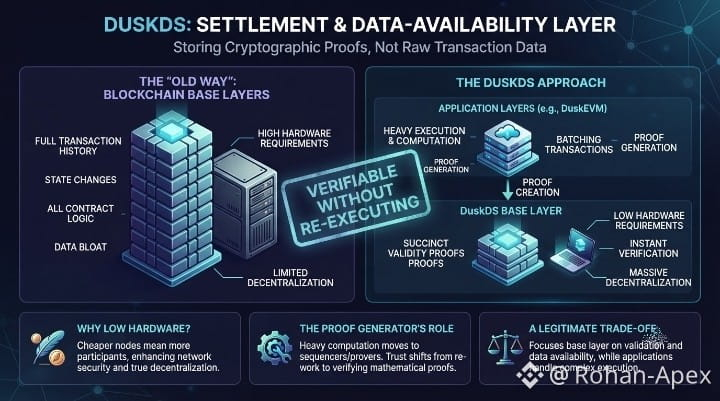
DuskDS, Dusk's Settlement- und Data-Availability-Layer, speichert nur knappe Validitätsbeweise. Der eigentliche, rechenintensive Zustand — die detaillierten Transaktionsdaten, die Ergebnisse der Vertragslogik — lebt stattdessen in den Anwendungsschichten wie DuskEVM. DuskDS hält lediglich kompakte kryptografische Beweise dafür, dass die Ausführung korrekt durchgeführt wurde, nicht aber die Ausführung selbst.
Der genannte Grund ist direkt: So bleiben die Anforderungen an Hardware für Vollknoten niedrig. Man muss nicht alles speichern oder alles jemals auf jeder Schicht neu abspielen, nur um einen validierenden Knoten in der Basiskette zu betreiben. Das ist ein echter, praktischer Gewinn für die Dezentralisierung — günstigere Hardware bedeutet, dass mehr Menschen tatsächlich einen Knoten betreiben können.
Hier ist der Teil, den ich immer wieder im Kopf gedreht habe. Wenn DuskDS nur prüft, ob ein Beweis gültig ist, musste doch jemand diesen Beweis erzeugen, indem er tatsächlich die vollständige Ausführung durchführt — Transaktionen bündeln, den resultierenden Zustand berechnen, und ihn zu etwas knappen komprimieren. Diese Arbeit verschwindet nicht, sie verlagert sich nur auf diejenige Schicht, die den Beweis erstellt, wie zum Beispiel den Sequencer von DuskEVM. Leichtere Knoten auf der Basisschicht sind real. Aber „leichter“ bedeutet hier: Die schwere Arbeit findet irgendwo anders statt — bei jemand anderem — und DuskDS vertraut der Mathematik des Beweises, statt die Arbeit selbst nochmals zu erledigen.
Das ist ein legitimer Trade-off und kein versteckter Fehler — knappe Beweise sind genau das, was es erlaubt, dem Ergebnis zu vertrauen, ohne die Eingaben neu auszuführen. Aber dadurch verschiebt sich die Frage von „ist die Basisschicht dezentral?“ zu „ist auch derjenige, der diese Beweise erzeugt, dezentral?“
#dusk $DUSK @Dusk $EVAA $VELVET
Die angenommene Basisschicht jeder Blockchain muss die vollständige Historie vorhalten — jede Transaktion, jede Zustandsänderung, dort für jeden, um sie von Grund auf neu zu verifizieren. DuskDS funktioniert nicht so.
DuskDS, Dusk's Settlement- und Data-Availability-Layer, speichert nur knappe Validitätsbeweise. Der eigentliche, rechenintensive Zustand — die detaillierten Transaktionsdaten, die Ergebnisse der Vertragslogik — lebt stattdessen in den Anwendungsschichten wie DuskEVM. DuskDS hält lediglich kompakte kryptografische Beweise dafür, dass die Ausführung korrekt durchgeführt wurde, nicht aber die Ausführung selbst.
Der genannte Grund ist direkt: So bleiben die Anforderungen an Hardware für Vollknoten niedrig. Man muss nicht alles speichern oder alles jemals auf jeder Schicht neu abspielen, nur um einen validierenden Knoten in der Basiskette zu betreiben. Das ist ein echter, praktischer Gewinn für die Dezentralisierung — günstigere Hardware bedeutet, dass mehr Menschen tatsächlich einen Knoten betreiben können.
Hier ist der Teil, den ich immer wieder im Kopf gedreht habe. Wenn DuskDS nur prüft, ob ein Beweis gültig ist, musste doch jemand diesen Beweis erzeugen, indem er tatsächlich die vollständige Ausführung durchführt — Transaktionen bündeln, den resultierenden Zustand berechnen, und ihn zu etwas knappen komprimieren. Diese Arbeit verschwindet nicht, sie verlagert sich nur auf diejenige Schicht, die den Beweis erstellt, wie zum Beispiel den Sequencer von DuskEVM. Leichtere Knoten auf der Basisschicht sind real. Aber „leichter“ bedeutet hier: Die schwere Arbeit findet irgendwo anders statt — bei jemand anderem — und DuskDS vertraut der Mathematik des Beweises, statt die Arbeit selbst nochmals zu erledigen.
Das ist ein legitimer Trade-off und kein versteckter Fehler — knappe Beweise sind genau das, was es erlaubt, dem Ergebnis zu vertrauen, ohne die Eingaben neu auszuführen. Aber dadurch verschiebt sich die Frage von „ist die Basisschicht dezentral?“ zu „ist auch derjenige, der diese Beweise erzeugt, dezentral?“
#dusk $DUSK @Dusk $EVAA $VELVET