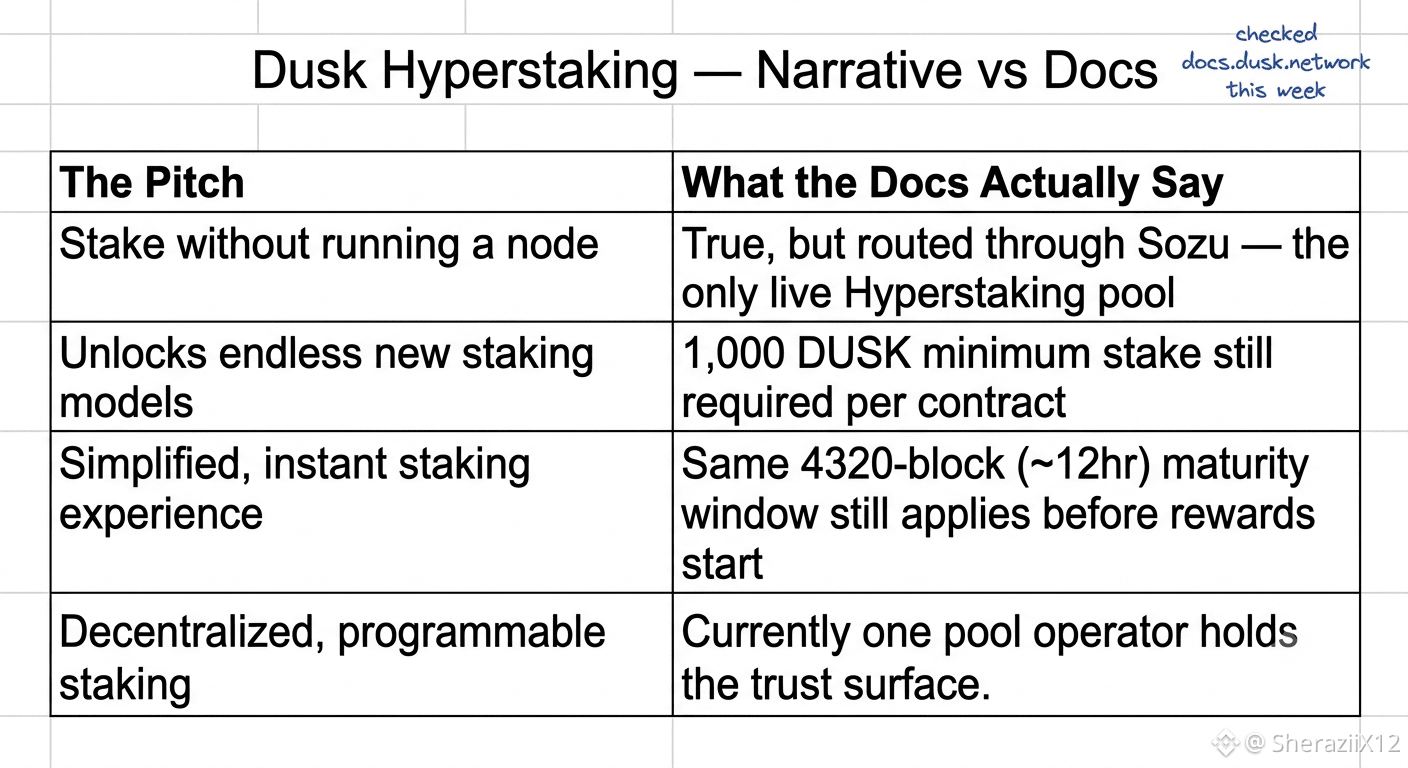
Spent the afternoon digging through Dusk's staking docs instead of the usual hype threads, and one line stopped me — #dusk $DUSK @Dusk markets Hyperstaking as "stake without running a node," but when you actually read the stake abstraction spec, only one partner, Sozu, is live using it.
Here's the part that stuck. Solo staking on Dusk still means running a provisioner node 24/7, watching uptime, worrying about soft slashing. Hyperstaking's pitch is that contracts absorb all that — deposit and walk away. Fine. But the contract still needs 1,000 DUSK minimum to activate, and stake still sits through the same 4320-block maturity window (~12 hours) before it earns anything. The "easy path" doesn't skip the mechanics, it just moves them behind a pool operator you now have to trust instead of infrastructure you control yourself.
I went looking for a second Hyperstaking pool to compare terms against Sozu's. Couldn't find one. Hmm — for a feature framed as unlocking "endless new staking models," there's exactly one live implementation, and it's the one everyone cites.
So the accessibility story is real, technically. It's just currently a single point of trust wearing a decentralization label. Does that change once more builders ship on stake abstraction, or does one early mover just end up holding most of the pooled stake by default?
Here's the part that stuck. Solo staking on Dusk still means running a provisioner node 24/7, watching uptime, worrying about soft slashing. Hyperstaking's pitch is that contracts absorb all that — deposit and walk away. Fine. But the contract still needs 1,000 DUSK minimum to activate, and stake still sits through the same 4320-block maturity window (~12 hours) before it earns anything. The "easy path" doesn't skip the mechanics, it just moves them behind a pool operator you now have to trust instead of infrastructure you control yourself.
I went looking for a second Hyperstaking pool to compare terms against Sozu's. Couldn't find one. Hmm — for a feature framed as unlocking "endless new staking models," there's exactly one live implementation, and it's the one everyone cites.
So the accessibility story is real, technically. It's just currently a single point of trust wearing a decentralization label. Does that change once more builders ship on stake abstraction, or does one early mover just end up holding most of the pooled stake by default?