For an NVDA trader, the harder question is not access. It is how fast the thesis must be right when volatility arrives first
That matters as Nvidia approaches its August 26 earnings report, with options recently pricing an 8.8% move around the event. In May, Saxo showed 85.24% implied volatility for the May 22 weekly expiry versus 45.20% for the June 18 monthly, showing how sharply time changes risk
TermMax Alpha changes that structure. bStocks exposure is available through Alpha, with new bStocks maturities on BNB Chain. Alpha uses Calls or Puts with an upfront premium and defined maturity instead of conventional margin mechanics. TermMax describes it as liquidation-free leverage
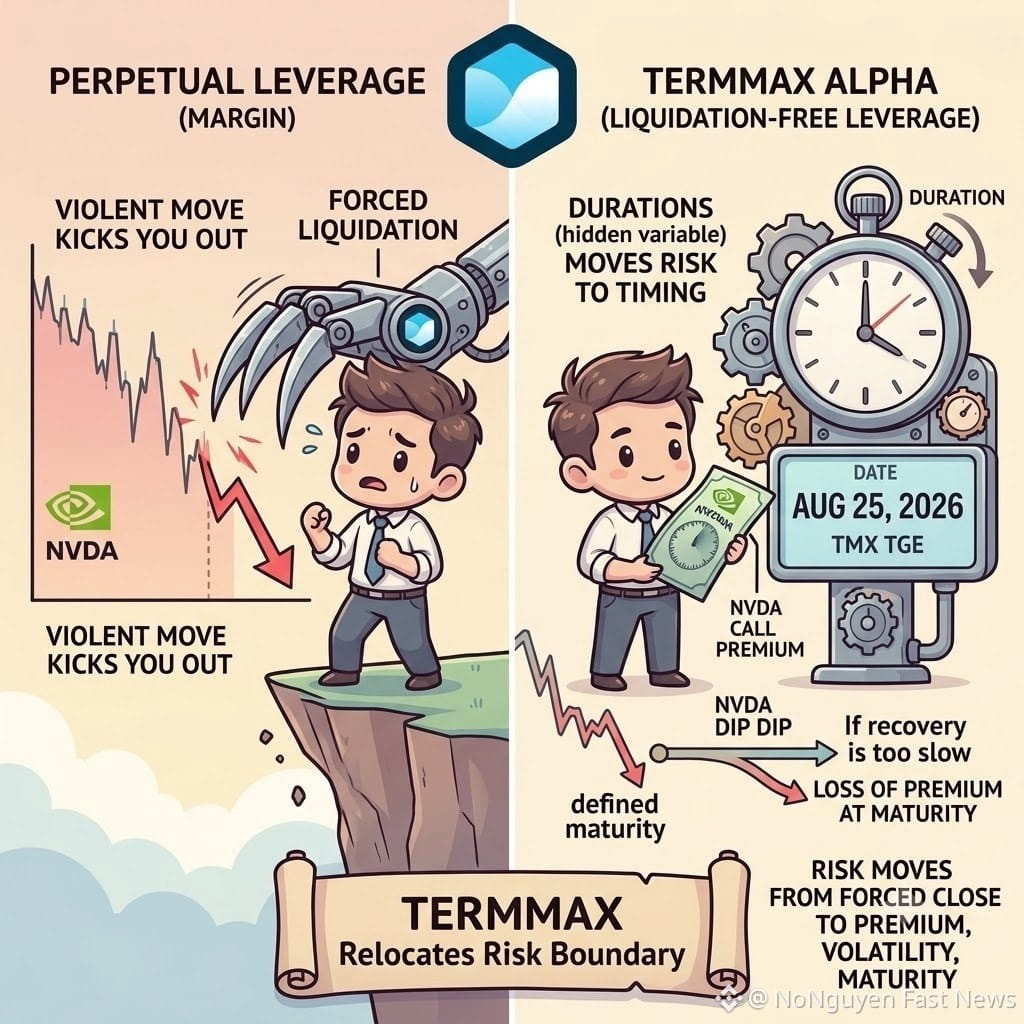
The subtle part is what “no liquidation” actually changes. In a perpetual, a violent move can force collateral into the market before the thesis recovers. In Alpha, that forced-close mechanism is removed for the buyer, but the economic clock remains
Consider a hypothetical $1,000 premium on a 30-day NVDA Call. A 15% drawdown does not create a margin call, but recovery after expiry can still lose the full $1,000 now. Risk has moved from forced liquidation to timing: direction must arrive before maturity
That makes duration the hidden variable. This is not simply leveraged NVDA exposure, but a time-bounded claim whose economics depend on strike, maturity, volatility and premium pricing. The market must price whether the thesis becomes profitable before the clock runs out
So I would not call Alpha “stock leverage without risk.” TermMax relocates the risk boundary: away from forced liquidation and toward premium, volatility and maturity. Tokenized equities solve access, but they do not automatically guarantee efficient pricing or an easy exit
With $TMX TGE scheduled for August 25 2026, the timing is notable, but a structural question remains: if liquidation is no longer the binding constraint for tokenized-equity leverage, does the next bottleneck become the market’s ability to price and trade time-bounded claims efficiently before maturity
@TermMax #TermMax
That matters as Nvidia approaches its August 26 earnings report, with options recently pricing an 8.8% move around the event. In May, Saxo showed 85.24% implied volatility for the May 22 weekly expiry versus 45.20% for the June 18 monthly, showing how sharply time changes risk
TermMax Alpha changes that structure. bStocks exposure is available through Alpha, with new bStocks maturities on BNB Chain. Alpha uses Calls or Puts with an upfront premium and defined maturity instead of conventional margin mechanics. TermMax describes it as liquidation-free leverage
The subtle part is what “no liquidation” actually changes. In a perpetual, a violent move can force collateral into the market before the thesis recovers. In Alpha, that forced-close mechanism is removed for the buyer, but the economic clock remains
Consider a hypothetical $1,000 premium on a 30-day NVDA Call. A 15% drawdown does not create a margin call, but recovery after expiry can still lose the full $1,000 now. Risk has moved from forced liquidation to timing: direction must arrive before maturity
That makes duration the hidden variable. This is not simply leveraged NVDA exposure, but a time-bounded claim whose economics depend on strike, maturity, volatility and premium pricing. The market must price whether the thesis becomes profitable before the clock runs out
So I would not call Alpha “stock leverage without risk.” TermMax relocates the risk boundary: away from forced liquidation and toward premium, volatility and maturity. Tokenized equities solve access, but they do not automatically guarantee efficient pricing or an easy exit
With $TMX TGE scheduled for August 25 2026, the timing is notable, but a structural question remains: if liquidation is no longer the binding constraint for tokenized-equity leverage, does the next bottleneck become the market’s ability to price and trade time-bounded claims efficiently before maturity
@TermMax #TermMax