
DeFi lending has grown rapidly, but one major problem still remains: uncertainty.
Borrowing rates can change sharply. Yield opportunities can disappear overnight. Traders often know the price of an asset—but not the true cost of capital they will face tomorrow.
That is where TermMax enters the conversation.
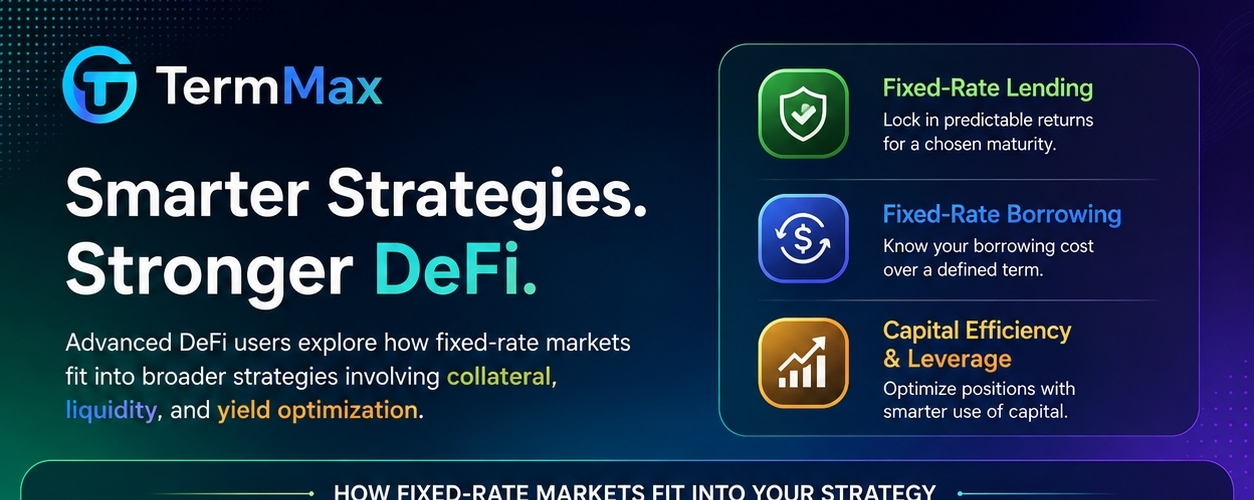
TermMax is building around a powerful idea: bringing fixed-rate, fixed-term borrowing and lending into DeFi. Instead of relying only on floating-rate money markets, users can potentially lock in clearer borrowing costs and more predictable yield structures for a defined period.
In simple words: it aims to make DeFi capital markets feel less like guessing and more like planning.
Why Fixed Rates Matter in DeFi
Most on-chain lending protocols use variable interest rates. When borrowing demand rises, rates can jump. When liquidity increases, yields may fall.
That model works well for flexible, short-term capital. But it can be difficult for users who need predictability.
For example:
A trader may want to borrow stablecoins for a defined strategy period.
A DAO may want to manage treasury financing without sudden rate shocks.
A lender may prefer a known return structure instead of constantly changing yields.
A market participant may want to hedge interest-rate exposure rather than simply accept it.
Traditional finance has long used fixed-income products, bonds, and term-based lending markets to solve these problems. DeFi, however, is still early in building a deep and liquid fixed-rate infrastructure.
TermMax is positioning itself in that gap.
The Core Thesis Behind @TermMax
The broader thesis is straightforward:
If DeFi matures into a real global capital market, users may increasingly demand not only liquidity—but also certainty.
A fixed-term lending protocol can create a more structured environment for borrowers and lenders.
Borrowers may be able to understand their financing cost in advance. Lenders may be able to choose a maturity profile that better matches their time horizon. Advanced users may gain more tools to manage interest-rate risk.
This matters because the next stage of DeFi may not be driven only by higher yields. It may be driven by better financial primitives.
The market does not only need another place to deposit assets. It needs infrastructure that makes capital more efficient, transparent, and manageable.
What Makes the Fixed-Rate Narrative Interesting
The fixed-rate lending narrative sits at the intersection of several major DeFi themes:
On-Chain Fixed Income
Fixed income is one of the largest categories in traditional finance. Yet on-chain fixed-income markets are still relatively underdeveloped.
Protocols that successfully create liquid term markets could help unlock new use cases for stablecoins, tokenized real-world assets, DAOs, institutions, and sophisticated DeFi users.
Better Risk Management
Variable lending rates can create uncertainty during volatile markets. Fixed-rate structures may help users plan ahead—although they do not remove market, collateral, liquidation, or smart-contract risks.
Predictable interest costs can be especially valuable when market conditions become unstable.
Capital Efficiency
When users can choose maturities and rates, capital can potentially be allocated more efficiently across different time horizons.
Short-term liquidity, medium-term financing, and longer-duration yield demand do not always need the same product. A term-based protocol can serve more specific needs than a purely floating-rate market.
Institutional Readiness
Institutional participants often care deeply about risk controls, predictable financing, and transparent maturity structures.
If DeFi wants to attract larger pools of capital, products with clearer rate and duration mechanics may become increasingly important.
TermMax is therefore not only competing for retail attention. Its bigger ambition may be tied to how DeFi evolves into a more complete financial system.
The Bull Case: Why People Are Watching Projects Like TermMax
The bullish argument is not simply “fixed rates are good.” It is more nuanced.
A strong fixed-rate protocol could benefit from several forces:
Growing stablecoin adoption
More on-chain treasury management
Expansion of tokenized treasury and real-world-asset markets
Demand for hedging tools in volatile rate environments
More sophisticated DeFi users seeking structured yield
Institutional interest in transparent, programmable capital markets
If on-chain lending continues to grow, users may eventually seek the same tools available in traditional markets: yield curves, maturity matching, interest-rate hedging, and more predictable financing.
That could create a meaningful role for protocols focused on fixed-term capital.
However, this thesis depends on actual user demand—not just narrative excitement.
The Challenges @TermMax Must Overcome
Every promising DeFi idea faces execution risk, and fixed-rate lending is not easy to scale.
Liquidity Is Everything
For a term market to work well, it needs deep liquidity across multiple maturities.
A protocol may have an attractive design, but if users cannot enter or exit positions efficiently, adoption can remain limited. Liquidity fragmentation is one of the biggest challenges across DeFi.
Smart-Contract Risk
DeFi users always face smart-contract and oracle risk. Fixed-rate mechanisms can also be more complex than basic lending pools, which may introduce additional design and security considerations.
Users should evaluate audits, risk disclosures, collateral mechanisms, oracle dependencies, and protocol governance before using any platform.
Demand Must Be Real
The difference between a successful financial protocol and a short-lived narrative is usually sustained demand.
The key question is not whether fixed rates sound useful. The key question is whether borrowers, lenders, treasuries, and liquidity providers actually use the product repeatedly.
Competition Will Be Intense
The fixed-income and lending sector is too important to remain empty.
TermMax may compete with established lending protocols, yield-tokenization platforms, structured-product protocols, and future products from large DeFi ecosystems. Winning may depend on user experience, liquidity incentives, integrations, risk management, and market trust.
Metrics That Matter More Than Social Hype
For anyone researching TermMax, the most important signals are likely to be fundamental rather than promotional.
Watch for:
Total value locked and whether it is growing sustainably
Borrowing and lending volume
Liquidity depth across different maturities
Active wallets and repeat users
Stablecoin integrations
Security audits and protocol risk controls
Ecosystem partnerships
Revenue model and fee generation
Token utility, emissions, unlock schedules, and governance design—if applicable
Whether the protocol attracts organic usage beyond incentive campaigns
A large social following can create visibility. But durable DeFi value usually comes from liquidity, product-market fit, and trust.
The Bigger Picture: DeFi Needs More Than High APY
For years, DeFi has often been associated with high APYs, farming incentives, and speculative token activity.
But sustainable DeFi may look different.
It may be built around products that solve real financial problems:
Borrowing at predictable rates
Lending for known time periods
Managing treasury liquidity
Hedging interest-rate exposure
Building transparent on-chain credit markets
Creating yield curves for digital assets
TermMax belongs to this more mature DeFi narrative.
That does not mean success is guaranteed. It means the problem it is trying to solve is important.
Final Thoughts
TermMax represents an interesting direction for decentralized finance: moving from simple floating-rate lending toward a more structured world of fixed-term capital markets.
Its long-term relevance will depend on whether it can build deep liquidity, keep risk controlled, attract real borrowers and lenders, and prove that fixed-rate DeFi can become a widely used financial primitive.
The opportunity is real, but so are the risks.
In crypto, strong narratives can attract attention quickly. Strong products, however, are the ones that survive market cycles.
TermMax is worth watching not because it promises easy gains—but because predictable on-chain lending could become one of the most important building blocks of the next DeFi cycle.
Disclaimer: This article is for educational and informational purposes only. It is not financial advice. Crypto assets and DeFi protocols involve substantial risk, and past performance does not guarantee future results.