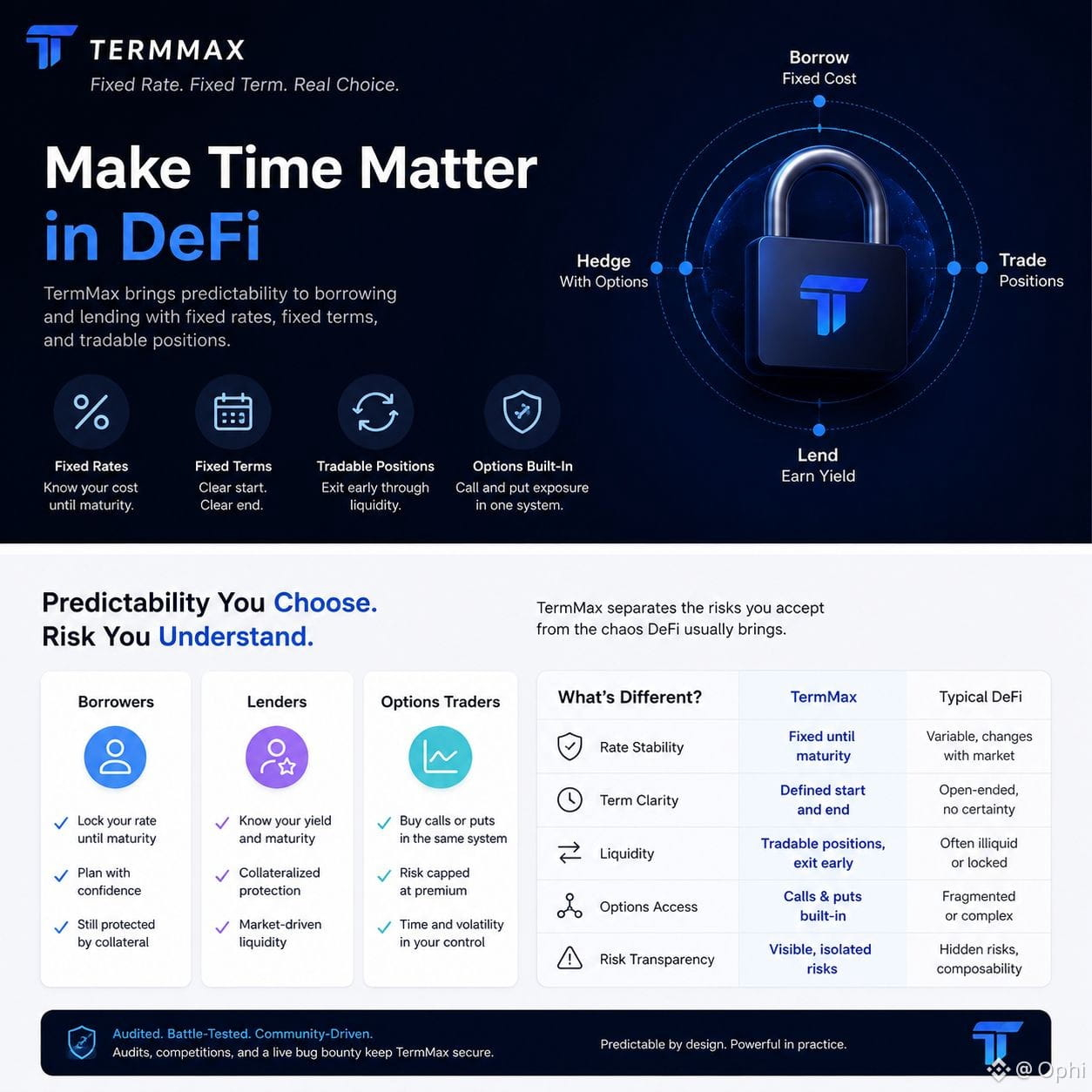
I’m noticing TermMax for a reason I didn’t expect: it is trying to make time matter in DeFi again. After years of watching variable rates jump the moment a trade gets crowded, a fixed borrowing cost until maturity feels less like innovation and more like a missing piece finally being attempted.
I’ve seen this before, though. Crypto takes a simple promise—predictability—and buries it under tokens, leverage, AMM curves, collateral rules and incentives. TermMax turns fixed-term debt into tradable positions, lets users exit through liquidity, and now folds call and put exposure into the same world. On paper, that connects lending, leverage and options neatly. In practice, every extra layer creates another place for thin liquidity, bad pricing or a violent collateral move to expose what the interface hid.
I keep noticing the most interesting part is also the uncomfortable one: the rate may be fixed, but the risk never is. A borrower can know the cost and still face liquidation. A lender can know the maturity and still depend on collateral, contracts and a market willing to take the other side. An options buyer can cap the loss at the premium and still watch time erase the position.
I don’t fully trust it. Audits, competitions and a live bug bounty help, but they don’t turn code into certainty. Still, something about this feels different. TermMax isn’t pretending volatility disappears; it is trying to separate the risks we choose from the chaos we usually inherit. I’m not sure yet whether enough real liquidity will stay once rewards fade. That is the part I’m watching.#termmax
@TermMax
I’ve seen this before, though. Crypto takes a simple promise—predictability—and buries it under tokens, leverage, AMM curves, collateral rules and incentives. TermMax turns fixed-term debt into tradable positions, lets users exit through liquidity, and now folds call and put exposure into the same world. On paper, that connects lending, leverage and options neatly. In practice, every extra layer creates another place for thin liquidity, bad pricing or a violent collateral move to expose what the interface hid.
I keep noticing the most interesting part is also the uncomfortable one: the rate may be fixed, but the risk never is. A borrower can know the cost and still face liquidation. A lender can know the maturity and still depend on collateral, contracts and a market willing to take the other side. An options buyer can cap the loss at the premium and still watch time erase the position.
I don’t fully trust it. Audits, competitions and a live bug bounty help, but they don’t turn code into certainty. Still, something about this feels different. TermMax isn’t pretending volatility disappears; it is trying to separate the risks we choose from the chaos we usually inherit. I’m not sure yet whether enough real liquidity will stay once rewards fade. That is the part I’m watching.#termmax
@TermMax