I thought a finance L1 just needed to be fast. Dusk made me look at the whole lifecycle.
I had a pretty simple checklist for a finance L1. Fast enough, fees that make sense, and it can handle tokenized assets. If settlement works on-chain, the rest is just apps built on top. At least that's what I used to think.
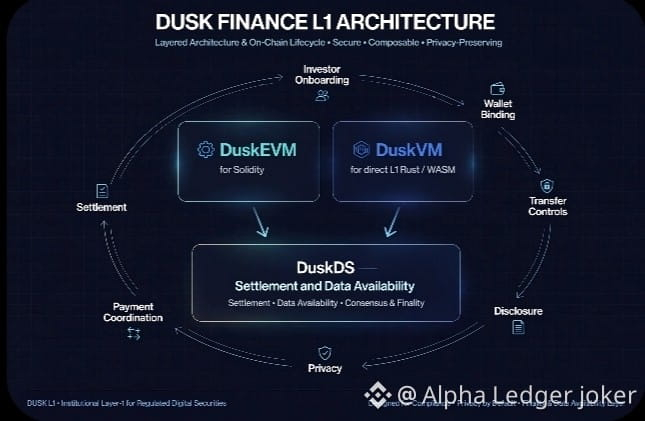
Reading Dusk more closely made me realize I was missing a lot. They are not just putting an asset on-chain. They are building around its entire life. How investors get onboarded, how wallets get bound, who is allowed to transfer what, what needs to be disclosed, what needs to stay private, and how the payment actually lines up with the asset.
It made me rethink RWA. A bond or a fund as a token is not automatically usable finance just because it lives on a blockchain. You still have to answer who can buy it, who can hold it, what has to be public, what has to be confidential, and how cash and asset settle together.
That's why Dusk's split makes sense to me. DuskEVM for Solidity, DuskVM for apps that need to touch L1 directly, and DuskDS underneath for settlement and data availability.
More layers doesn't automatically mean it's good financial infrastructure. More pieces just means more that has to be proven in practice.
But that's exactly why I want to keep following it. Can it take all these fragmented, very traditional market requirements and turn them into one seamless on-chain workflow?
#dusk $DUSK @Dusk $RICE
I had a pretty simple checklist for a finance L1. Fast enough, fees that make sense, and it can handle tokenized assets. If settlement works on-chain, the rest is just apps built on top. At least that's what I used to think.
Reading Dusk more closely made me realize I was missing a lot. They are not just putting an asset on-chain. They are building around its entire life. How investors get onboarded, how wallets get bound, who is allowed to transfer what, what needs to be disclosed, what needs to stay private, and how the payment actually lines up with the asset.
It made me rethink RWA. A bond or a fund as a token is not automatically usable finance just because it lives on a blockchain. You still have to answer who can buy it, who can hold it, what has to be public, what has to be confidential, and how cash and asset settle together.
That's why Dusk's split makes sense to me. DuskEVM for Solidity, DuskVM for apps that need to touch L1 directly, and DuskDS underneath for settlement and data availability.
More layers doesn't automatically mean it's good financial infrastructure. More pieces just means more that has to be proven in practice.
But that's exactly why I want to keep following it. Can it take all these fragmented, very traditional market requirements and turn them into one seamless on-chain workflow?
#dusk $DUSK @Dusk $RICE