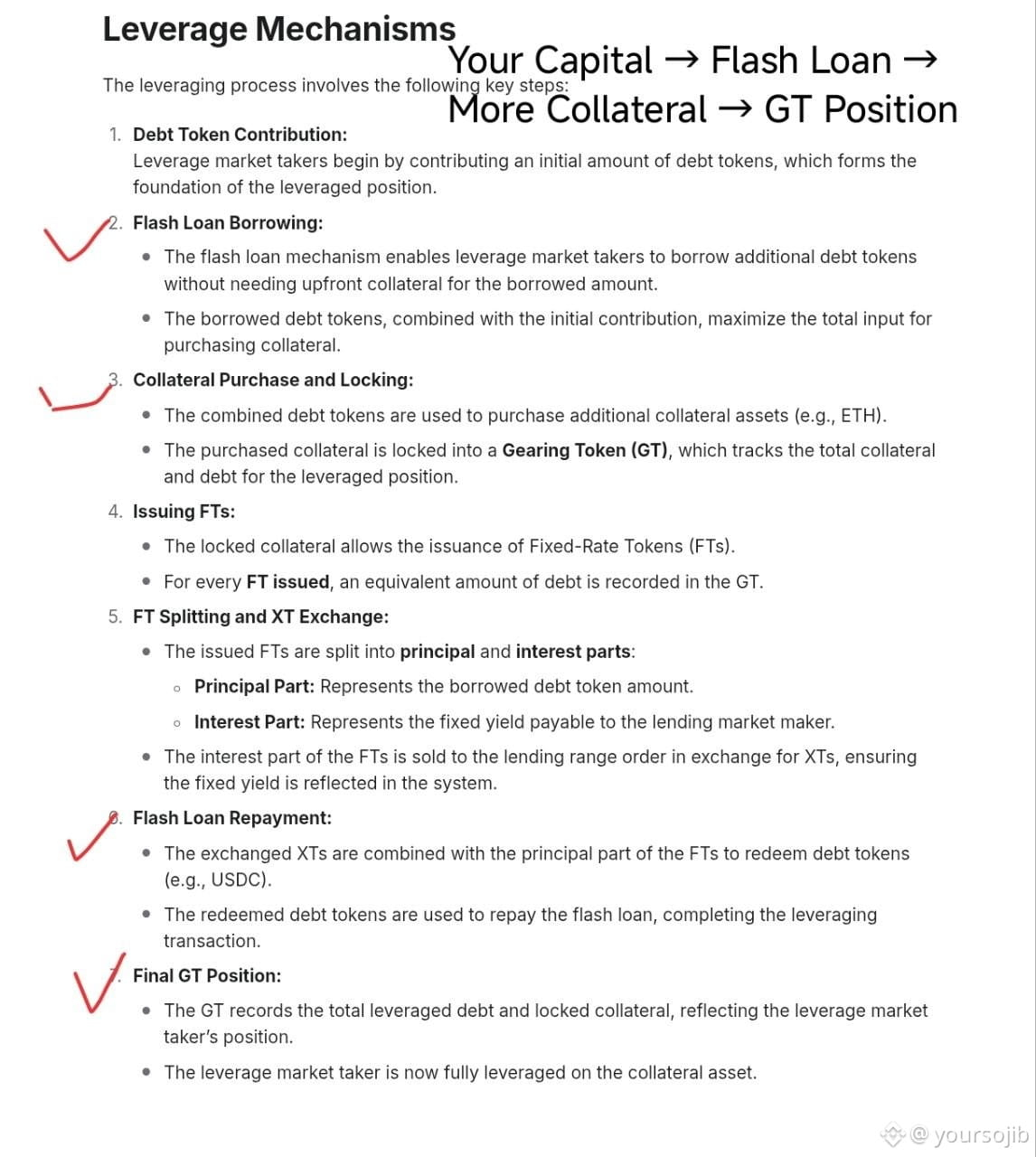
I went through TermMax’s leverage mechanism today instead of just looking at the “leverage” button.
The part that caught my attention is what happens behind that one transaction.
You start with your own debt tokens, add a flash loan, use the combined amount to buy more collateral, and lock that collateral into a Gearing Token (GT).
Then the system separates the fixed-rate position into principal and interest parts, settles the flash loan, and leaves the leveraged collateral + debt recorded in the GT.
What I find interesting is how much is happening under the hood without forcing the user to manually manage every step.
To me, that’s the real value here.
Leverage isn’t difficult because people don’t understand multiplication. It’s difficult because execution gets messy when you have to coordinate multiple borrowing, swapping and collateral steps yourself.
@TermMax is essentially packaging that complexity into a structured onchain position.
After going through the mechanism, I understand the product a lot better than I did from simply looking at the UI.
That’s the kind of DeFi design I actually like exploring.
$TMX #TermMax
The part that caught my attention is what happens behind that one transaction.
You start with your own debt tokens, add a flash loan, use the combined amount to buy more collateral, and lock that collateral into a Gearing Token (GT).
Then the system separates the fixed-rate position into principal and interest parts, settles the flash loan, and leaves the leveraged collateral + debt recorded in the GT.
What I find interesting is how much is happening under the hood without forcing the user to manually manage every step.
To me, that’s the real value here.
Leverage isn’t difficult because people don’t understand multiplication. It’s difficult because execution gets messy when you have to coordinate multiple borrowing, swapping and collateral steps yourself.
@TermMax is essentially packaging that complexity into a structured onchain position.
After going through the mechanism, I understand the product a lot better than I did from simply looking at the UI.
That’s the kind of DeFi design I actually like exploring.
$TMX #TermMax