#termmax @TermMax
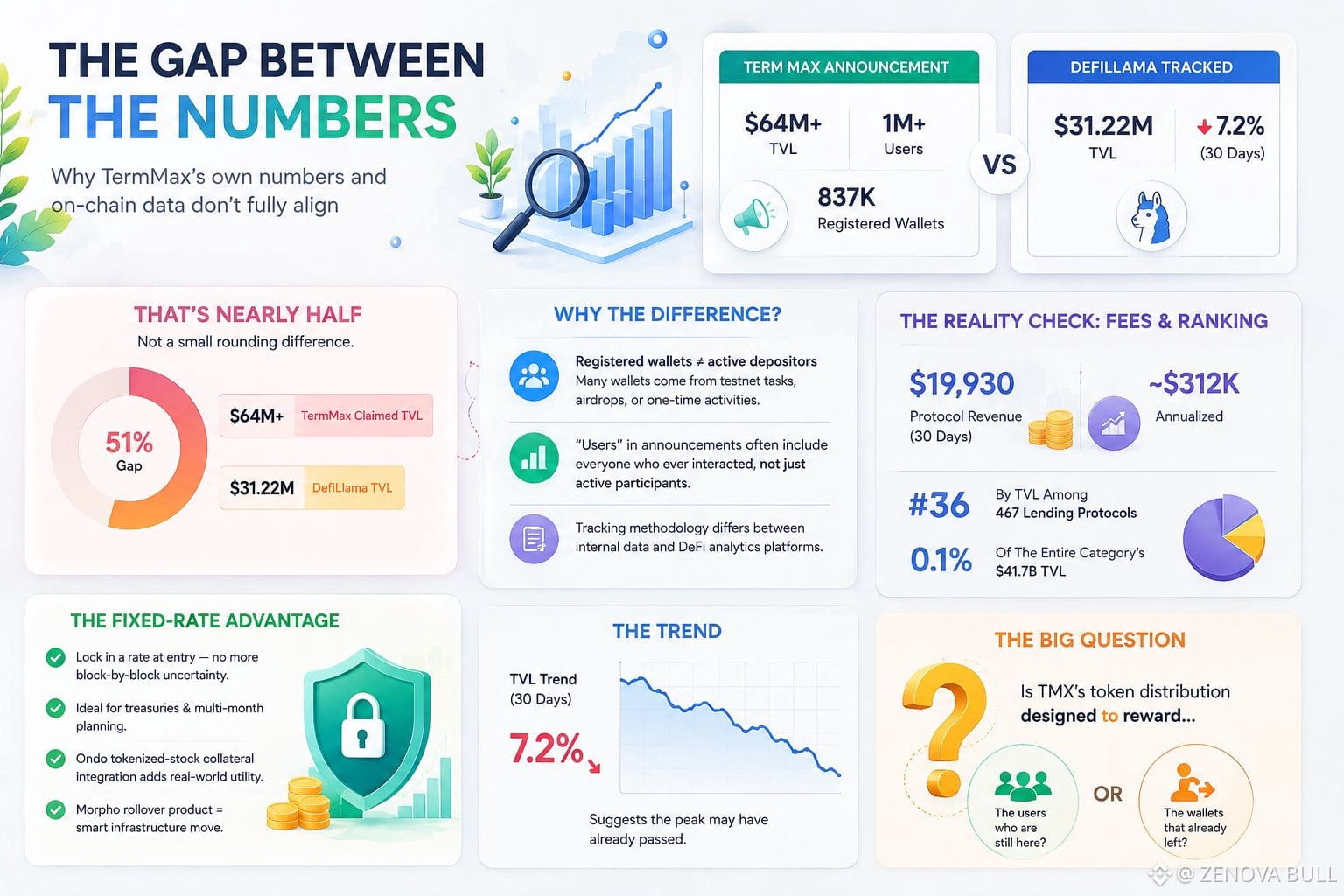
What caught my attention was the gap between two numbers that should roughly agree: TermMax's own announcement cites $64M+ TVL and over 1M users with 837K registered wallets, while DefiLlama's tracked figure currently sits at $31.22M — down 7.2% over the past 30 days.
That's not a small rounding difference. It's nearly half.
I went looking for what explains it. Some of it is methodology — registered wallets aren't the same as active depositors, and "users" in a TGE announcement often counts every wallet that ever touched a testnet task or airdrop farm. TermMax's fee data backs this reading: $19,930 in protocol revenue over 30 days, annualizing to roughly $312K. For a protocol sitting at #36 by TVL among 467 lending protocols tracked, that's thin — 0.1% of the entire category's $41.7B.
The fixed-rate pitch itself is sound. Locking a rate at entry instead of riding Aave/Compound's block-by-block curve genuinely solves a real problem for treasuries and anyone doing multi-month planning. The Ondo tokenized-stock collateral integration and the Morpho rollover product are legitimate infrastructure moves, not vaporware.
But infrastructure and usage are different claims. Declining TVL alongside a TGE and a "170,000 daily active users at peak" headline suggests the peak already passed, and current activity is the trailing edge of it.
I'm not saying the product doesn't work. What I'm wondering is whether TMX's token distribution is designed to reward the users who are still here, or the wallets that already left.
$HEMI
$RE
$TREE
What caught my attention was the gap between two numbers that should roughly agree: TermMax's own announcement cites $64M+ TVL and over 1M users with 837K registered wallets, while DefiLlama's tracked figure currently sits at $31.22M — down 7.2% over the past 30 days.
That's not a small rounding difference. It's nearly half.
I went looking for what explains it. Some of it is methodology — registered wallets aren't the same as active depositors, and "users" in a TGE announcement often counts every wallet that ever touched a testnet task or airdrop farm. TermMax's fee data backs this reading: $19,930 in protocol revenue over 30 days, annualizing to roughly $312K. For a protocol sitting at #36 by TVL among 467 lending protocols tracked, that's thin — 0.1% of the entire category's $41.7B.
The fixed-rate pitch itself is sound. Locking a rate at entry instead of riding Aave/Compound's block-by-block curve genuinely solves a real problem for treasuries and anyone doing multi-month planning. The Ondo tokenized-stock collateral integration and the Morpho rollover product are legitimate infrastructure moves, not vaporware.
But infrastructure and usage are different claims. Declining TVL alongside a TGE and a "170,000 daily active users at peak" headline suggests the peak already passed, and current activity is the trailing edge of it.
I'm not saying the product doesn't work. What I'm wondering is whether TMX's token distribution is designed to reward the users who are still here, or the wallets that already left.
$HEMI
$RE
$TREE