I keep seeing DuskEVM described like a switch someone flips: write Solidity, deploy, done, instantly compatible with everything Ethereum already built. That framing is comforting. It is also incomplete, and Dusk Network gave us proof of exactly where it breaks down.
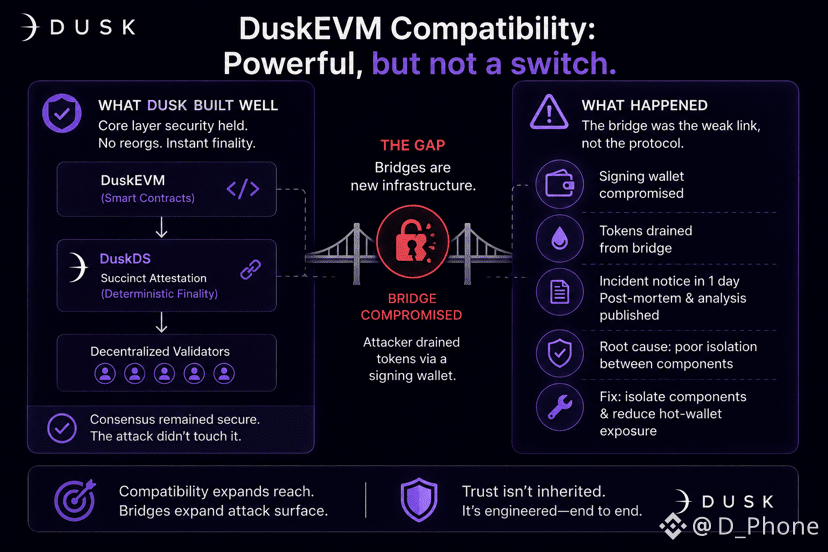
The core layer, DuskDS, runs Succinct Attestation, a consensus design built so blocks do not reorg and settlement does not sit around waiting for enough confirmations to feel safe. That part held up fine in January 2026, when an attacker drained tokens from the bridge connecting Dusk to EVM networks. The exploit never touched consensus. It hit a signing wallet, a piece of auxiliary infrastructure sitting at the seam between the native chain and the EVM side, not the deterministic finality Dusk spent years building.
That is the gap worth naming plainly. The pitch for EVM compatibility is about developer experience: familiar tooling, existing liquidity, less code to rewrite. What gets undersold is that every bridge is new infrastructure with its own key management and its own failure modes, sitting outside the guarantees the base layer worked hard to earn. Dusk published a bridge incident notice within a day of the attack, followed by a fuller post-mortem and a separate security analysis about two months later. The root cause named in that review was a lightweight bridge design that lacked proper isolation between components, not any flaw in Succinct Attestation itself. The fix was not a protocol patch. It was isolating components and cutting hot-wallet exposure so one compromised key cannot drain a bridge again.
None of this makes DuskEVM a bad idea. Bringing programmable privacy to ordinary Solidity contracts through Hedger is genuinely useful if the surrounding infrastructure earns trust. I would rather judge compatibility honestly, as a decision that expands attack surface at the same moment it expands reach, instead of treating it as a free upgrade with no downside
@Dusk $DUSK #dusk $BTW $PORTAL
The core layer, DuskDS, runs Succinct Attestation, a consensus design built so blocks do not reorg and settlement does not sit around waiting for enough confirmations to feel safe. That part held up fine in January 2026, when an attacker drained tokens from the bridge connecting Dusk to EVM networks. The exploit never touched consensus. It hit a signing wallet, a piece of auxiliary infrastructure sitting at the seam between the native chain and the EVM side, not the deterministic finality Dusk spent years building.
That is the gap worth naming plainly. The pitch for EVM compatibility is about developer experience: familiar tooling, existing liquidity, less code to rewrite. What gets undersold is that every bridge is new infrastructure with its own key management and its own failure modes, sitting outside the guarantees the base layer worked hard to earn. Dusk published a bridge incident notice within a day of the attack, followed by a fuller post-mortem and a separate security analysis about two months later. The root cause named in that review was a lightweight bridge design that lacked proper isolation between components, not any flaw in Succinct Attestation itself. The fix was not a protocol patch. It was isolating components and cutting hot-wallet exposure so one compromised key cannot drain a bridge again.
None of this makes DuskEVM a bad idea. Bringing programmable privacy to ordinary Solidity contracts through Hedger is genuinely useful if the surrounding infrastructure earns trust. I would rather judge compatibility honestly, as a decision that expands attack surface at the same moment it expands reach, instead of treating it as a free upgrade with no downside
@Dusk $DUSK #dusk $BTW $PORTAL