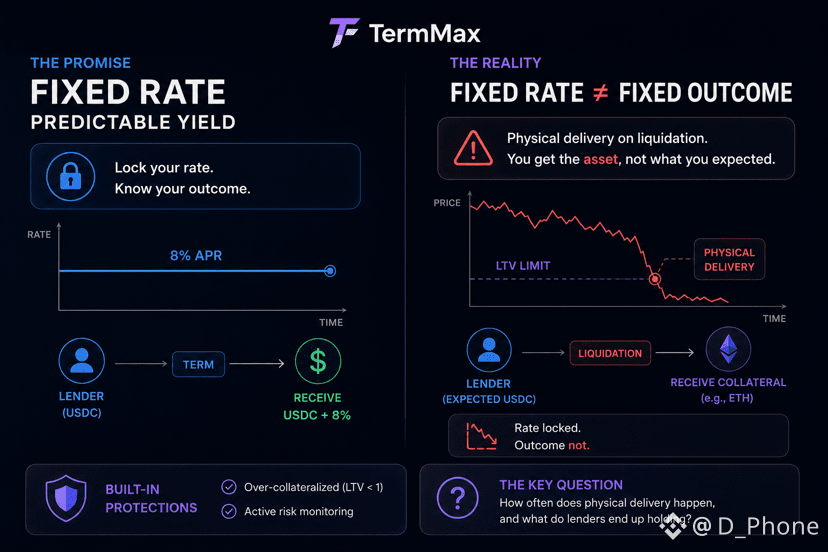
"Fixed rate" sounds like a promise. Lock in a number, walk away, know exactly what you owe or earn when the term ends. That's the pitch behind TermMax, and for the coupon itself, it holds up. The rate you lock is the rate you get at maturity. But a loan is more than its coupon, and that's where I keep circling back to a real gap between what TermMax promises and what actually happens on a bad day.
TermMax handles thin liquidity and sharp volatility through physical delivery: instead of the discount-auction liquidation most lending protocols run, collateral gets delivered straight to the lender when a position breaks down. On paper this looks like protection. In practice it hands the lender an asset they didn't ask for, at a moment they didn't choose, worth whatever the market says it's worth right then. A lender who wanted USDC back at 8% now holds ETH in a falling market. The rate was fixed. The outcome wasn't.
Physical delivery isn't a hair-trigger either. TermMax caps each market with a maximum loan-to-value ratio comfortably under 1, so a position has real room to move before it ever touches that boundary. That buffer helps in an ordinary drawdown. It says a lot less about a genuine gap event, the kind of move where price skips straight past the buffer before anyone, human or automated, can react to it in time.
I don't think this makes TermMax reckless. Over-collateralization requirements and active risk monitoring exist because someone at TermMax already understood this tension well before I noticed it. But "fixed rate" as a phrase implies more certainty than the mechanism delivers once collateral, not just yield, enters the picture. The question I'd want answered before depositing real size: how often has physical delivery actually triggered, and what did lenders walk away holding? Predictability at the coupon level and predictability at the portfolio level are not the same claim, and TermMax's own design quietly admits that by building a fallback for the moment they diverge.
@TermMax #TermMax $BTW $PORTAL $HEMI
TermMax handles thin liquidity and sharp volatility through physical delivery: instead of the discount-auction liquidation most lending protocols run, collateral gets delivered straight to the lender when a position breaks down. On paper this looks like protection. In practice it hands the lender an asset they didn't ask for, at a moment they didn't choose, worth whatever the market says it's worth right then. A lender who wanted USDC back at 8% now holds ETH in a falling market. The rate was fixed. The outcome wasn't.
Physical delivery isn't a hair-trigger either. TermMax caps each market with a maximum loan-to-value ratio comfortably under 1, so a position has real room to move before it ever touches that boundary. That buffer helps in an ordinary drawdown. It says a lot less about a genuine gap event, the kind of move where price skips straight past the buffer before anyone, human or automated, can react to it in time.
I don't think this makes TermMax reckless. Over-collateralization requirements and active risk monitoring exist because someone at TermMax already understood this tension well before I noticed it. But "fixed rate" as a phrase implies more certainty than the mechanism delivers once collateral, not just yield, enters the picture. The question I'd want answered before depositing real size: how often has physical delivery actually triggered, and what did lenders walk away holding? Predictability at the coupon level and predictability at the portfolio level are not the same claim, and TermMax's own design quietly admits that by building a fallback for the moment they diverge.
@TermMax #TermMax $BTW $PORTAL $HEMI