
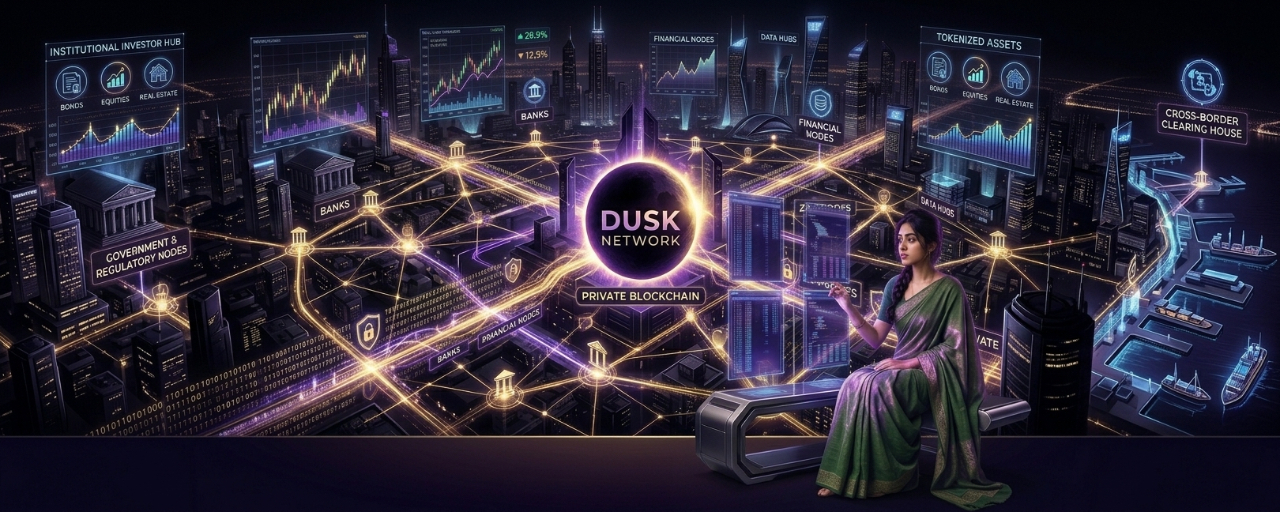
Let's talk about something that most retail investors are sleeping on — a project that sits at the intersection of two of the most powerful narratives in the entire crypto space right now: real-world asset (RWA) tokenization and privacy-preserving blockchain technology. That project is Dusk Network, and its native token is $dusk.
Before we dive deep, let me be clear: this isn't a hype post. This isn't about price predictions or moonshot fantasies. This is a genuine, research-backed breakdown of why Dusk Network is building something that the financial world genuinely needs — and why the broader crypto community hasn't given it the attention it deserves. Yet.
🏦 The Problem with Traditional Finance and Blockchain
To understand why Dusk matters, you first need to understand the problem it's solving.
Traditional finance (TradFi) is built on decades-old infrastructure. Stock settlement takes T+2 days. Bond issuance requires armies of lawyers, custodians, and intermediaries. Cross-border transfers are slow, expensive, and opaque. The system works — barely — but it's inefficient, costly, and deeply exclusionary.
Blockchain technology promised to fix this. And in many ways, it has — for decentralized, permissionless applications. DeFi has shown that you can lend, borrow, trade, and earn yield without a bank. That's revolutionary.
But here's the catch: regulators are not going away. Institutions cannot simply plug into a public blockchain that has no compliance layer. They cannot use systems where transaction data is fully public — exposing their trading strategies, client information, and business operations to anyone with a blockchain explorer. And they cannot operate in ecosystems where there is no legal clarity around the assets being traded.
This is the wall that most blockchain projects hit when they try to attract institutional capital. And this is precisely the wall that Dusk Network was designed to break through.
🔐 What Is Dusk Network?
Dusk Network is a Layer 1 blockchain purpose-built for compliant, privacy-preserving financial applications. It is not a general-purpose chain trying to do everything. It is laser-focused on one mission: making regulated financial instruments — securities, bonds, equities, tokenized real-world assets — work natively on a blockchain.
The key word here is natively. Not wrapped, not bridged, not approximated. Natively. From the ground up, Dusk has been architected to support the kind of compliance, privacy, and programmability that financial institutions actually need.
Here's what that means in practice:
🔹 Zero-Knowledge Proofs at the Core
Dusk uses zero-knowledge cryptography — specifically, a custom ZK proving system — to enable transaction privacy. This means that when a financial institution executes a trade on Dusk, the details of that trade can remain confidential while still being verifiable.
Think about that for a second. You can prove that a transaction is valid — that the sender had sufficient funds, that the rules were followed, that the compliance checks passed — without revealing the underlying data. This is the holy grail for institutional finance. It's the difference between "we can't use this" and "this is exactly what we need."
🔹 Programmable Compliance
One of Dusk's most underappreciated features is its approach to programmable compliance. Through its smart contract system (built on the Rusk VM), issuers can embed regulatory rules directly into financial instruments. This means KYC/AML checks, transfer restrictions, investor eligibility requirements, and reporting obligations can all be enforced automatically — at the protocol level — without relying on off-chain intermediaries.
This is massive. It means a security token issued on Dusk can automatically ensure that it only transfers between verified, eligible investors. It can automatically block transfers that would violate lock-up periods. It can automatically generate the audit trail that regulators require. All of this happens on-chain, transparently (to the right parties), and without human intervention.
🔹 The XSC Standard (Confidential Security Tokens)
Dusk has developed the XSC (Confidential Security Token) standard — essentially their answer to ERC-20, but designed specifically for regulated financial instruments. XSC tokens allow for the issuance of securities that are both privacy-preserving and compliant — a combination that no other major blockchain natively supports at scale.
This isn't a minor technical detail. This is a foundational building block for the future of tokenized finance. When institutions want to issue a tokenized bond, a tokenized equity, or a tokenized fund on a blockchain, they need something like XSC. And Dusk is one of the very few chains that has built this from scratch, with regulatory requirements in mind from day one.
🌍 The RWA Narrative — And Why Dusk Is Perfectly Positioned
Real-world asset tokenization is not a niche crypto trend. It is being taken seriously at the highest levels of global finance.
BlackRock — the world's largest asset manager with over $10 trillion in AUM — has launched tokenized funds on blockchain. JPMorgan has been running blockchain-based repo transactions for years through its Onyx platform. The Bank for International Settlements (BIS) has published multiple reports on the potential of tokenized finance. Governments around the world are exploring tokenized government bonds.
The numbers being thrown around are staggering. Some analysts project that tokenized assets could represent $16 trillion or more in value by 2030. Others put the figure even higher. Whether the exact number is $10 trillion or $30 trillion, the direction is clear: a significant portion of the world's financial assets are going to move onto blockchain infrastructure.
The question is: which blockchain?
Most of the current RWA activity is happening on Ethereum or Ethereum-compatible chains. These chains are powerful and have massive ecosystems. But they were not designed with institutional compliance in mind. Transaction data is public. Privacy is an afterthought, not a foundation. Compliance has to be bolted on externally.
Dusk was built for exactly this moment. It's not retrofitting privacy onto an existing chain. It's not trying to add compliance as a layer on top of a DeFi-native system. It was architected from the beginning to serve regulated financial markets. That is a significant competitive advantage.
⚙️ The Technology Stack — Going Deeper
Let's get a bit more technical, because the technology behind Dusk is genuinely impressive.
Rusk — The Protocol Implementation
Rusk is Dusk's protocol implementation — the software that runs the network. It's written in Rust (chosen for performance and memory safety) and encompasses the entire stack: the consensus mechanism, the VM, the cryptographic primitives, and the networking layer.
Succinct Attestation (Pallas Consensus)
Dusk uses a BFT-based consensus mechanism called Succinct Attestation, which is designed for high throughput and fast finality. In financial applications, finality matters enormously. You cannot have a settlement system where transactions might be reversed. Dusk's consensus provides deterministic finality — once a transaction is confirmed, it's done. This is what institutions need.
Phoenix and Zedger Transaction Models
Dusk uses two transaction models:
Phoenix: A UTXO-based model that uses ZK proofs to enable shielded (private) transactions. This is where the privacy magic happens. Phoenix transactions hide the sender, receiver, and amount, while still being verifiable by the network.
Zedger: A transaction model designed specifically for regulated assets. It enables privacy while also allowing for the selective disclosure required for compliance — meaning regulators and authorized parties can see what they need to see, while the broader public cannot.
This dual-model approach is elegant. It allows Dusk to serve both private users and regulated institutional use cases without compromising either.
Piecrust VM
Dusk's virtual machine, Piecrust, is designed to execute smart contracts efficiently with ZK proofs in mind. Building ZK-friendly smart contracts is notoriously difficult — most existing VMs were designed without ZK in mind and require significant workarounds. Piecrust is being built to make ZK-native smart contract development more accessible.
👥 The Team and Institutional Credibility
Dusk Network was founded by Emanuele Francioni and has been developing its technology since 2018. The team is heavily research-oriented, with cryptographers, economists, and financial experts contributing to the protocol.
What sets Dusk apart from many projects is its engagement with actual financial regulators and institutions. The team has worked with regulators in the Netherlands and beyond, ensuring that the protocol is not just technically sound but also legally grounded. This is rare in crypto. Most projects build first and ask regulatory questions later (if ever). Dusk has baked compliance into its DNA from the start.
💡 Use Cases — Where $Dusk Gets Real
Let's bring this down to earth with some concrete use cases that Dusk enables:
1. Tokenized Securities
A company wants to issue equity or bonds on a blockchain. With Dusk, they can issue XSC-standard security tokens that automatically enforce transfer restrictions, investor eligibility, and reporting requirements. Settlement is near-instant. Intermediaries are minimized. Costs drop dramatically.
2. Private DeFi for Institutions
An asset manager wants to participate in on-chain lending or yield strategies but cannot expose their portfolio positions publicly. With Dusk's privacy layer, they can engage with DeFi-style applications while keeping their strategies confidential.
3. Regulatory Reporting
A financial institution needs to demonstrate compliance to regulators without exposing client data to the public. Dusk's ZK proofs enable selective disclosure — proving compliance to the right parties without a full data dump.
4. Central Bank Digital Currency (CBDC) Infrastructure
Dusk's architecture is well-suited for CBDC implementations that require privacy for users while maintaining auditability for central banks. As governments explore retail and wholesale CBDCs, infrastructure like Dusk becomes increasingly relevant.
5. Tokenized Real Estate and Funds
Fractional ownership of real estate, private equity funds, and other illiquid assets can be tokenized on Dusk, enabling broader investor access while maintaining compliance with securities laws.
📊 $DUSK Tokenomics and Utility
The $DUSK token is the native currency of the Dusk Network. It serves several critical functions:
Gas fees: All transactions on the network require $Duskfor gas.
Staking: $Dusk holders can stake their tokens to participate in consensus and earn rewards. The network uses a Proof of Stake mechanism, so stakers are economically invested in the network's security.
Governance: $Dusk plays a role in the governance of the protocol, giving holders a voice in the network's future development.
Economic security: The staking mechanism aligns the incentives of validators with the health of the network.
As the network grows and more financial activity flows through Dusk, demand for $Dusk increases — both for gas and for staking. This creates a natural economic link between the network's adoption and the token's value.
🔭 The Road Ahead
Dusk has been building quietly and methodically for years. The mainnet launch was a significant milestone, and the team continues to develop the ecosystem — attracting builders, partners, and institutional interest.
The convergence of several macro trends creates a powerful tailwind for Dusk:
Regulatory clarity is slowly emerging in major markets (EU, US, Asia), making institutions more willing to engage with blockchain.
RWA tokenization is accelerating, with major financial players actively exploring blockchain-based issuance and settlement.
Privacy is increasingly recognized as a necessity, not a luxury — both for user protection and regulatory compliance.
ZK technology is maturing rapidly, making privacy-preserving applications more practical and scalable than ever before.
Dusk sits at the intersection of all four of these trends. That is not a coincidence — it is the result of years of deliberate, focused building.
🚀 Final Thoughts
The crypto space is noisy. Every week brings new narratives, new tokens, and new hype cycles. It's easy to get distracted by the noise and miss the projects that are doing genuinely important work.
Dusk Network is one of those projects.
It's not the most talked-about chain. It doesn't have the biggest marketing budget or the loudest community. But it has something more valuable: a clear mission, a technically sophisticated solution, and a target market — regulated institutional finance — that represents trillions of dollars in potential value.
When the infrastructure for tokenized finance matures, when institutions need a blockchain that respects privacy and compliance simultaneously, when the RWA narrative moves from "interesting experiment" to "standard practice" — Dusk will be there. It was built for exactly that moment.
$DUSK is not just a token. It's a bet on the future of compliant, private, programmable finance. And that future is closer than most people think.
Do your own research. Read the docs. Explore the ecosystem. But don't sleep on @Dusk — because when the world wakes up to what they're building, you'll wish you had paid attention sooner. 🌑✨
