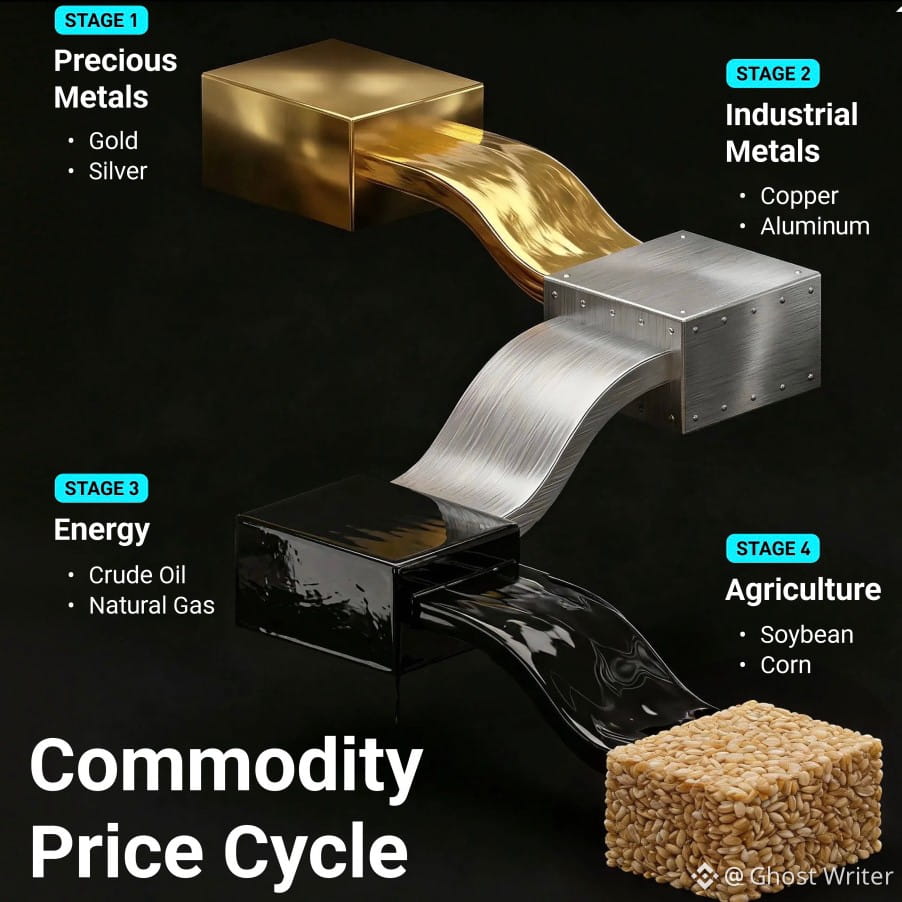
Markets don’t move randomly. Capital rotates, and it does so in patterns that repeat across cycles. In TradFi, this rotation is well-documented: precious metals → industrial metals → energy → agriculture. It’s an asset inflation relay, and each leg signals a different phase of liquidity and growth.
🔸 Understanding the Rotation
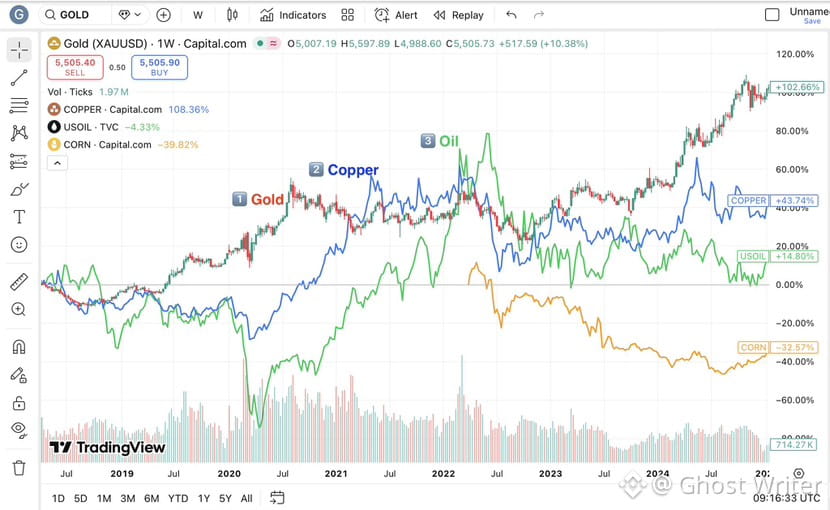
When uncertainty rises and rate cuts come into focus, capital hides in gold $XAU and silver $XAG first. This is not speculation; it’s capital preservation. Precious metals often move before equities and risk assets react.
As confidence rebuilds, money shifts into industrial metals like copper and aluminum. This is the market pricing in real economic activity — infrastructure, manufacturing, construction. This is where risk-on quietly begins.
Next comes energy. Oil and natural gas move as growth accelerates and demand tightens against supply. This is usually the mid-cycle phase where inflation becomes visible, not theoretical.
Finally, agriculture reacts. Higher energy, transport, and input costs flow into food prices. Agriculture is often the late-cycle catch-up trade — slow, then sudden.
This rotation isn’t theory. It’s observable on charts, across cycles.
🔸 Why This Matters for Crypto Traders
Crypto doesn’t exist in isolation. Liquidity that fuels Bitcoin, altcoins, and risk assets often originates in TradFi cycles.
Ignoring commodities means missing:
Early signals of liquidity expansion
Inflation hedges before crypto reacts
Capital rotation timing that affects risk appetite
🔸 Why Binance TradFi Is Strategic in 2026
Binance bringing TradFi assets on-chain and into perpetual markets changes the game.
It means:
One platform for macro + crypto execution
Faster rotation between asset classes
Better risk management during regime shifts
True freedom isn’t choosing crypto instead of TradFi.
It’s having access to every asset that matters when capital moves.