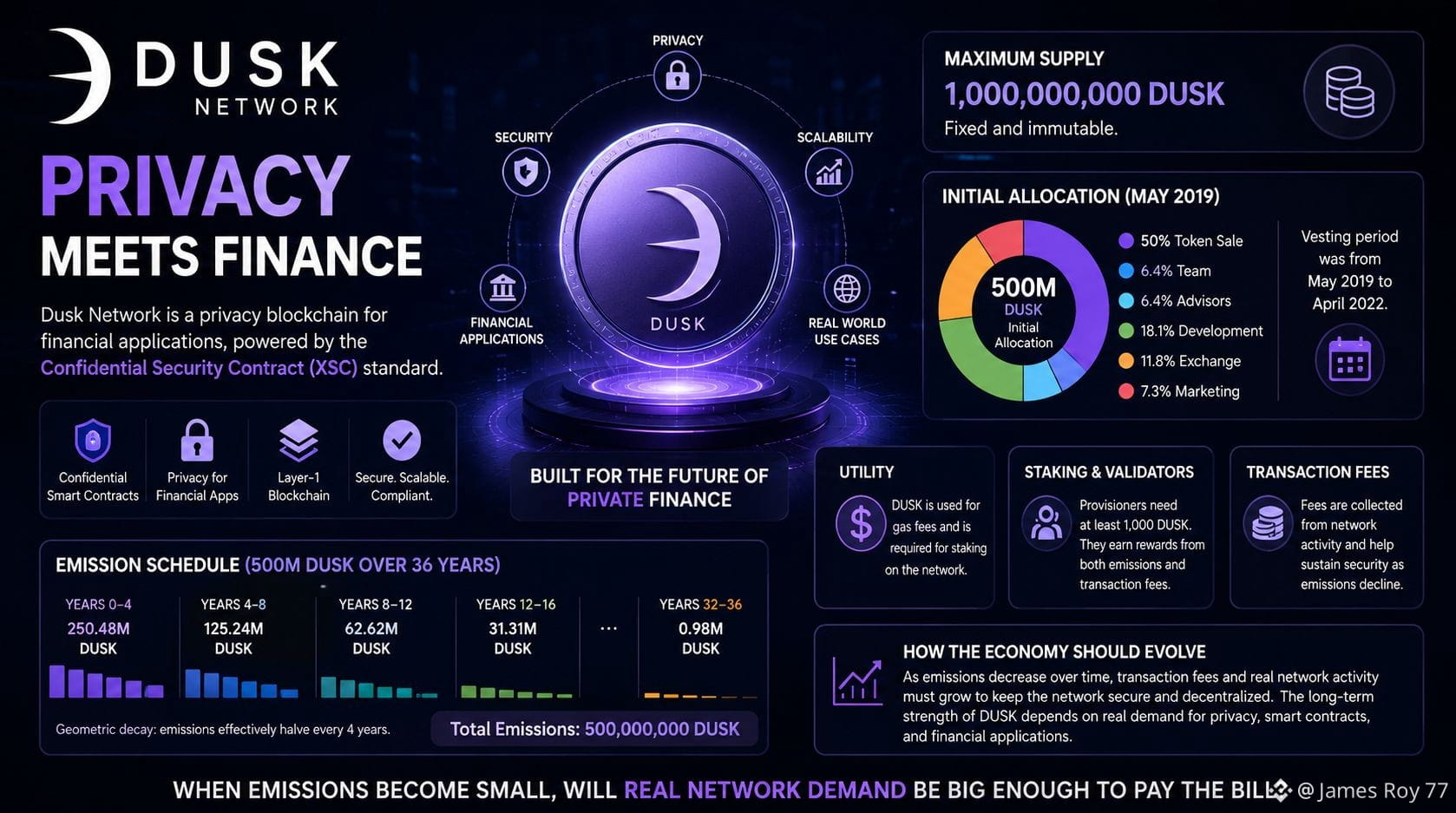
Was mich an DUSK Aufmerksamkeit erregt, ist nicht die maximale Gesamtmenge von 1 Milliarde. Es ist vielmehr die Tatsache, dass die Hälfte dieser Versorgung von Anfang an so konzipiert wurde, während die andere Hälfte von 500 Millionen über 36 Jahre hinweg schrittweise freigegeben wird.
Die ursprüngliche Zuteilung von 500 Mio. DUSK umfasste 50% Token-Sale, 6,4% Team, 6,4% Advisors, 18,1% Entwicklung, 11,8% Börse und 7,3% Marketing. Dieser Vesting-Zeitraum lief von Mai 2019 bis April 2022, sodass der alte Unlock-Overhang bereits ein anderes Thema ist als die fortlaufenden Protokoll-Emissionen.
Der spannendere Teil ist, was als Nächstes passiert. Dusk emittiert 500 Mio. DUSK über ein geometrisches Zerfallsmodell; die Emissionen halbieren sich effektiv alle vier Jahre: etwa 250,48 Mio. in den Jahren 0–4, dann 125,24 Mio., 62,62 Mio., 31,31 Mio. und so weiter. In den Jahren 32–36 beträgt die geplante Emission nur noch etwa 0,98 Mio.
DUSK hat eine echte Netzwerk-Utility, weil es für Gas bezahlt und für Staking erforderlich ist. Provisioner benötigen mindestens 1.000 DUSK, während die Belohnungen sowohl aus neu emittierten Tokens als auch aus Transaktionsgebühren stammen. Gebühren sind daher wichtig, weil sie die Sicherheits-Subvention mit abnehmenden Emissionen nach und nach ersetzen können.
Das ist der eigentliche Test für mich. Eine abnehmende Emissionskurve wirkt auf dem Papier diszipliniert, aber irgendwann können Anreize das Netzwerk nicht mehr allein tragen. Dusk braucht genügend echte finanzielle Aktivität, die Nutzung von Smart Contracts und eine Generierung von Gebühren, um Sicherheit wirtschaftlich attraktiv zu machen, ohne stark auf neues DUSK angewiesen zu sein.
Die Frage, zu der ich immer wieder zurückkehre, ist einfach: Wenn die Emissionen klein werden, wird die echte Nachfrage im Netzwerk dann groß genug sein, um die Rechnung zu bezahlen?
#dusk $DUSK @Dusk
Die ursprüngliche Zuteilung von 500 Mio. DUSK umfasste 50% Token-Sale, 6,4% Team, 6,4% Advisors, 18,1% Entwicklung, 11,8% Börse und 7,3% Marketing. Dieser Vesting-Zeitraum lief von Mai 2019 bis April 2022, sodass der alte Unlock-Overhang bereits ein anderes Thema ist als die fortlaufenden Protokoll-Emissionen.
Der spannendere Teil ist, was als Nächstes passiert. Dusk emittiert 500 Mio. DUSK über ein geometrisches Zerfallsmodell; die Emissionen halbieren sich effektiv alle vier Jahre: etwa 250,48 Mio. in den Jahren 0–4, dann 125,24 Mio., 62,62 Mio., 31,31 Mio. und so weiter. In den Jahren 32–36 beträgt die geplante Emission nur noch etwa 0,98 Mio.
DUSK hat eine echte Netzwerk-Utility, weil es für Gas bezahlt und für Staking erforderlich ist. Provisioner benötigen mindestens 1.000 DUSK, während die Belohnungen sowohl aus neu emittierten Tokens als auch aus Transaktionsgebühren stammen. Gebühren sind daher wichtig, weil sie die Sicherheits-Subvention mit abnehmenden Emissionen nach und nach ersetzen können.
Das ist der eigentliche Test für mich. Eine abnehmende Emissionskurve wirkt auf dem Papier diszipliniert, aber irgendwann können Anreize das Netzwerk nicht mehr allein tragen. Dusk braucht genügend echte finanzielle Aktivität, die Nutzung von Smart Contracts und eine Generierung von Gebühren, um Sicherheit wirtschaftlich attraktiv zu machen, ohne stark auf neues DUSK angewiesen zu sein.
Die Frage, zu der ich immer wieder zurückkehre, ist einfach: Wenn die Emissionen klein werden, wird die echte Nachfrage im Netzwerk dann groß genug sein, um die Rechnung zu bezahlen?
#dusk $DUSK @Dusk