The more I read about Dusk’s consensus process, the more I notice that producing a block is actually the easy part.
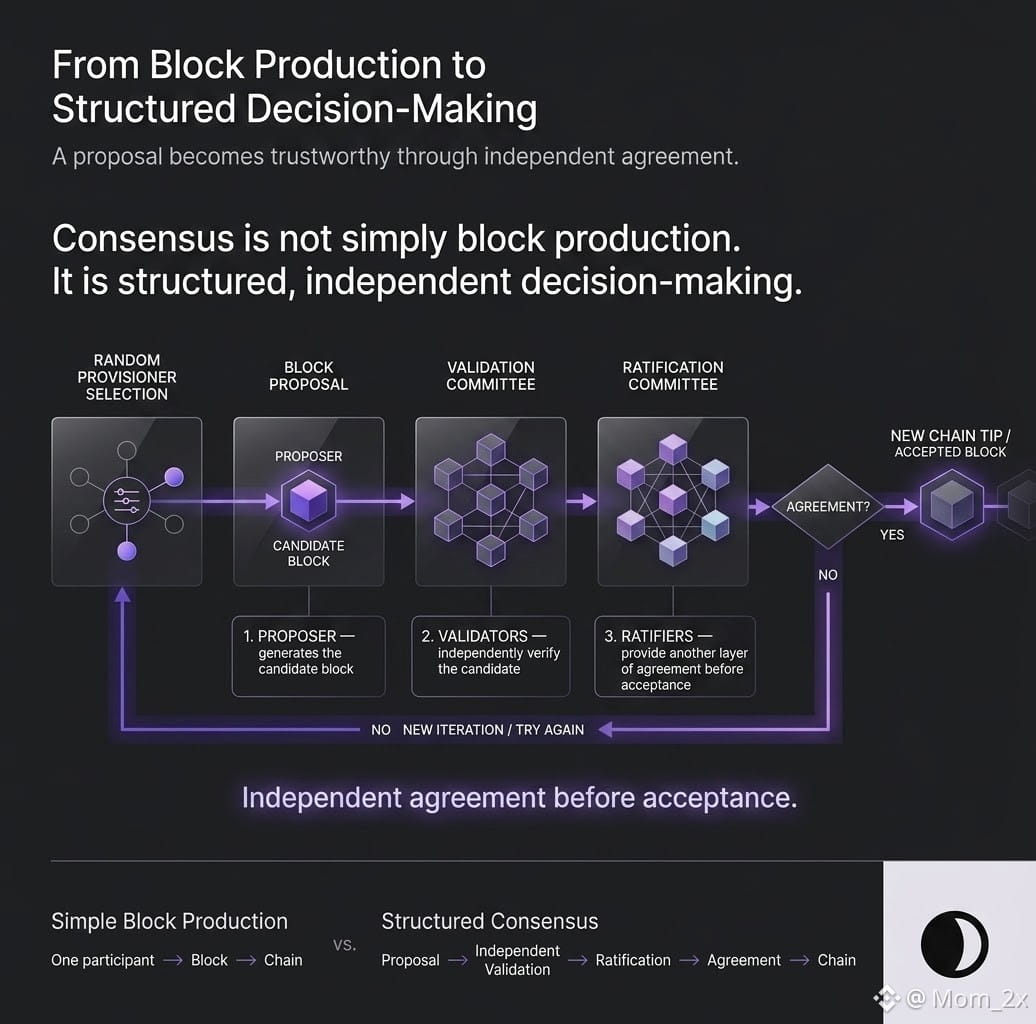
A provisioner can be randomly selected to propose a candidate block, but that proposal doesn't immediately become part of the chain. First, another committee has to validate it. Then a different committee gets involved to ratify the result.
That separation caught my attention.
It means the network isn't simply asking one participant, “Did you create a block?” It is asking different groups to independently agree that the block is valid before accepting it as the new tip.
And if agreement isn't reached, the process doesn't just force an outcome. The round can move into another iteration and try again.
For a financial network, I find that design interesting because settlement isn't only about getting an answer quickly. It's also about having enough independent agreement behind that answer to make it trustworthy.
The deeper I look, the more consensus starts to feel less like block production and more like structured decision-making.
@Dusk $DUSK #dusk
A provisioner can be randomly selected to propose a candidate block, but that proposal doesn't immediately become part of the chain. First, another committee has to validate it. Then a different committee gets involved to ratify the result.
That separation caught my attention.
It means the network isn't simply asking one participant, “Did you create a block?” It is asking different groups to independently agree that the block is valid before accepting it as the new tip.
And if agreement isn't reached, the process doesn't just force an outcome. The round can move into another iteration and try again.
For a financial network, I find that design interesting because settlement isn't only about getting an answer quickly. It's also about having enough independent agreement behind that answer to make it trustworthy.
The deeper I look, the more consensus starts to feel less like block production and more like structured decision-making.
@Dusk $DUSK #dusk