I’ll be honest, I didn’t really get the point of Dusk at first.
I used to think that if a blockchain made everything public and easy to verify, that was automatically better for finance.
Then I started digging into Dusk.
And I had to rethink that.
Think about a real financial market. Do you really want everyone seeing every investor’s position, transaction, or portfolio?
Probably not.
That’s where Dusk started making sense to me.
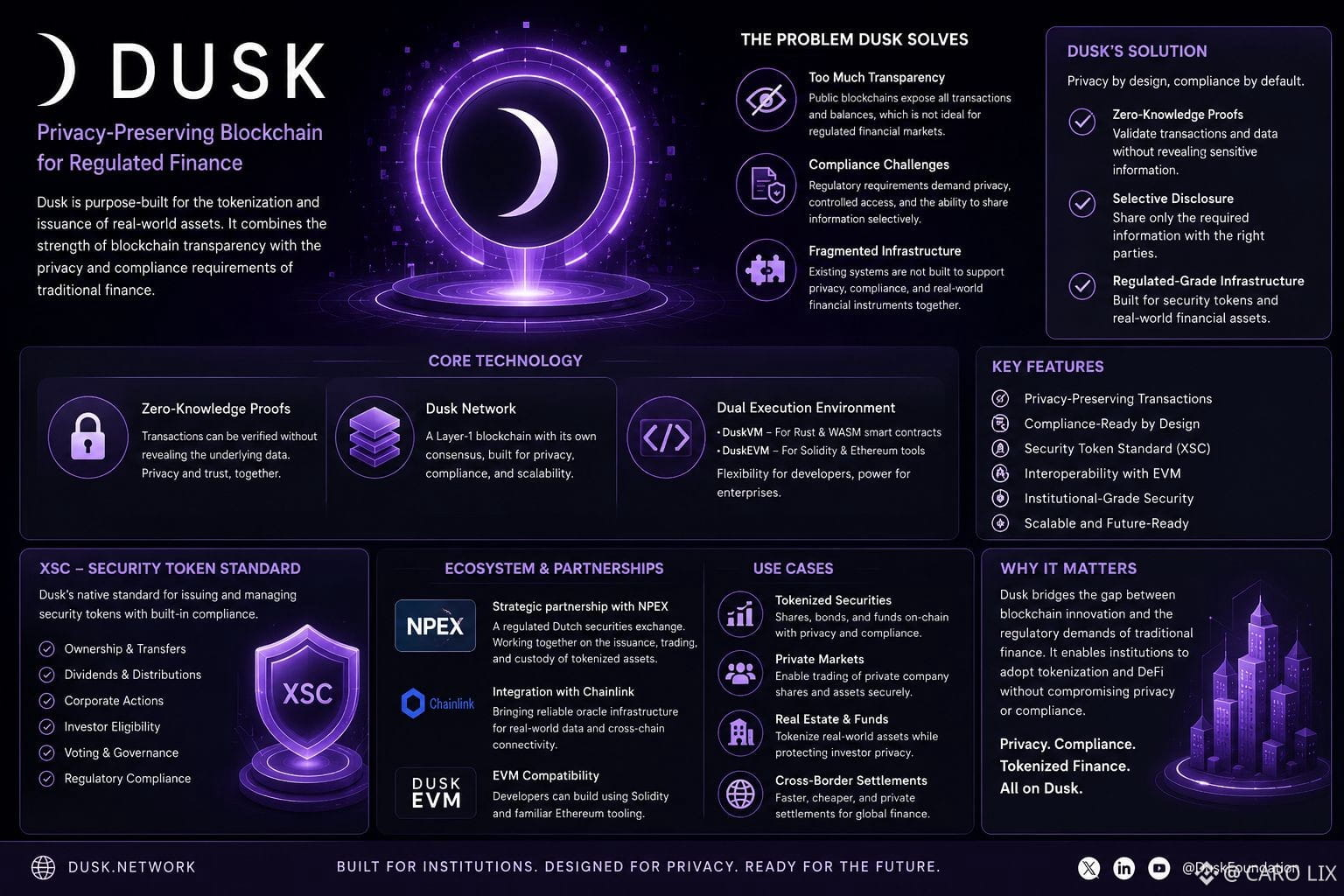
The network is built around privacy without giving up the ability to prove what matters. Zero-knowledge proofs and selective disclosure let information stay private while still allowing the necessary facts to be verified.
Then I found the XSC standard for security tokens.
This is where it got more interesting. It’s designed around real financial functions like ownership, transfers, dividends and voting, while keeping compliance in the picture.
And Dusk isn’t stopping at the protocol level.
Its work with NPEX, a regulated Dutch exchange, caught my attention because it puts the technology much closer to actual securities markets.
There’s also DuskEVM, which makes it easier for Solidity developers to build on the network.
After going through all of this, I think I finally understand where Dusk fits.
It’s not about making finance completely open.
It’s about making sensitive financial activity private when it should be private, and verifiable when it needs to be verified.
That’s the part I’m watching now.
Because if Dusk can turn that idea into real-world activity, the project becomes a lot more interesting to me.
@Dusk $DUSK #dusk
I used to think that if a blockchain made everything public and easy to verify, that was automatically better for finance.
Then I started digging into Dusk.
And I had to rethink that.
Think about a real financial market. Do you really want everyone seeing every investor’s position, transaction, or portfolio?
Probably not.
That’s where Dusk started making sense to me.
The network is built around privacy without giving up the ability to prove what matters. Zero-knowledge proofs and selective disclosure let information stay private while still allowing the necessary facts to be verified.
Then I found the XSC standard for security tokens.
This is where it got more interesting. It’s designed around real financial functions like ownership, transfers, dividends and voting, while keeping compliance in the picture.
And Dusk isn’t stopping at the protocol level.
Its work with NPEX, a regulated Dutch exchange, caught my attention because it puts the technology much closer to actual securities markets.
There’s also DuskEVM, which makes it easier for Solidity developers to build on the network.
After going through all of this, I think I finally understand where Dusk fits.
It’s not about making finance completely open.
It’s about making sensitive financial activity private when it should be private, and verifiable when it needs to be verified.
That’s the part I’m watching now.
Because if Dusk can turn that idea into real-world activity, the project becomes a lot more interesting to me.
@Dusk $DUSK #dusk