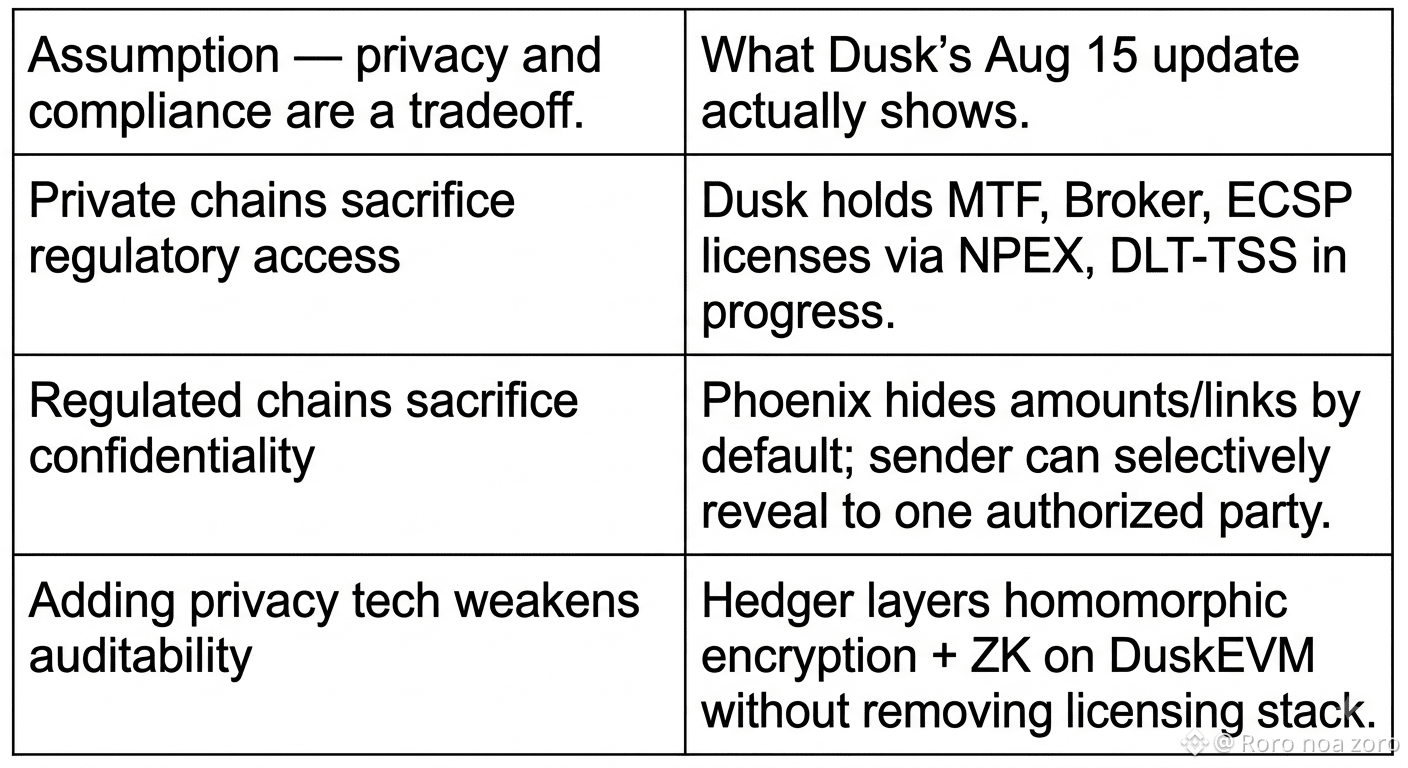
Was digging through Dusk's site update from August 15 and got stuck on one phrase — "privacy with selective disclosure." Not privacy. Not transparency. Both, deliberately paired. Dusk Network $DUSK @DuskFoundation #Dusk built Phoenix specifically so a transaction can hide amounts and links from the public while still letting the sender prove details to one authorized party on request. Hold up — that's not a compromise between privacy and compliance, that's the actual product.
The verifiable part: through the NPEX partnership Dusk now runs on an MTF license, a Broker license, an ECSP license, with a DLT-TSS license in progress — four separate regulatory permissions stacked directly into protocol behavior. Meanwhile Hedger, the newer piece for DuskEVM, adds confidential flows using homomorphic encryption plus ZK proofs on top of that. So you've got full public licensing on one side and mathematically enforced confidentiality on the other, running through the same settlement layer.#dusk $DUSK @Dusk
I kept expecting to find the seam where one undermines the other — where "auditable" quietly means "actually just public" or "private" quietly means "unregulatable." Didn't find it, at least not yet. The disclosure stays scoped to whoever needs it — a notary, a regulator, a counterparty — not the whole chain.
Still not sure that scoped-disclosure model holds once volume and legal jurisdictions multiply. Does selective disclosure stay selective at institutional scale, or does "authorized party" quietly expand until it's just transparency with extra steps?
The verifiable part: through the NPEX partnership Dusk now runs on an MTF license, a Broker license, an ECSP license, with a DLT-TSS license in progress — four separate regulatory permissions stacked directly into protocol behavior. Meanwhile Hedger, the newer piece for DuskEVM, adds confidential flows using homomorphic encryption plus ZK proofs on top of that. So you've got full public licensing on one side and mathematically enforced confidentiality on the other, running through the same settlement layer.#dusk $DUSK @Dusk
I kept expecting to find the seam where one undermines the other — where "auditable" quietly means "actually just public" or "private" quietly means "unregulatable." Didn't find it, at least not yet. The disclosure stays scoped to whoever needs it — a notary, a regulator, a counterparty — not the whole chain.
Still not sure that scoped-disclosure model holds once volume and legal jurisdictions multiply. Does selective disclosure stay selective at institutional scale, or does "authorized party" quietly expand until it's just transparency with extra steps?