🌊 SUN Is Building More Than a Deflationary Story — It Is Strengthening TRON’s DeFi Engine
The most obvious headline from the TRON ECO Q2 Value Deflation Report is the scale of token burning.
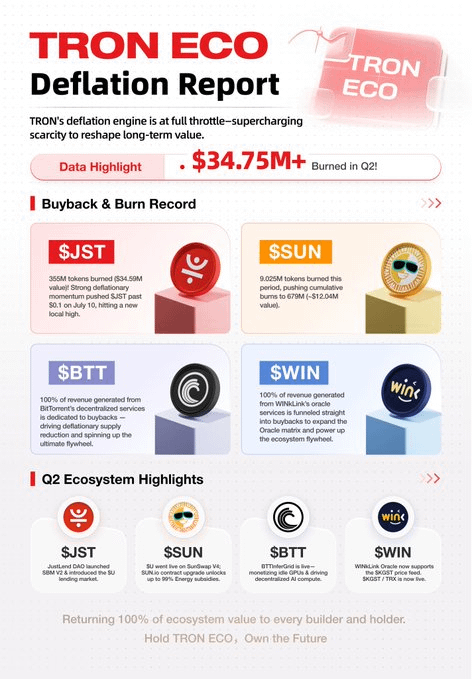
The ecosystem recorded more than $34.75 million in quarterly burns, while SUN burned approximately 9.025 million tokens during the period, bringing cumulative SUN burns to around 679 million.
But focusing exclusively on supply reduction misses another important part of the story.
SUN is also evolving as part of the infrastructure that powers DeFi activity across TRON.
And that combination—deflation + liquidity infrastructure + lower user costs—may ultimately be more important than burn numbers alone.
🏗️ DeFi Infrastructure Creates Economic Activity
Every blockchain ecosystem needs places where capital can move efficiently.
Users need liquidity.
Projects need markets.
Assets need trading pairs.
Traders need efficient execution.
That makes decentralized exchanges foundational infrastructure rather than optional products.
Within TRON, SunSwap plays that role.
As SunSwap continues evolving through V4, its strategic importance goes beyond individual feature upgrades.
A stronger DEX can contribute to deeper liquidity, more efficient markets, and greater interaction between assets throughout the ecosystem.
That activity provides the economic foundation upon which token utility can grow.
🪙 $U on SunSwap V4 Expands the Network Effect
The introduction of $U on SunSwap V4 adds another component to this expanding liquidity environment.
Every relevant asset integrated into a DEX can potentially create new routes for capital.
More routes can create more trading opportunities.
More trading activity can deepen liquidity.
And deeper liquidity can make the overall platform more attractive for both users and projects.
This is how DeFi network effects begin to compound.
A DEX with greater liquidity attracts additional users.
Additional users can attract more projects.
More projects create additional trading demand.
The result can become a reinforcing cycle.
For SUN, being positioned within that cycle creates a utility narrative that complements its deflationary mechanics.
⚡ Up to 99% Energy Subsidies Attack a Major Friction Point
DeFi adoption is often discussed in terms of yields, liquidity, and technology.
But transaction friction matters just as much.
Users notice every cost attached to an on-chain action.
They notice it when swapping.
They notice it when managing positions.
They notice it when experimenting with a new protocol.
SUN.io's energy subsidy of up to 99% directly targets this friction.
The principle is simple:
make interaction cheaper, and users have more freedom to interact.
This can be especially valuable for users who transact frequently.
It can also lower the psychological barrier for newcomers who may otherwise hesitate before performing their first few on-chain operations.
Reducing transaction friction therefore supports more than convenience.
It can contribute to ecosystem participation.
🔥 Burns Create Scarcity While Products Create Demand
This is where SUN's Q2 data becomes more interesting.
Token burns affect the supply side.
Products affect the demand side.
The healthiest token economies attempt to develop both.
If supply falls but users have no reason to interact with the ecosystem, scarcity alone has limited meaning.
If products attract activity but token supply expands indefinitely, value capture can also become more challenging.
The stronger model combines:
🔥 declining supply,
🌊 growing liquidity,
⚡ lower transaction friction,
🧩 expanding utility,
👥 and sustained user activity.
SUN's current development direction increasingly touches each of these components.
📉 Deflation Can Become a Long-Term Structural Feature
With approximately 679 million SUN already burned cumulatively, the scale of historical supply removal is becoming significant.
Another 9.025 million SUN burned during the latest reporting period continues that trajectory.
The real importance is consistency.
One large burn attracts headlines.
Repeated burns change supply structure.
Over multiple quarters, persistent deflation can progressively alter the economic profile of an asset.
That does not automatically determine market value—usage, liquidity, demand, and broader conditions still matter.
But it does create a clearly measurable scarcity mechanism that investors and ecosystem participants can monitor.
🔄 The Flywheel Looks Different From Simple Token Burning
The phrase “deflationary flywheel” becomes much more meaningful when viewed through ecosystem activity.
Consider the potential cycle:
SunSwap infrastructure improves → user activity grows → ecosystem utility expands → SUN remains economically relevant → supply continues being reduced.
Add lower energy costs and the barrier to participation falls further.
This is very different from burning tokens without building anything around them.
Infrastructure makes the deflationary mechanism part of a broader economic system.
🌐 TRON's Scale Gives the Strategy a Larger Stage
SUN does not operate in isolation.
It exists inside the wider TRON ecosystem.
That means developments around liquidity, stable assets, trading, DeFi participation, and on-chain activity can all influence the environment in which SUN.io operates.
The Q2 ecosystem burn figure of more than $34.75 million therefore provides useful context.
Deflation is occurring across a broader ecosystem strategy rather than being limited to one standalone token.
The more integrated SUN becomes with that wider economic activity, the more meaningful its own tokenomics can potentially become.
🚀 The Long-Term Question Is Whether Utility Can Compound With Scarcity
The Q2 report gives us numbers.
But the future depends on whether several trends continue reinforcing each other.
Can SunSwap attract deeper liquidity?
Can $U expand activity?
Can lower energy costs attract more users?
Can SUN.io continue improving the experience?
Can token burns remain persistent?
If those elements continue moving together, the SUN ecosystem may build something stronger than a simple deflation narrative.
It could develop a utility-driven scarcity model.
And that is a much more interesting long-term proposition.
☀️ 9.025M SUN burned this period.
🔥 Approximately 679M SUN burned cumulatively.
💰 More than $34.75M in TRON ECO Q2 ecosystem burns.
🌊 SunSwap V4 expands with $U.
⚡ Up to 99% energy subsidies through SUN.io.
Deflation is reducing supply.
Infrastructure is expanding utility.
And TRON's DeFi flywheel continues turning.