🔥 SUN’s Q2 Burn Data Shows Why Scarcity Is Becoming a Core Part of Its Tokenomics
In crypto, supply matters—but how supply changes over time can matter even more.
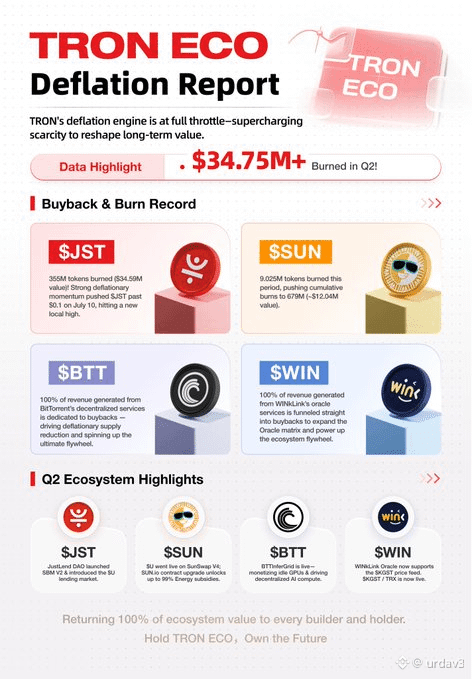
The latest TRON ECO Q2 Value Deflation Report puts this idea back in focus. According to the report, the ecosystem recorded more than $34.75 million in quarterly burns, while SUN continued advancing its own deflationary mechanism.
During the period, approximately 9.025 million SUN were burned, pushing cumulative burns to roughly 679 million SUN.
Those numbers highlight a larger question:
What happens when an ecosystem continuously removes supply while simultaneously expanding the utility surrounding its token?
☀️ Deflation Is More Powerful When It Becomes Systematic
A token burn can easily become a short-term marketing event.
A sustainable deflationary mechanism is different.
Its significance grows when supply reduction is repeated over time and connected with actual ecosystem activity.
Every additional SUN removed from circulation contributes to a progressively tighter supply structure.
The effect may appear incremental quarter by quarter, but cumulative burns are where the long-term story becomes more interesting.
With approximately 679 million SUN already burned, deflation is no longer simply a theoretical feature of the ecosystem.
It is becoming a measurable component of SUN's token economics.
🔄 The Deflationary Flywheel Needs Utility
Scarcity alone, however, does not create a healthy ecosystem.
A token also needs reasons to be used.
That is why the broader development around SUN.io and SunSwap V4 matters.
SunSwap sits at an important intersection of liquidity, trading, and on-chain user activity within the TRON ecosystem.
The introduction of $U on SunSwap V4 expands this utility layer and potentially creates more opportunities for users and liquidity to interact inside the ecosystem.
This produces a more interesting economic structure than token burning alone.
More utility can encourage more activity.
More activity can strengthen ecosystem economics.
And when that activity exists alongside continued supply reduction, the deflationary narrative gains more substance.
⚡ 99% Energy Subsidies Target the User Experience
Another important development is SUN.io's energy subsidy of up to 99%.
Blockchain users care about functionality, but they also care about friction.
If interacting with DeFi applications requires high transaction overhead, casual users may simply participate less frequently.
Reducing energy costs lowers that barrier.
For active users, even relatively small savings can become meaningful when multiplied across many transactions.
For new users, lower costs can make experimentation easier.
This is particularly relevant in DeFi, where users may perform multiple actions across swaps, liquidity operations, and other on-chain activities.
Lower friction can therefore support a broader goal: increasing the frequency and accessibility of ecosystem participation.
🌊 SunSwap V4 Adds Another Layer to the Flywheel
SunSwap V4 should also be viewed through the wider development of TRON's DeFi infrastructure.
A DEX is more than a venue where users exchange tokens.
It can become a liquidity hub.
Liquidity attracts traders.
Trading creates activity.
Activity can attract additional projects and capital.
That strengthens the surrounding ecosystem.
If SUN remains deeply connected with this infrastructure, the token's long-term story increasingly depends on the relationship between utility and scarcity.
This is where the deflationary flywheel becomes particularly interesting.
🔥 Supply is reduced.
🌊 Utility expands.
⚡ Transaction friction falls.
👥 Users gain more reasons to interact.
When those forces move together, tokenomics becomes an ecosystem mechanism rather than simply a supply statistic.
📊 679 Million Burned Is a Milestone, Not the Finish Line
The cumulative burn figure deserves attention, but it should not be viewed in isolation.
The stronger metric over time will be whether the ecosystem can maintain multiple trends simultaneously:
continued supply reduction, active liquidity, growing usage, competitive DeFi products, and an improving user experience.
That combination is much more important than any single quarterly number.
The Q2 report indicates that the deflationary side of the equation is continuing to move.
Now the long-term focus shifts toward how ecosystem expansion develops alongside it.
🚀 Scarcity Becomes Stronger When the Ecosystem Keeps Building
Crypto markets frequently talk about scarcity.
But sustainable scarcity is more interesting when it emerges alongside actual infrastructure.
SUN's evolving story increasingly combines both sides.
On one side:
🔥 Millions of SUN continue leaving supply.
On the other:
☀️ SUN.io continues expanding.
🌊 SunSwap V4 adds ecosystem functionality.
⚡ Energy subsidies reduce friction for users.
The result is a potentially stronger flywheel where tokenomics and product development reinforce each other.
A burn reduces supply.
A better product can increase usage.
Growing usage strengthens the ecosystem.
And a stronger ecosystem gives scarcity more economic relevance.
That is why the Q2 figures should be viewed as more than a burn report.
They are another data point in the evolution of SUN's broader economic design.
☀️ 902.5 million? No—9.025 million SUN burned this period. 🔥 Approximately 679 million SUN burned cumulatively. 💰 TRON ECO Q2 ecosystem burns exceeded $34.75 million. 🌊 SunSwap V4 continues expanding with $U. ⚡ SUN.io offers energy subsidies of up to 99%.
The deflationary flywheel is moving.
The bigger question is how powerful it becomes as utility continues to grow.