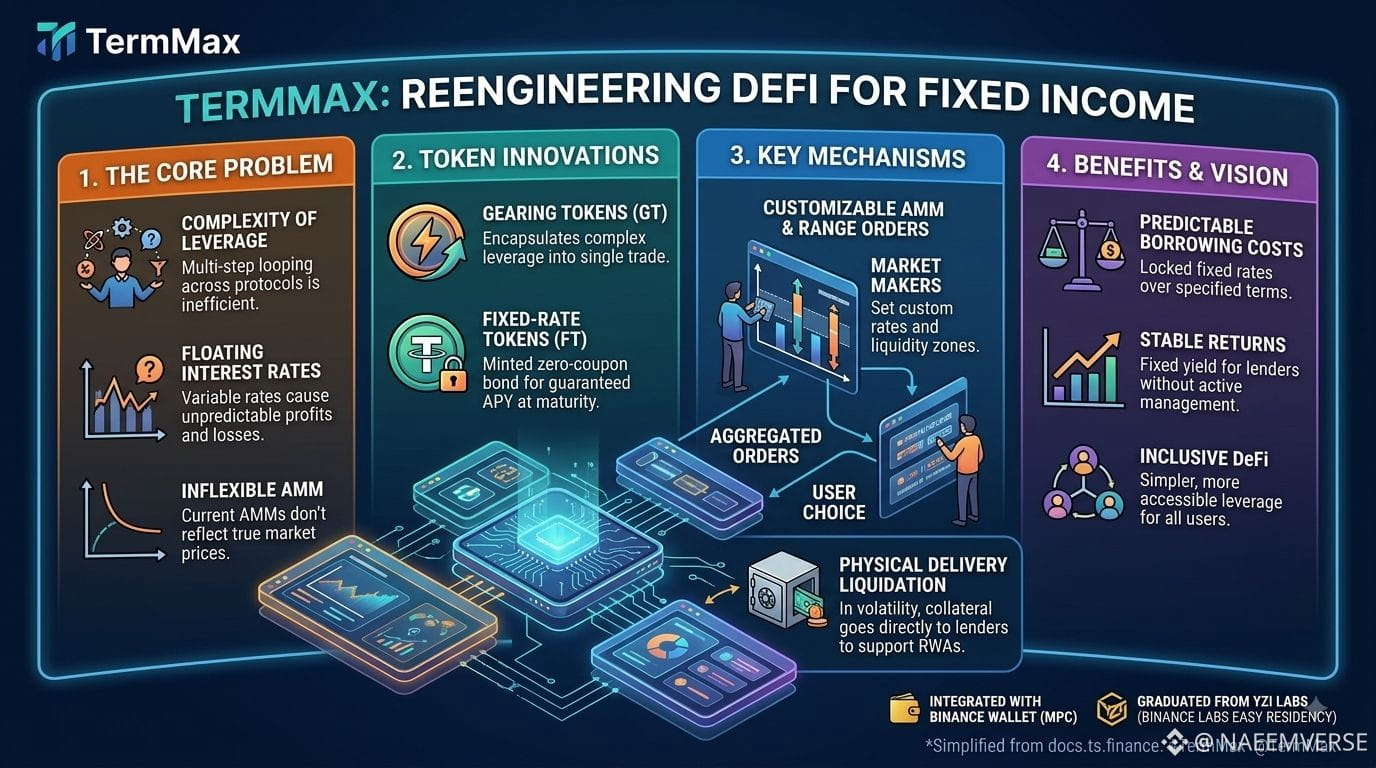
Heute bin ich tief in die offizielle Dokumentation von @TermMax (docs.ts.finance) eingetaucht, und was sie abhebt, ist nicht nur das Versprechen fester APYs – sondern wie sie das zentrale Uniswap‑V3‑AMM‑Modell neu aufgesetzt haben, um strukturelle Liquiditätsineffizienzen in DeFi zu lösen.
Die meisten traditionellen Geldmärkte drängen Nutzer in variable Zinsunsicherheit oder in komplexe Multi‑Step‑Looping‑Transaktionen über mehrere Protokolle hinweg. TermMax ändert den Status quo mit zwei zentralen Token‑Innovationen:
Gearing Tokens (GT): Die Bündelung komplexer Leverage‑ und Yield‑Strategien in einen One‑Click‑Token‑Handel.
Fixed‑Rate Tokens (FT): Das Erzeugen von Zero‑Coupon‑Schuldinstrumenten, die vorhersehbare Kreditkosten sowie feste Renditen bis zur Fälligkeit garantieren.
Was mich beim Architektur‑Breakdown wirklich beeindruckt hat, ist ihr anpassbares AMM mit Range Orders. Market Maker können Range Orders über verschiedene Märkte hinweg konfigurieren. Aggregiert ergibt das, dass Taker vollständige Freiheit haben, sich zu den bevorzugten, stark zugeschnittenen Zinssätzen zu leihen oder zu verleihen – und slippage‑Probleme zu vermeiden, die bei Festlaufzeit‑Pools häufig auftreten.
Zusätzlich ist ihr Mechanismus für die physische Lieferung im Liquidationsfall ein großer Sicherheitsfortschritt für nicht standardmäßige Sicherheiten (inklusive RWAs und Assets mit geringerer Liquidität). Dadurch erhalten Kreditgeber direkte Sicherheitenlieferungen während Tail‑Risk‑Volatilität, statt sich auf fehlerhafte Liquidations‑Auktionen verlassen zu müssen.
Mit einem DeFiSafety‑PQR‑Score von 93%, kontinuierlichem Hypernative‑On‑Chain‑Monitoring und dem Abschluss/der Graduation von YZi Labs (Binance Labs EASY Residency Season 3) ist $TMX nicht nur dabei, einen weiteren Lending‑Pool zu bauen – sie errichten die grundlegende Fixed‑Income‑Schicht für Web3.
Bin ich neugierig, ob automatisierte Range‑Order‑AMMs in diesem Jahr offiziell die herkömmlichen Utilization Curves ersetzen werden?
#TermMax @TermMax
Die meisten traditionellen Geldmärkte drängen Nutzer in variable Zinsunsicherheit oder in komplexe Multi‑Step‑Looping‑Transaktionen über mehrere Protokolle hinweg. TermMax ändert den Status quo mit zwei zentralen Token‑Innovationen:
Gearing Tokens (GT): Die Bündelung komplexer Leverage‑ und Yield‑Strategien in einen One‑Click‑Token‑Handel.
Fixed‑Rate Tokens (FT): Das Erzeugen von Zero‑Coupon‑Schuldinstrumenten, die vorhersehbare Kreditkosten sowie feste Renditen bis zur Fälligkeit garantieren.
Was mich beim Architektur‑Breakdown wirklich beeindruckt hat, ist ihr anpassbares AMM mit Range Orders. Market Maker können Range Orders über verschiedene Märkte hinweg konfigurieren. Aggregiert ergibt das, dass Taker vollständige Freiheit haben, sich zu den bevorzugten, stark zugeschnittenen Zinssätzen zu leihen oder zu verleihen – und slippage‑Probleme zu vermeiden, die bei Festlaufzeit‑Pools häufig auftreten.
Zusätzlich ist ihr Mechanismus für die physische Lieferung im Liquidationsfall ein großer Sicherheitsfortschritt für nicht standardmäßige Sicherheiten (inklusive RWAs und Assets mit geringerer Liquidität). Dadurch erhalten Kreditgeber direkte Sicherheitenlieferungen während Tail‑Risk‑Volatilität, statt sich auf fehlerhafte Liquidations‑Auktionen verlassen zu müssen.
Mit einem DeFiSafety‑PQR‑Score von 93%, kontinuierlichem Hypernative‑On‑Chain‑Monitoring und dem Abschluss/der Graduation von YZi Labs (Binance Labs EASY Residency Season 3) ist $TMX nicht nur dabei, einen weiteren Lending‑Pool zu bauen – sie errichten die grundlegende Fixed‑Income‑Schicht für Web3.
Bin ich neugierig, ob automatisierte Range‑Order‑AMMs in diesem Jahr offiziell die herkömmlichen Utilization Curves ersetzen werden?
#TermMax @TermMax