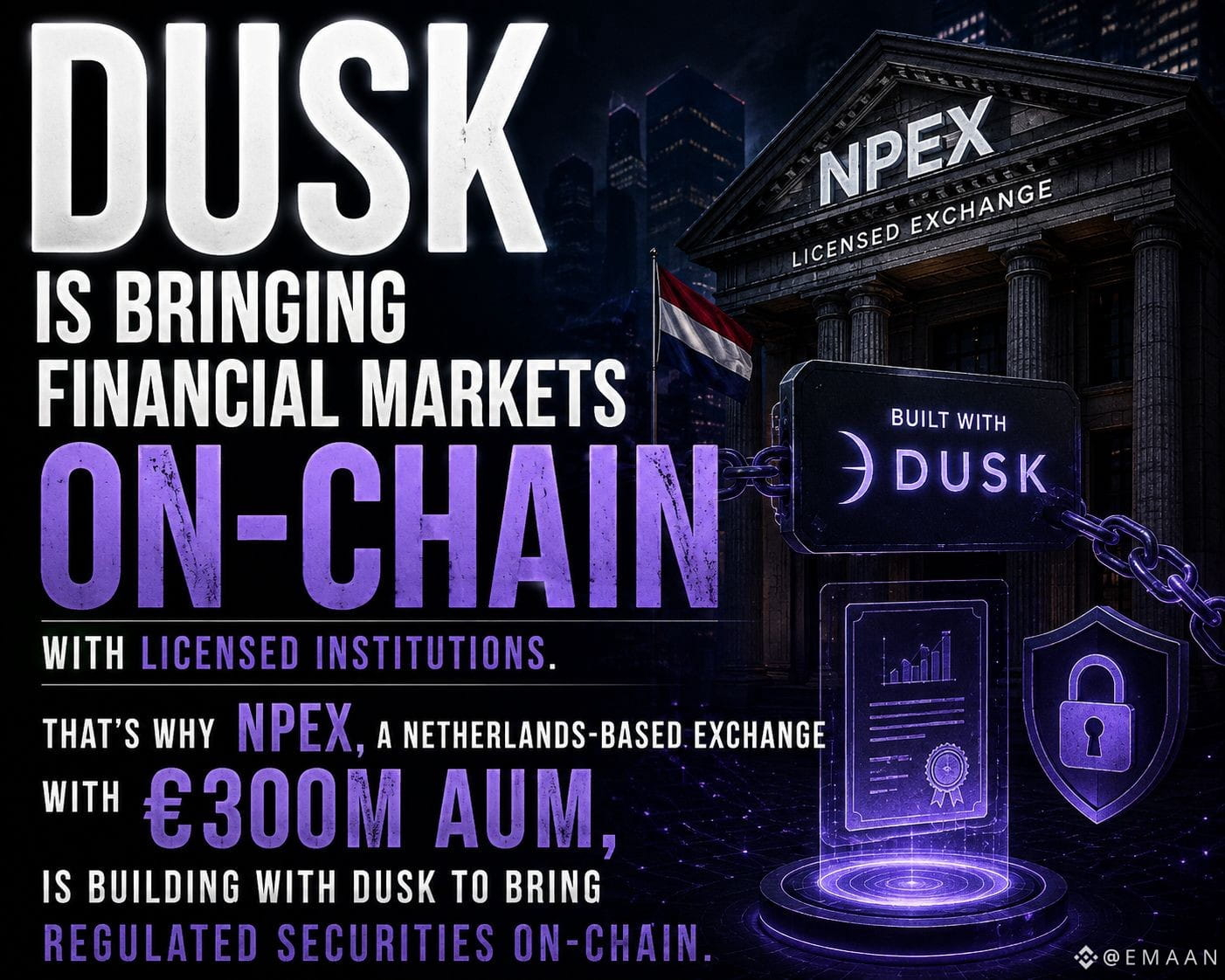
I keep thinking about the part of this story that sounds almost too sensible: regulated securities, licensed institutions, a real exchange, €300M in assets under management. NPEX building with Dusk feels very different from the usual crypto promise where everyone is pretending liquidity will arrive just because the chain can process transactions.
And maybe that is exactly why I’m hesitating.
I’ve watched enough cycles to know that putting an asset on-chain doesn’t automatically make the market underneath it better. The ugly parts usually survive. Custody doesn’t disappear. Compliance doesn’t disappear. Liquidity doesn’t appear on command. Sometimes the blockchain just gives the old machinery a new surface.
What happens when somebody actually wants out at the wrong time? Who is sitting on the other side of the trade when volume is thin? How much friction sits between an investor holding a regulated security and turning that position back into something spendable? I keep coming back to user inertia too. People tolerate clunky systems when money is moving easily. They tolerate them much less when markets freeze.
NPEX having €300M AUM makes the experiment more interesting to me, not less. There is actual financial weight here, which also means actual expectations. Institutional users don’t usually forgive broken flows just because the architecture is elegant.
I remember older cycles where the story was always strongest before the first real stress test. The pitch survived until liquidity dried up, incentives changed, or everyone discovered that the exit was more complicated than the entry.
I can’t tell yet whether Dusk is removing those old problems or simply forcing them into clearer view. Maybe that is the detail bothering me most. Regulated assets on-chain sound cleaner. Live markets rarely are.
#dusk $DUSK @Dusk
And maybe that is exactly why I’m hesitating.
I’ve watched enough cycles to know that putting an asset on-chain doesn’t automatically make the market underneath it better. The ugly parts usually survive. Custody doesn’t disappear. Compliance doesn’t disappear. Liquidity doesn’t appear on command. Sometimes the blockchain just gives the old machinery a new surface.
What happens when somebody actually wants out at the wrong time? Who is sitting on the other side of the trade when volume is thin? How much friction sits between an investor holding a regulated security and turning that position back into something spendable? I keep coming back to user inertia too. People tolerate clunky systems when money is moving easily. They tolerate them much less when markets freeze.
NPEX having €300M AUM makes the experiment more interesting to me, not less. There is actual financial weight here, which also means actual expectations. Institutional users don’t usually forgive broken flows just because the architecture is elegant.
I remember older cycles where the story was always strongest before the first real stress test. The pitch survived until liquidity dried up, incentives changed, or everyone discovered that the exit was more complicated than the entry.
I can’t tell yet whether Dusk is removing those old problems or simply forcing them into clearer view. Maybe that is the detail bothering me most. Regulated assets on-chain sound cleaner. Live markets rarely are.
#dusk $DUSK @Dusk