
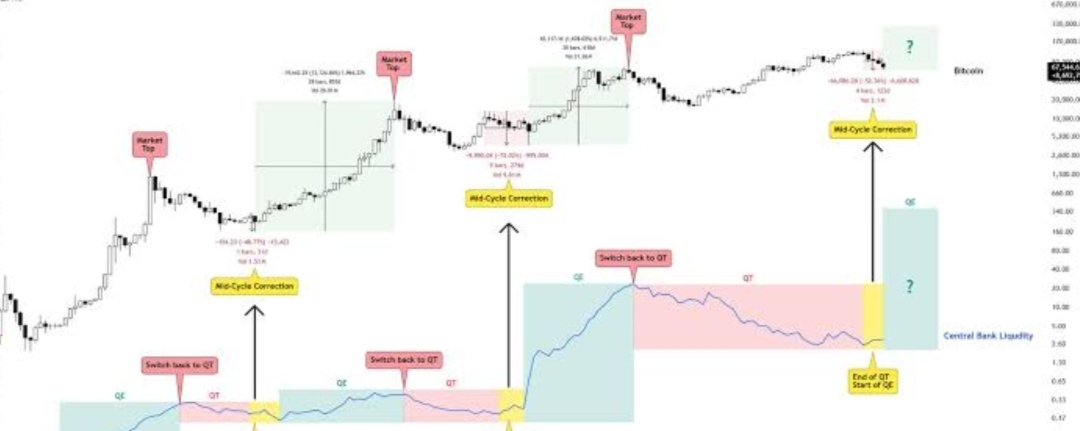

Crypto liquidity is changing, and I think looking only at Bitcoin or altcoin prices misses the bigger story.
Capital isn’t simply entering or leaving crypto anymore. It is moving between stablecoins, Bitcoin, tokenized real-world assets, DeFi infrastructure and other parts of the on-chain economy.
The real question is: where is the money positioning itself next?
Stablecoins Are Becoming the Center of Crypto Liquidity
The first place I’m watching is stablecoins.
Stablecoins have evolved far beyond being temporary parking spots between trades. They are increasingly being used for payments, settlement, DeFi and moving money across blockchain networks.
The Federal Reserve reported that stablecoin market capitalization grew by roughly 50% during 2025, while transaction volume and DeFi usage also increased. The BIS now describes stablecoins as the dominant medium of exchange within the crypto ecosystem.
I think this matters because stablecoin liquidity can provide the fuel for future market rotations. The important question is what holders decide to do with that capital.
Real-World Assets Are Absorbing More Capital
One destination becoming increasingly difficult to ignore is tokenized real-world assets.
Tokenized Treasuries, private credit, commodities and investment funds allow capital to remain on-chain while gaining exposure to traditional financial assets.
Recent research from The Block estimated the broader RWA landscape, including stablecoins, at more than $730 billion, with significant growth over the previous year.
To me, this suggests crypto liquidity is becoming more sophisticated. Investors no longer have to choose only between holding stablecoins or buying volatile tokens.
They can increasingly put capital into yield-generating assets without completely leaving blockchain rails.
Tokenization Could Create a New Liquidity Highway
This is where the story becomes even bigger.
Tokenization is beginning to connect traditional markets directly with blockchain infrastructure. Stocks, bonds, funds and other assets could increasingly become accessible through on-chain systems.
In August, reporting highlighted ongoing efforts around tokenized securities and the possibility of blockchain infrastructure supporting more continuous trading and faster settlement.
I believe this could eventually change what we mean by “crypto liquidity.”
Instead of capital moving only between BTC, ETH, stablecoins and altcoins, we could see liquidity move between crypto assets and tokenized traditional assets within the same broader ecosystem.
DeFi May Benefit From the Next Phase
DeFi could become one of the biggest beneficiaries if these liquidity pools begin connecting.
Imagine stablecoins being used for settlement, tokenized Treasuries being used as collateral and decentralized markets providing lending or trading infrastructure around those assets.
That would be very different from the speculative DeFi boom of previous cycles.
However, there is still a gap between tokenization and actual DeFi liquidity. Earlier 2026 data showed that much of the tokenized RWA market remained isolated from permissionless DeFi.
I’m watching whether that gap begins closing.
Institutional Capital Is Changing the Game
Another major shift is the growing connection between traditional finance and crypto infrastructure.
For example, Citadel Securities invested $400 million in Crypto.com in July at a reported $20 billion valuation, with expansion into areas including tokenized securities and derivatives among the plans discussed around the deal.
Moves like this tell me institutions aren't looking at crypto only as a collection of speculative coins.
They are increasingly interested in the infrastructure surrounding digital assets.
That distinction could become extremely important for the next market cycle.
Bitcoin Still Matters
None of this means Bitcoin suddenly becomes irrelevant.
Bitcoin remains one of the biggest destinations for crypto capital and often acts as the market's primary risk indicator. When uncertainty rises, liquidity can concentrate around BTC and stablecoins instead of spreading across smaller assets.
But I think the next major liquidity expansion could become broader than simply “Bitcoin pumps, then altcoins pump.”
Capital now has far more places to go.
Altcoins May Need to Compete Harder for Liquidity
This creates an interesting problem for altcoins.
There are thousands of tokens competing for investor attention, but investors can now choose between Bitcoin, stablecoins, DeFi, tokenized assets and increasingly sophisticated blockchain-based financial products.
That means simply having a strong narrative may not be enough.
I think projects capable of attracting actual users, stablecoin liquidity, developers and sustainable economic activity could have an advantage when capital begins rotating again.
The Next Rotation Could Look Different
Previous crypto cycles often followed a familiar pattern: Bitcoin moves first, Ethereum follows, large-cap altcoins gain strength and eventually speculation spreads toward smaller tokens.
I wouldn't assume the next cycle will follow exactly the same path.
The growing importance of stablecoins and RWAs suggests some liquidity may stay inside more productive or lower-volatility on-chain assets rather than immediately rotating into speculative altcoins. At the same time, regulated stablecoin initiatives continue expanding; a Standard Chartered-backed venture began rolling out a Hong Kong dollar stablecoin to institutional and professional users this month.
That makes liquidity flows more complicated—but also more interesting.
Where I’m Watching the Money
I’m paying close attention to stablecoin growth, Bitcoin demand, RWA expansion, DeFi activity and institutional participation.
If stablecoin liquidity expands while Bitcoin demand strengthens, risk appetite could be returning.
If RWA and tokenized-market activity keeps growing even while speculative tokens remain weak, that could signal something different: crypto may be evolving from a speculation-first market toward financial infrastructure.
That could be one of the biggest transformations of this cycle.
The next major opportunity may not simply come from finding the coin with the loudest narrative.
I think the bigger edge will come from understanding where liquidity is quietly moving before the rest of the market notices.