

I mean actually.....
When someone first starts trading, there is usually a temptation to learn everything at once.
Indicators, patterns, signals, moving averages, RSI, MACD, Fibonacci, different strategies..... the list keeps growing.
But honestly, trading doesn’t have to start that complicated.
Before adding ten different indicators to a chart, I think it makes more sense to understand what price itself is doing. That’s where Price Action comes in.
Price action is basically the study of how price moves on a chart. Instead of depending completely on indicators, you learn to look at support, resistance, trends, breakouts, candles and, most importantly, how much risk you are taking.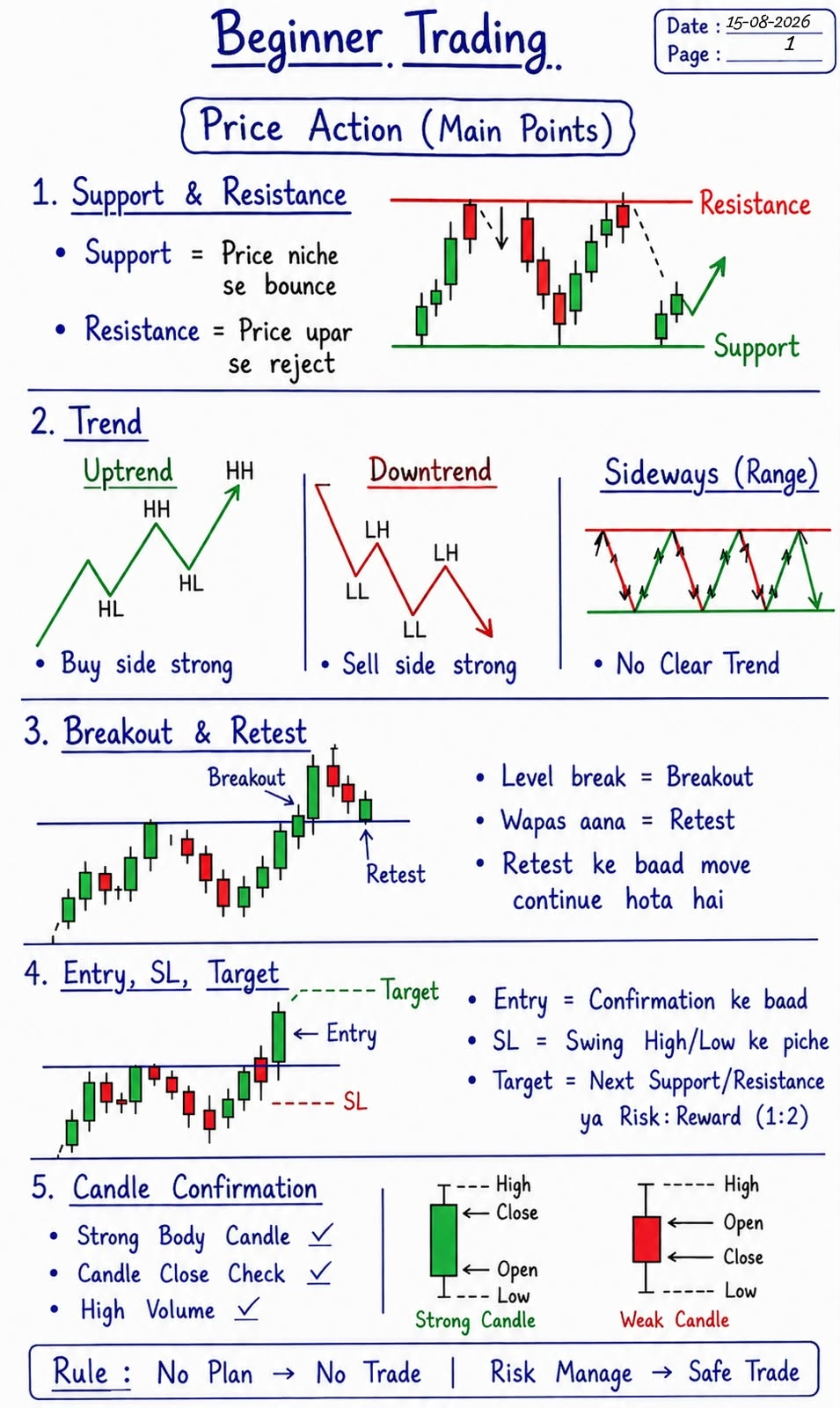
So, if you’re completely new to trading, these are the areas I would focus on first.
1. Support and Resistance
Support is an area where price has previously found buying interest and struggled to move lower.
Resistance is the opposite. It is an area where selling pressure has appeared and price has struggled to move higher.
The important thing is not to treat these levels like exact lines carved into the chart. Price can move slightly above or below them.
Think of them more as zones.
For example, if BTC repeatedly reacts around a certain price area, that level becomes worth watching. If price approaches it again, you already have some context instead of making a random decision.
2. Understand the Trend
Before thinking about an entry, ask a simple question:
What is the market actually doing?
An uptrend generally creates higher highs and higher lows.
A downtrend creates lower highs and lower lows.
And sometimes... the market is simply going sideways.
That last one is easy to ignore.
Traders often feel like they have to trade every move, but a sideways market can produce a lot of confusing signals. Sometimes the better decision is just waiting for clearer direction.
3. Breakout and Retest
A breakout happens when price moves through an important support or resistance area.
But here’s where beginners often get caught.
Seeing a candle break a level does not automatically mean price will continue in that direction.
This is why the retest can matter.
Price may break resistance, come back to test that previous resistance area, and then continue higher if buyers remain in control.
It doesn’t happen every time, of course. That’s the point. Trading is about probabilities, not guarantees.
4. Entry, Stop Loss and Target
A trade should not begin with only one question:
“Where do I enter?”
There are actually three things to think about.
Where will I enter?
Where will I accept that the idea is wrong?
And where am I planning to take profit?
That second question is especially important.
A stop loss is not something you add after entering because the trade started moving against you. It should be part of the setup from the beginning.
If you don’t know where your setup becomes invalid, you probably don’t have a complete trade plan yet.
5. Candle Confirmation
Candles tell you a small story about what happened between buyers and sellers during a specific period.
A strong rejection, a large body, an engulfing candle or a failed breakout can sometimes provide useful confirmation.
But I wouldn’t look at one candle in isolation.
Context matters.
A bullish candle at an important support zone can mean something very different from the exact same candle appearing in the middle of nowhere.
So instead of asking, “What pattern is this?”
Try asking:
“Where did this candle appear, and what was price doing before it?”
That question can change how you read a chart.
6. Risk Management Comes First
This is probably the part beginners understand last, even though it should come first.
A good setup can still fail.
A great-looking breakout can fail.
Even a trade that looks almost perfect can go the other way.
That is normal.
The goal isn't to make every trade profitable. The goal is to make sure one bad trade doesn't damage your account badly enough that you cannot continue.
Position size, stop loss and risk per trade all matter.
You don't need to risk a huge percentage of your account just because you feel confident about a setup.
Confidence and risk should not be the same thing.
The Real Skill Is Patience
The more charts you watch, the more you realize that there is always another setup coming.
You don't need to catch every move.
Sometimes the best trade is the one you don't take because the setup wasn't clear enough.
So before entering any position, take a moment and ask:
What is the trend?
Where are the important levels?
What confirms the setup?
Where is my stop loss?
Where is my target?
How much am I risking if I'm wrong?
If you can't answer those questions, maybe the trade isn't ready yet.
And that's completely fine.
Trading is not a race. The goal isn't to trade more. The goal is to make better decisions over time.
No Plan → No Trade
Manage Risk → Protect Your Capital
Learn the basics, keep reviewing them, and give yourself time to understand how price behaves.
Consistency doesn't come from finding one magical strategy.
It usually comes from learning, patience, discipline and managing risk properly.