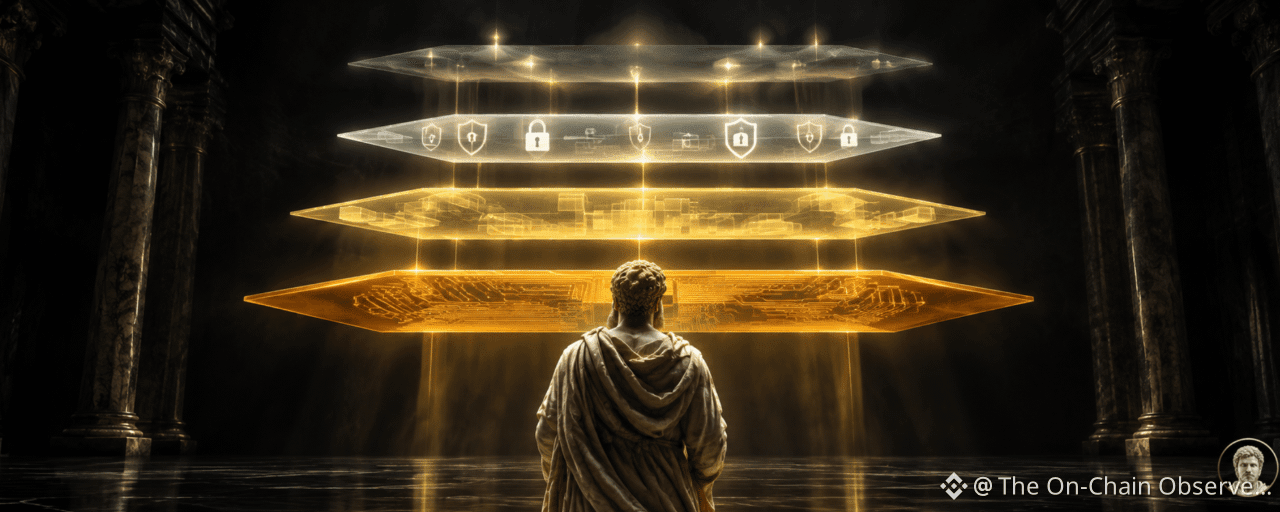
What kept changing every time I thought I understood the "privacy chain" label
As a Web3 research analyst, RWA is my field. I went into @Dusk expecting a privacy pitch. Weeks later, after going through the architecture, the tokenomics, on-chain behavior, and the community's own sharpest critiques of it, I don't think "privacy chain" was ever the right description. It's closer to: a chain trying to solve four separate trust problems — settlement, execution, compliance, and privacy — as four separate layers instead of one bundled promise.
Two settlement models, not one. Moonlight handles ordinary public, account-based transactions. Phoenix sits beside it, handling shielded transfers — same network, same settlement guarantees, different visibility depending on what the transaction actually needs. Privacy here isn't the default state everything falls into. It's a choice made per transaction.
Consensus that admits finality isn't instant. Succinct Attestation uses small, randomly selected committees per block — one provisioner proposes, one committee validates, another ratifies — chosen through stake-weighted sortition so the same validators aren't running every round. A block moves through accepted → attested → confirmed → final, with soft penalties for missed participation and hard slashing reserved for real violations. For securities, "probably settled" and "cryptographically settled" being different stages isn't overengineering — though I'll admit, whether the average user needs to see all four stages, versus just Dusk handling that complexity invisibly, is a genuinely open UX question nobody's answered yet.
Phoenix's real trick is the edge cases, not the headline feature. It replaces account balances with notes sealed inside a Merkle tree; spending one publishes a nullifier and a ZK proof instead of pointing to which note moved. A view key lets an authorized party see exactly what they're permitted to, without touching spending power. What separates this from a superficial privacy layer is that it accounts for refunds, fees, change, and public-to-shielded transitions — precisely where weaker systems leak fingerprints even while hiding the "real" transaction.
Compliance is proof, not disclosure. A regulator can verify a rule was followed — eligibility, ownership limits, transfer restrictions — without seeing the raw transaction behind it. Most "compliant" chains fake this by making everything public and calling that transparency compliance, which quietly defeats privacy's purpose. Citadel handles identity specifically — proving residency, age, or accreditation without exposing the underlying documents — kept separate from asset rules, which are kept separate from Phoenix's transaction privacy, which is kept separate from disclosure. Four distinct problems, not one KYC checkbox. What none of this answers: who controls the rule that grants eligibility, and whether a cryptographic promise is ever enough for a regulator who wants more.
That last point connects to something I underestimated at first — the idea that different privacy chains aren't separated by how much they hide, but by where privacy sits in the system. Treating it as a bolted-on feature versus building it alongside access control and settlement from day one produces very different systems, even if both call themselves "private." And more privacy doesn't automatically mean less friction for users — that's a separate, unproven assumption.
Execution is two engines with one settlement guarantee — plus a privacy layer built specifically for the EVM side. DuskVM runs Rust/WASM contracts natively on Wasmtime. DuskEVM is a separate OP Stack-based environment for Solidity developers, settling through the same DuskDS layer. Sitting on top of DuskEVM is Hedger — a privacy engine combining homomorphic encryption (ElGamal) and zero-knowledge proofs, built specifically because most DeFi privacy tools rely on ZK alone; Hedger keeps balances and transfers confidential while remaining auditable, with in-browser proof generation reportedly under two seconds. It's been live in public alpha testing since November 2025. On top of that stack sits Dusk Trade — formerly STOX — an application layer for tokenized bonds, ETFs, money-market funds, and other regulated assets, working alongside NPEX's broker license for compliance. The stated goal underneath all of it is native issuance: moving an asset's actual lifecycle on-chain, not just wrapping something held elsewhere in a token.
There's a strategic read on the two-execution-environment design worth sitting with: DuskEVM lowers the entry cost for teams already in the Solidity world; DuskVM offers a path toward native capability once they're in. "Compatibility gets developers in. Capability keeps them there." That's a real conversion funnel most single-VM chains don't have — but it cuts both ways. Two environments can just as easily split liquidity and developer attention if they end up feeling like separate ecosystems instead of complementary layers. Raw deployment counts won't tell you which outcome is happening. Migration behavior, cross-environment asset flow, and whether existing applications deepen their usage over time will.
Staking runs deeper than validator security. The minimum stake is 1,000 DUSK, activating after roughly one to two epochs. The same token secures consensus, pays gas, and — as applications land on DuskEVM and DuskVM — potentially sits underneath a wider range of economic activity than staking alone. Stake Abstraction lets smart contracts themselves participate in staking, which could eventually make automated staking strategies native to the ecosystem rather than something built entirely outside it. Notably, Dusk's own framing has moved: its November 2024 whitepaper update centered on Moonlight-plus-Phoenix as the core story; by June 2025, the company was describing a three-layer architecture — DuskDS, DuskEVM, DuskVM — as the foundation. The shift itself says something: even Dusk stopped describing this as a privacy chain with extras and started describing it as settlement infrastructure with privacy built in.
And here's a distinction that reframes almost everything above: privacy and institutional readiness are not the same conversation. Privacy hides exposure. Institutional readiness means hidden activity can still be reviewed when required, without anyone manually stepping outside the system to prove it. Some on-chain observation has pointed to clusters of large, evenly spaced transactions with no visible amounts — consistent with confidential, institutional-style workflows running through the same execution layer as everything else, rather than a separate bolted-on process. I'd treat that as a pattern worth watching rather than confirmed evidence — isolated activity and early organic adoption look identical from the outside until you see whether it repeats, and whether more than one counterparty starts using the same pathway.
That's really the crux of everything I found: the engineering keeps answering "can this be trusted." Nothing answers "will anyone actually use it." Those are different questions, and only measuring the right things closes that gap — not headline deployment counts or announcement volume, but recurrence of activity, growth in distinct participants, and the ratio of real economic usage to staking-and-infrastructure activity. Right now, that ratio isn't visible from the outside, and even close observers say so openly.
The token still has to answer to arithmetic regardless of how good the architecture is. DUSK peaked at $1.17 in 2021 and trades roughly 94% below that today, near $0.06, with a market cap a little over $30M. Early vesting wrapped up in 2022 — no unlock cliff — but 500M more DUSK emits over the next 36 years, roughly halving every four years, mostly rewarding stakers, with fees currently folding into block rewards rather than any burn. That supply keeps flowing whether or not real volume shows up. Good design translating into adoption is not automatic — it only happens when incentives are strong enough to actually change behavior, and right now that's still theoretical.
Weeks of research left me somewhere I didn't expect. Dusk isn't a privacy chain wearing a compliance costume — it's one of the most carefully layered pieces of financial infrastructure I've looked at in RWA this year, built with real institutional partnerships (NPEX) behind it. But careful architecture and proven demand are two separate achievements, and only one of them shows up in a price chart.
⚠️ Not financial advice. DYOR.