
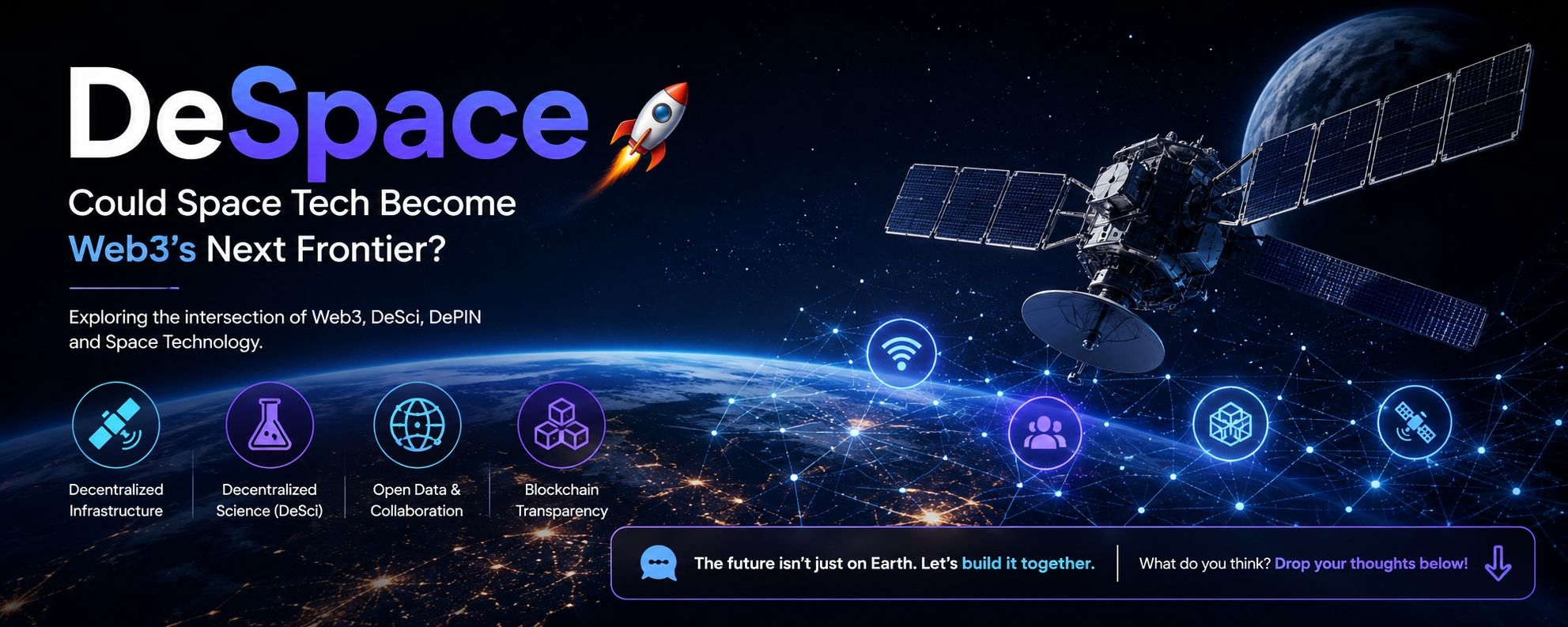
While crypto attention often revolves around memecoins, AI and DeFi, another interesting narrative is developing at the intersection of Web3, DeSci, DePIN and space technology.
This emerging idea is often referred to as DeSpace — using decentralized networks, blockchain infrastructure and token-based coordination to explore new ways of building and funding space-related infrastructure.
Here are a few areas worth watching 👇
1️⃣ Blockchain Meets Space Infrastructure 🛰️
Blockchain isn’t just being discussed in theory.
NASA has explored blockchain-based architectures for satellite constellations, including applications for distributed data exchange, communication coordination and tracking mission events. Research has also examined blockchain for secure satellite-to-satellite communications.
The bigger idea: blockchain could potentially provide a shared coordination and verification layer for increasingly complex space networks.
2️⃣ DePIN Goes Beyond the Ground 🌍📡
DePIN — Decentralized Physical Infrastructure Networks — uses blockchain-based incentives to coordinate physical infrastructure such as connectivity, computing, storage and sensors.
That concept is now reaching the space sector.
Projects such as Spacecoin are exploring decentralized satellite connectivity using blockchain-enabled satellites and a DePIN-style model. Spacecoin says its network is designed around permissionless participation and low-Earth-orbit infrastructure.
3️⃣ Space Data Could Become More Open 🪐
Satellites generate enormous amounts of valuable data — from Earth observation to communications and scientific research.
Blockchain could potentially help with data provenance, verification, access control and coordination between different participants.
That doesn't mean every piece of satellite data needs to be stored on-chain. Instead, blockchain may serve as a coordination and verification layer alongside existing space infrastructure.
4️⃣ DeSci + Space Research 🔬🚀
DeSci aims to make scientific funding, collaboration, data sharing and research more open and accessible.
Combining these principles with space research could eventually create new models for funding experiments, coordinating contributors and distributing scientific data.
💡 The Bigger Picture
The interesting part isn't simply putting “crypto” into space.
It's whether decentralized infrastructure can solve real problems around:
🔹 Coordination
🔹 Data verification
🔹 Infrastructure ownership
🔹 Global participation
🔹 Scientific collaboration
🔹 Satellite connectivity
We're still early, and many of these ideas are experimental.
But as blockchain moves further into DePIN, DeSci and real-world infrastructure, space technology could become one of the most unexpected areas to watch.
🚀 Could DeSpace become a major Web3 narrative in the next few years — or is it still too early?
What do you think? 👇