Most EVM applications treat transparency as a feature. But in institutional finance, that assumption starts to break down.
DeFi works well with public balances and transactions. Institutions often need something different: proving a trade is valid without exposing the entire portfolio, balance sheet, or counterparties.
That’s where DuskEVM gets interesting.
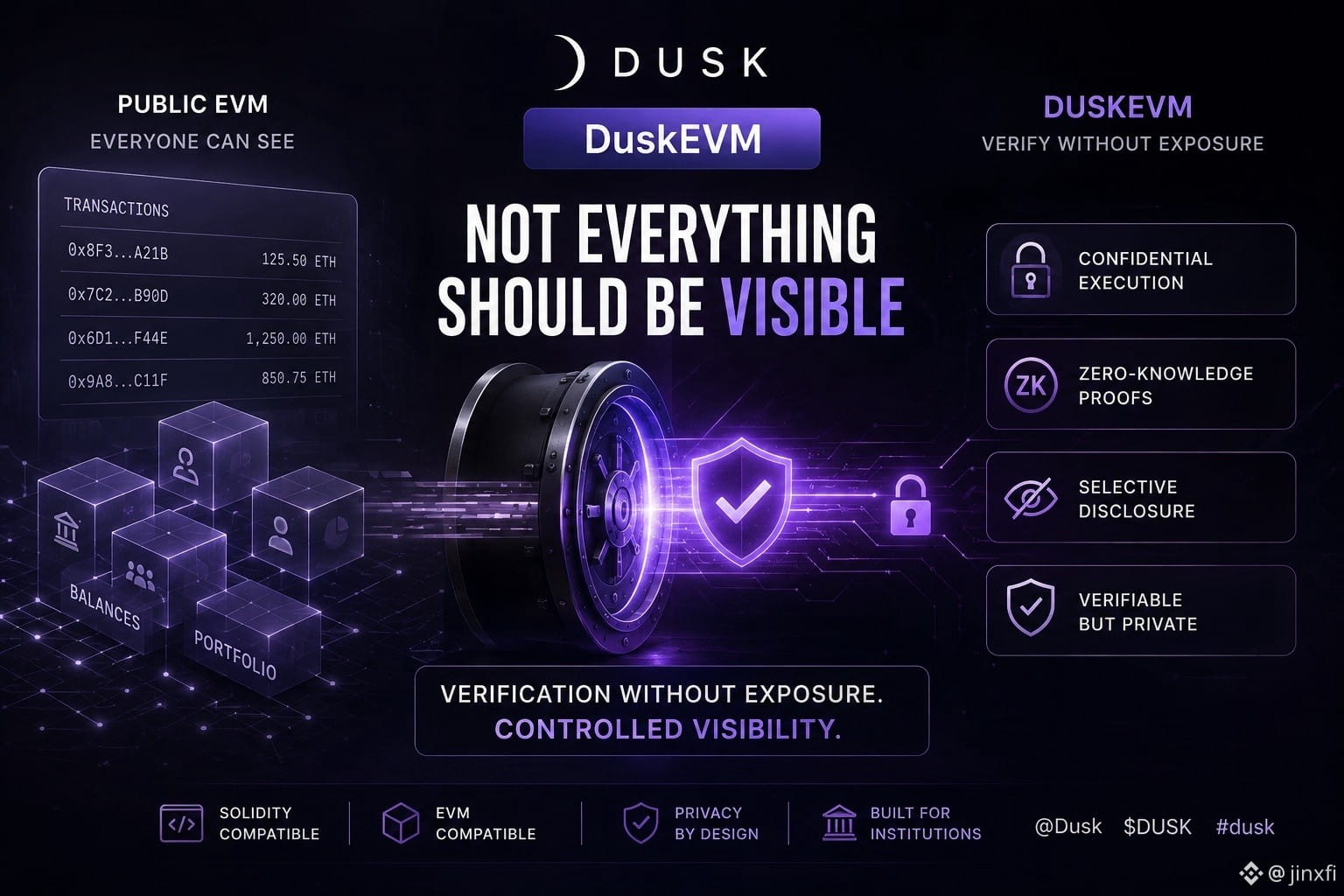
Dusk keeps the familiar Solidity and EVM environment while using confidential execution, encryption, and zero-knowledge proofs to separate verification from visibility.
The network can verify that the rules were followed without forcing everyone to see the underlying data.
That distinction matters.
Privacy doesn’t have to mean sacrificing verification. It can mean controlling who sees what while keeping the state provable.
The real challenge is making proof generation, performance, integration, and selective disclosure work reliably at scale.
As tokenized assets and institutional blockchain adoption grow, the question may not be whether financial data should be onchain.
It may be how much of that data actually needs to be visible.
The next EVM design problem might not be execution.
It might be controlled visibility.
@Dusk $DUSK #dusk
DeFi works well with public balances and transactions. Institutions often need something different: proving a trade is valid without exposing the entire portfolio, balance sheet, or counterparties.
That’s where DuskEVM gets interesting.
Dusk keeps the familiar Solidity and EVM environment while using confidential execution, encryption, and zero-knowledge proofs to separate verification from visibility.
The network can verify that the rules were followed without forcing everyone to see the underlying data.
That distinction matters.
Privacy doesn’t have to mean sacrificing verification. It can mean controlling who sees what while keeping the state provable.
The real challenge is making proof generation, performance, integration, and selective disclosure work reliably at scale.
As tokenized assets and institutional blockchain adoption grow, the question may not be whether financial data should be onchain.
It may be how much of that data actually needs to be visible.
The next EVM design problem might not be execution.
It might be controlled visibility.
@Dusk $DUSK #dusk