
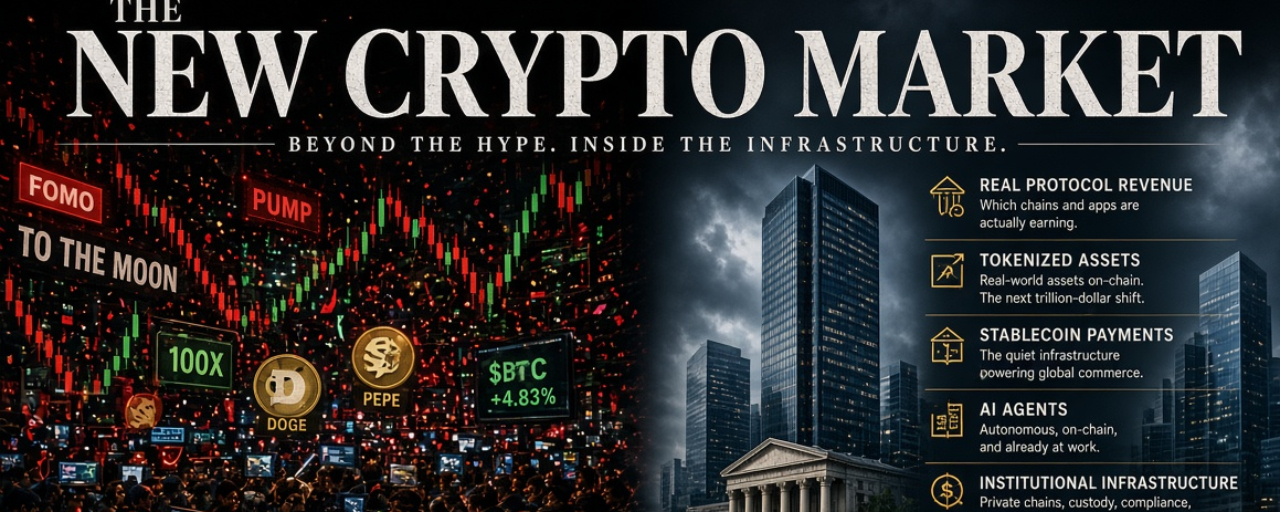
Crypto has always been a market driven by narratives.
DeFi.
NFTs.
AI.
Memecoins.
Layer-2s.
RWA.
Every cycle creates a new story capable of attracting billions of dollars.
But something interesting is happening in the current market.
Investors are becoming more selective.
The question is slowly changing from:
“How big could this narrative become?”
to:
“How much economic activity does this protocol actually generate?”
That change could have major consequences for altcoins.
💰 Revenue Is Becoming a New Metric
A token can have millions of followers.
A huge community.
A powerful brand.
And still have very little economic activity.
On the other hand, a smaller protocol can quietly generate substantial fees through actual usage.
Hyperliquid is an interesting example.
Recent reporting highlighted strong fee generation, although its weekly fees have shown signs of cooling.
That creates a much more interesting framework for valuation.
Instead of simply asking how popular a project is, traders can ask:
How much activity does it generate?
How much revenue does that activity create?
Does the token capture any of that value?
These questions are becoming increasingly important.
🔓 Token Unlocks Are Another Part of the Equation
Today is also an interesting day for Arbitrum.
A scheduled token unlock on August 15 creates additional supply, meaning traders have to consider potential selling pressure alongside demand.
But an unlock isn't automatically bearish.
If demand is strong enough, the market can absorb new supply.
That's why experienced traders don't simply read:
“Token unlock = sell.”
They examine:
Unlock size + market liquidity + trading volume + holder behavior.
That combination tells a much better story.
💵 Stablecoins Keep Building the Infrastructure
Stablecoins may be one of the least exciting parts of crypto from a speculative perspective.
But they could become one of the most important.
Why?
Because digital finance needs a stable unit of account.
Stablecoins can provide liquidity for trading, collateral for DeFi, and settlement for payments.
TRON remains an important network to watch in this area, while its upcoming mandatory network upgrade on August 16 adds a near-term catalyst for traders.
The bigger story is not necessarily TRX's short-term price.
It's the growing importance of stablecoin infrastructure itself.
🔗 RWA Needs Reliable Data
Tokenized stocks, funds, bonds and other real-world assets are gaining attention.
But tokenization creates another problem:
How does blockchain know what is happening in the real world?
That's where oracle infrastructure becomes important.
Price feeds.
Interest rates.
Market information.
Asset verification.
Proof of reserves.
All of these require reliable external data.
This is why projects such as Chainlink remain relevant to the broader RWA narrative.
The more traditional assets move on-chain, the more important reliable data becomes.
🤖 And Then There Is AI
The AI narrative is different.
It isn't simply about putting AI branding on a token.
The more interesting concept is autonomous economic agents.
Imagine an AI system capable of:
Managing a crypto wallet
Searching for liquidity
Executing trades
Paying for computing
Using DeFi applications
Interacting with other AI agents
That could create an entirely new category of blockchain user.
NEAR is one ecosystem exploring the intersection between AI and blockchain infrastructure.
If AI agents become economically active, blockchain could provide the financial rails they need.
📊 My Trader Framework for August
For me, the market is becoming easier to understand if we divide projects into four categories:
1. Revenue
Does the protocol actually generate economic activity?
2. Liquidity
Can capital enter and exit efficiently?
3. Catalysts
Are there upgrades, unlocks, listings or institutional developments approaching?
4. Adoption
Are real users actually using the network?
The strongest projects don't necessarily score perfectly in all four categories.
But the combination can reveal where the market is becoming increasingly interesting.
🎯 Final Market View
The crypto market doesn't need another hundred narratives.
It needs real users, real liquidity and real economic activity.
That's why I believe the next stage of the market could increasingly reward projects with measurable fundamentals rather than projects surviving purely on social-media attention.
The market may still produce explosive speculative moves.
That's crypto.
But underneath the volatility, a more mature financial system is being built.
Revenue.
Infrastructure.
Tokenization.
Stablecoins.
AI.
These are the areas I'm watching.
Not because every project will succeed.
But because these sectors are attempting to solve problems that exist beyond crypto itself.
#CryptoMarket #Altcoins #DeFi #RWA #ArtificialIntelligence

In the quiet hours of dawn, a focused crypto analyst sits alone in a dimly lit research room, the city skyline glowing softly through the window behind him. Multiple transparent holographic screens float around his desk, illuminating the space with cool blue protocol revenue charts climbing steadily, token unlock schedules, surging stablecoin flows mapped across the globe, network activity metrics, an AI adoption narrative, and a detailed liquidity heatmap. Notebooks, papers, and a steaming mug rest on the wooden desk beside his laptop, capturing the serious, investigative mood of financial journalism as he contemplates the real infrastructure shaping the future of crypto.