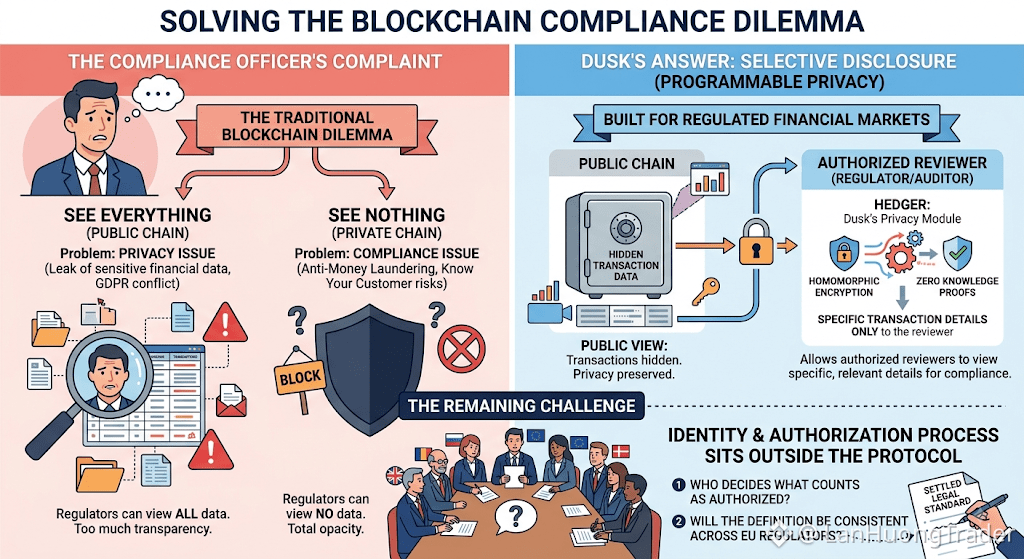
Every compliance officer I've ever heard describe blockchain has the same complaint: either they can see everything, which is a privacy problem, or they can see nothing, which is a compliance problem. Dusk's answer to that complaint is selective disclosure. Dusk is a Layer 1 blockchain built for regulated financial markets, and its model rests on privacy where needed, transparency where useful, selective disclosure for authorized review, and deterministic settlement, delivering what Dusk describes as programmable privacy for regulated markets. Much of that selective disclosure runs through Hedger, Dusk's privacy module for EVM, which uses homomorphic encryption and zero knowledge proofs so an authorized reviewer, a regulator or auditor, can see transaction details that stay hidden from the public.
What I find genuinely useful about this framing is that it doesn't ask a regulator to trust the chain blindly. It gives them a defined path to review specific data instead of either full exposure or full opacity.
I'd also flag that selective disclosure only works as well as the identity and authorization checks sitting underneath it. A cryptographic mechanism that lets an authorized party view specific data is only as trustworthy as the process that decided who counts as authorized in the first place, and that process sits outside the protocol entirely, inside whatever legal and compliance framework each individual partner brings to the relationship.
What it doesn't answer, at least not yet in public materials, is who decides what counts as authorized, and whether that definition holds consistently across different EU regulators. A technical mechanism for selective disclosure is not the same as a settled legal standard for who gets to use it, and that part is still being written, likely case by case as partners come online.
#dusk $DUSK @Dusk $ACE
What I find genuinely useful about this framing is that it doesn't ask a regulator to trust the chain blindly. It gives them a defined path to review specific data instead of either full exposure or full opacity.
I'd also flag that selective disclosure only works as well as the identity and authorization checks sitting underneath it. A cryptographic mechanism that lets an authorized party view specific data is only as trustworthy as the process that decided who counts as authorized in the first place, and that process sits outside the protocol entirely, inside whatever legal and compliance framework each individual partner brings to the relationship.
What it doesn't answer, at least not yet in public materials, is who decides what counts as authorized, and whether that definition holds consistently across different EU regulators. A technical mechanism for selective disclosure is not the same as a settled legal standard for who gets to use it, and that part is still being written, likely case by case as partners come online.
#dusk $DUSK @Dusk $ACE