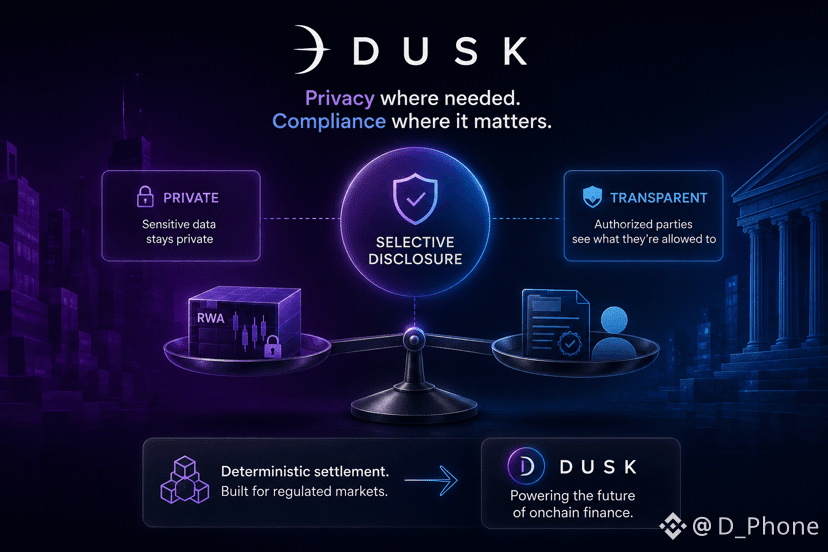
Most chains treat privacy as an all or nothing switch. Dusk doesn't. Dusk is a Layer 1 blockchain built for regulated financial markets, and its entire design rests on combining programmable privacy with compliance rather than picking one over the other. On Dusk, privacy applies where it's needed, transparency stays where it's useful, selective disclosure exists for authorized review, and settlement happens deterministically, a combination built for tokenized real world assets and regulated securities, and one meant to eventually carry native issuance workflows that move more of a security's lifecycle onchain once institutions and venues have the authorization required. DUSK is the native token powering this network.
I keep coming back to one question when I look at RWA projects: who actually gets to see what, and when? Most attempts either expose everything on a public ledger, which no institution wants, or hide everything behind permissioned walls, which defeats the point of using a blockchain at all. Dusk's answer sits in between, letting an issuer keep transaction details private from the public while still allowing a regulator or auditor to review what they're authorized to see. It's a narrower, harder problem than pure privacy or pure transparency, and narrower problems tend to be the ones that actually ship.
There's also a governance layer to this worth sitting with. Selective disclosure needs someone to define what counts as authorized in practice, and that definition will likely differ by jurisdiction and by asset type. Dusk can build the cryptographic machinery. It still needs regulators and institutions to agree on how that machinery gets used before privacy where needed becomes routine practice rather than a technical option.
None of this guarantees adoption. A settlement layer is only as useful as the assets and institutions that choose to settle on it, and that part isn't something Dusk controls alone.
@Dusk #dusk $DUSK $AKE $BTW
I keep coming back to one question when I look at RWA projects: who actually gets to see what, and when? Most attempts either expose everything on a public ledger, which no institution wants, or hide everything behind permissioned walls, which defeats the point of using a blockchain at all. Dusk's answer sits in between, letting an issuer keep transaction details private from the public while still allowing a regulator or auditor to review what they're authorized to see. It's a narrower, harder problem than pure privacy or pure transparency, and narrower problems tend to be the ones that actually ship.
There's also a governance layer to this worth sitting with. Selective disclosure needs someone to define what counts as authorized in practice, and that definition will likely differ by jurisdiction and by asset type. Dusk can build the cryptographic machinery. It still needs regulators and institutions to agree on how that machinery gets used before privacy where needed becomes routine practice rather than a technical option.
None of this guarantees adoption. A settlement layer is only as useful as the assets and institutions that choose to settle on it, and that part isn't something Dusk controls alone.
@Dusk #dusk $DUSK $AKE $BTW