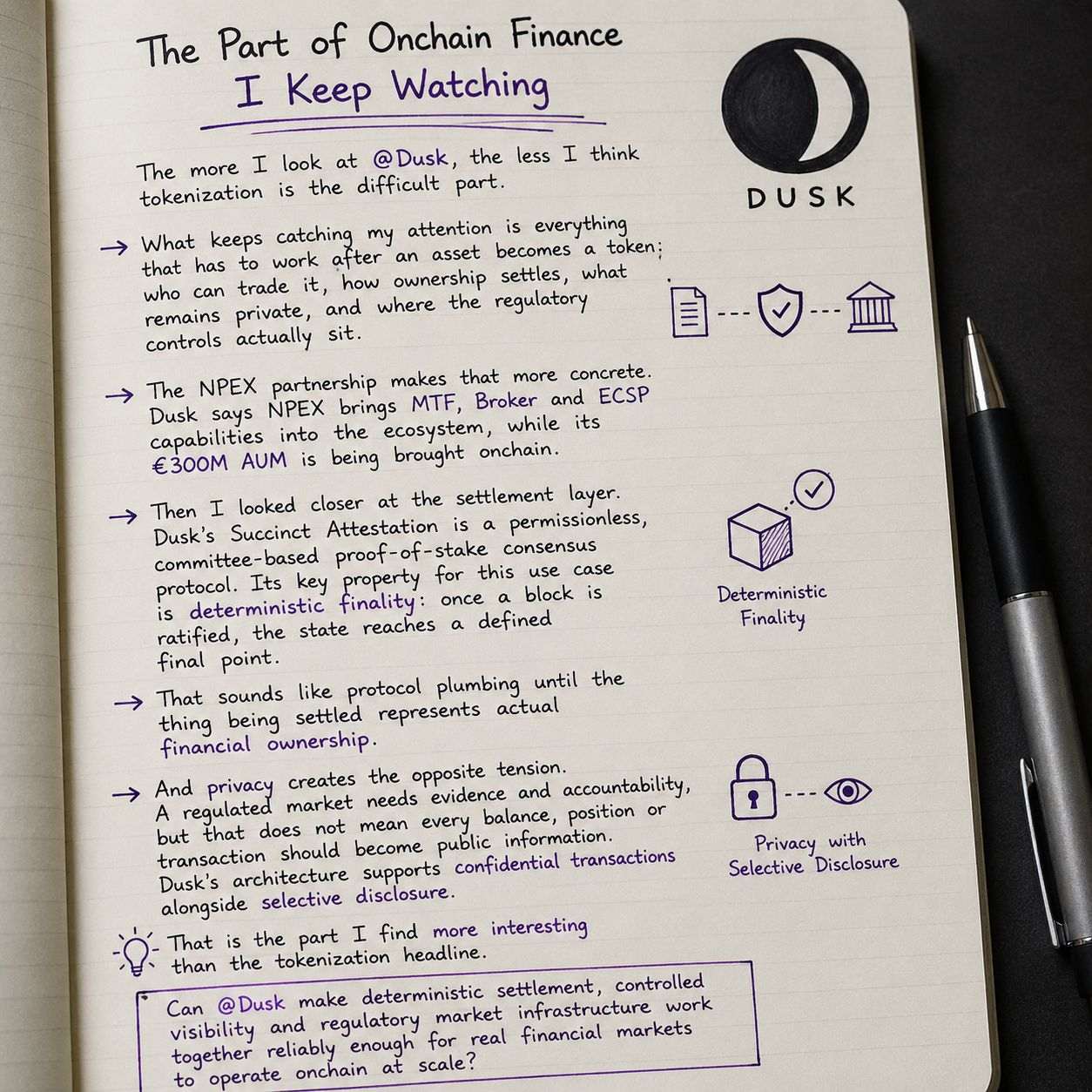
The Part of Onchain Finance I Keep Watching
The more I look at @Dusk , the less I think tokenization is the difficult part.
What keeps catching my attention is everything that has to work after an asset becomes a token: who can trade it, how ownership settles, what remains private, and where the regulatory controls actually sit.
The NPEX partnership makes that more concrete. Dusk says NPEX brings MTF, Broker and ECSP capabilities into the ecosystem, while its €300M AUM is being brought onchain.
Then I looked closer at the settlement layer.
Dusk’s Succinct Attestation is a permissionless, committee-based proof-of-stake consensus protocol. Its key property for this use case is deterministic finality: once a block is ratified, the state reaches a defined final point.
That sounds like protocol plumbing until the thing being settled represents actual financial ownership.
And privacy creates the opposite tension. A regulated market needs evidence and accountability, but that does not mean every balance, position or transaction should become public information. Dusk’s architecture supports confidential transactions alongside selective disclosure.
That is the part I find more interesting than the tokenization headline.
Can @Dusk make deterministic settlement, controlled visibility and regulatory market infrastructure work together reliably enough for real financial markets to operate onchain at scale?
#dusk $DUSK
The more I look at @Dusk , the less I think tokenization is the difficult part.
What keeps catching my attention is everything that has to work after an asset becomes a token: who can trade it, how ownership settles, what remains private, and where the regulatory controls actually sit.
The NPEX partnership makes that more concrete. Dusk says NPEX brings MTF, Broker and ECSP capabilities into the ecosystem, while its €300M AUM is being brought onchain.
Then I looked closer at the settlement layer.
Dusk’s Succinct Attestation is a permissionless, committee-based proof-of-stake consensus protocol. Its key property for this use case is deterministic finality: once a block is ratified, the state reaches a defined final point.
That sounds like protocol plumbing until the thing being settled represents actual financial ownership.
And privacy creates the opposite tension. A regulated market needs evidence and accountability, but that does not mean every balance, position or transaction should become public information. Dusk’s architecture supports confidential transactions alongside selective disclosure.
That is the part I find more interesting than the tokenization headline.
Can @Dusk make deterministic settlement, controlled visibility and regulatory market infrastructure work together reliably enough for real financial markets to operate onchain at scale?
#dusk $DUSK