

The European Central Bank’s 2026 Study on the Use of Cash by Companies in the Euro Area examines how businesses across the euro area accept and use cash, how they compare it with digital payment methods, and how cash infrastructure is evolving. The study covers companies in retail, restaurants and cafes, hotels, and arts, entertainment and recreation across all 21 euro area countries.
The report finds that cash remains a widely accepted payment method despite the continued growth of digital payments. In 2026,
92% of companies selling goods or services at physical locations said they accept cash, up from 90% in 2024.
Physical cards were accepted by 88% of companies, while
mobile payment acceptance rose sharply from 36% in 2024 to 68% in 2026.
Cash acceptance varies significantly across countries and sectors.
Greece and Italy recorded the highest cash acceptance rates among euro area SMEs at 99%, while
Belgium and Cyprus had the lowest rates, at 81% and 76%, respectively.
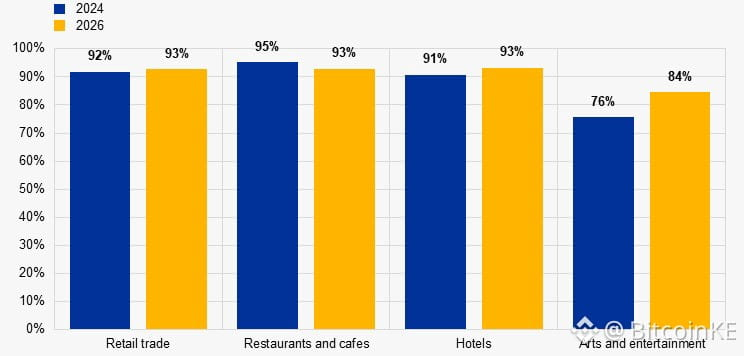
Retailers, restaurants and hotels had an overall cash acceptance rate of 93%, compared with
84% for arts, entertainment and recreation businesses.
Of all companies selling goods online in 2026,
82% accept payment cards and
74% accept credit transfers .
Only a very small share of companies (0.2%) accept crypto-assets.
The ECB also found that cash is likely to remain part of the payment mix.
Among companies that currently accept cash, 92% said they plan to continue accepting it over the next five years. Companies that reject cash most commonly cited low customer demand and the inconvenience or difficulty of depositing and withdrawing cash as reasons.
Businesses have mixed preferences over payment methods.
One-third of companies have no preference for how customers pay at physical locations, while
24% prefer debit cards,
21% prefer cash, and
14% prefer credit cards.
Companies generally rated cash more favourably than digital payments for privacy and reliability as well as for factors such as overall costs, transaction speed, ease of handling, and security.
The study also highlights the continued modernization of cash infrastructure.
Around 13% of companies have introduced self-checkout terminals, with
more than half of those businesses operating at least some self-checkouts that accept cash. Meanwhile,
38% have introduced cash registers at the point of payment and
37% have smart safes.
Bank counters remain the most common method for both withdrawing and depositing cash.
Overall, the ECB study suggests that the shift toward digital payments has not eliminated the role of cash for businesses. Instead, cash and digital payment methods are increasingly operating alongside each other with businesses balancing customer preferences, cost, security, reliability, and operational convenience when deciding which payment methods to accept.
Source: European Central Bank, Use of cash by companies in the euro area in 2026. Read the full ECB report.
REALITY CHECK | Why Cash Still Dominates Many African Economies
Stay tuned to BitKE updates on digital payments globally
Join our WhatsApp channel here.
Follow us on X for the latest posts and updates
Join and interact with our Telegram community
_________________