
Most copy trading setups on $SOL solve exactly half the problem. They put you in the same token as the wallet you follow, then leave you holding a position with no rule for getting out.
That second half is where the money goes. Entries are mechanical and repeatable. Exits are judgement, and on a mirrored trade the judgement is still yours.
The entry is the part software is genuinely good at
A copy trade setup watches an address and reacts when it buys. Everything you contribute happens before that, at configuration time: which wallet, how much per trade, what size of token you are willing to touch at all.
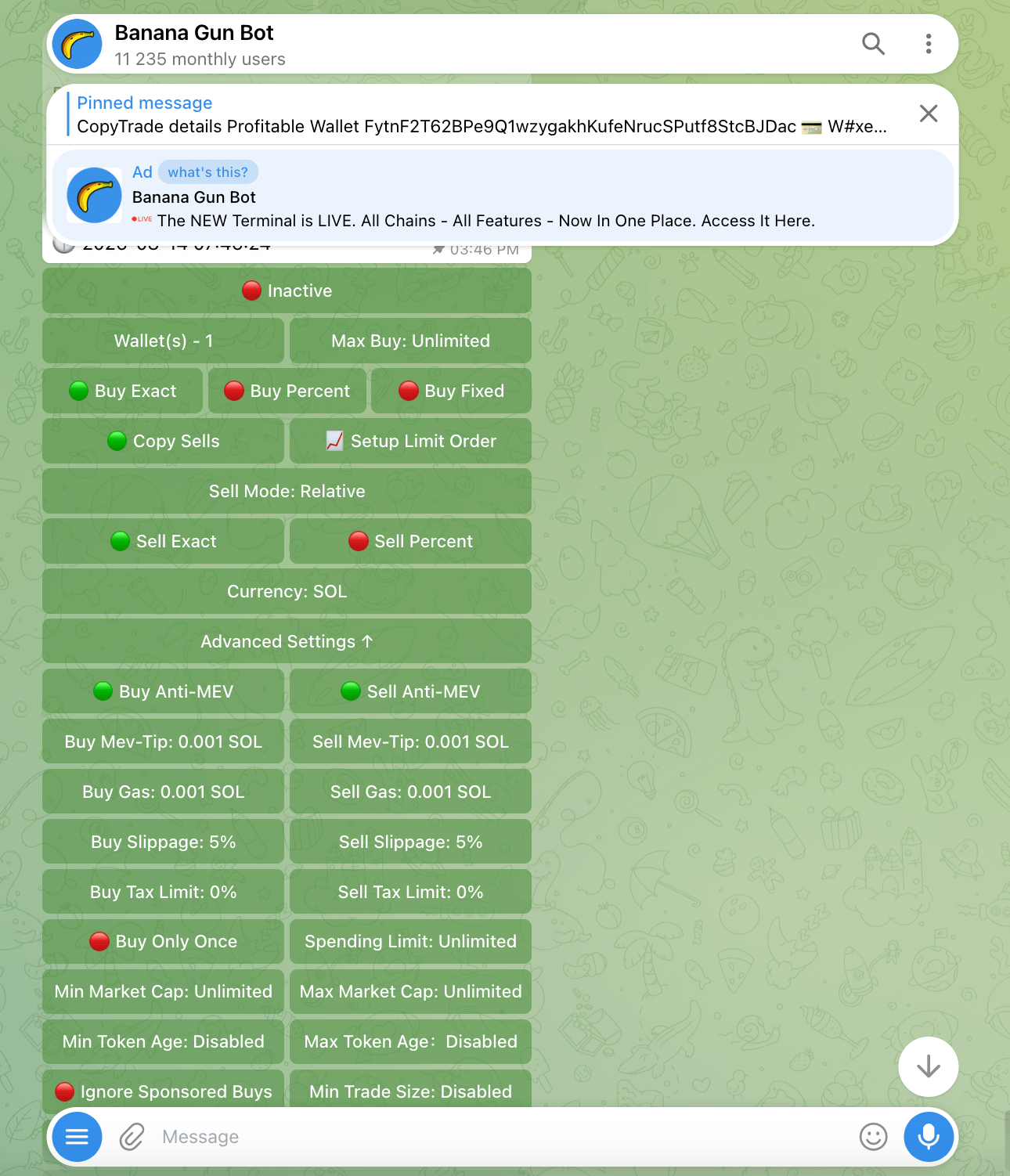
Tools built for this expose those controls directly. In Banana Gun that means a fixed buy amount and minimum and maximum market cap bounds, so a followed wallet chasing something far outside your range does not drag you in behind it.
Set it once and the entry side runs without supervision. This is the part of copy trading that removes real work, and it is why people start doing it.
The exit is where a mirror stops being a strategy
Now the uncomfortable part. The wallet you copy holds information you do not.
It knows its own cost basis. It knows what this position is worth relative to the rest of its bankroll. It knows why it opened the trade. You know one thing: that a buy happened.
So when that address sells, the sell is specific to its situation. It may be closing a position it opened days earlier at a completely different price, trimming into strength, or rotating into something it decided on last week.
Repeating the action without the reasoning is not the same trade, even when the token matches.
Decide the exit before the entry fires
The fix is unglamorous. Write the exit rule at setup time, when nothing is moving and you have no money at risk.
Two levels cover most of it. A price where you take profit regardless of what the followed wallet does, and a price where you cut regardless. Both get decided in advance or they get decided badly.
A trailing stop loss handles the mechanical side of the first one. It follows the position up and closes when the move turns, which keeps you out of the loop at the exact moment you are least able to think clearly. Banana Gun includes one, so this does not have to be a manual watch.
The point is not the specific tool. The point is that an exit rule you set while calm outperforms one you invent while a chart is dropping.
Wallet choice looks different once exits are your problem
Here is the part almost nobody factors in when they pick an address to follow.
A wallet that holds positions for days gives you room. You can build a plan around it, check in twice a day, act deliberately. A wallet that flips inside a single block leaves you with an entry and almost no window to do anything sensible.
Both styles can be profitable for the person running them. Only one is realistically copyable by someone who is not staring at a screen. High turnover looks impressive on a leaderboard and is often the hardest thing to mirror, because every trade demands a response you will not be there to give.
So screen for holding period, not just for whether the trades closed green. The best wallet to copy is not the most profitable one. It is the most profitable one whose pace matches yours.
What copy trading actually gives you
Strip the marketing away and the honest description is narrow: it is a sourcing tool. It finds tokens on $SOL you would not have found, at a time you would not have been watching.
That is worth a lot. It is not the same as a complete strategy, and the gap between those two ideas is where most first-year copy traders lose money. They treat the mirror as autopilot, then discover they outsourced their entries to a stranger while keeping every bit of the risk themselves.
Traders who stay in the game treat it the other way round. The wallet supplies ideas. The rules stay theirs.
That framing also makes the setup easier to evaluate. If the wallet you follow stops performing, you swap it. If your exit rules are wrong, no wallet fixes that.
Where do you sit? Do you close mirrored positions on your own rules, or do you wait for the wallet you follow to move first?
#CopyTrading #Solana #CryptoTrading #OnChain