#dusk $DUSK @Dusk
When Dusk places both Moonlight and Phoenix inside one trading framework, the first reaction is often confusion: if privacy is the goal, why keep a fully public transaction path at all?
The answer becomes clearer once you look at what each model is actually designed for. They solve different visibility needs.
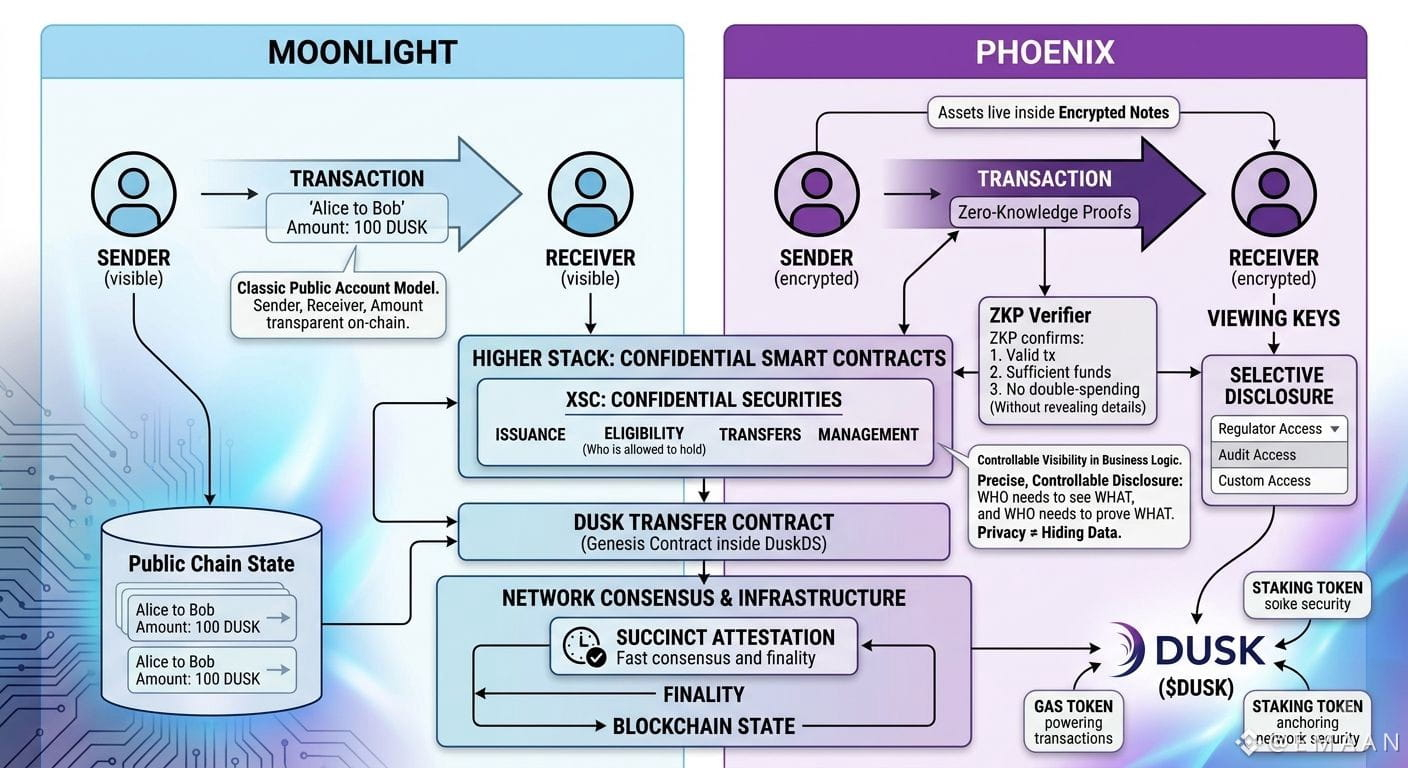
Moonlight follows a classic public-account approach. Sender, receiver, and amount are all transparent on-chain.
Phoenix takes the opposite route. Assets live inside encrypted notes. Zero-knowledge proofs confirm that a transaction is valid, that the sender has enough funds, and that double-spending is impossible — without revealing the underlying details. Viewing keys then allow selective disclosure when needed.
Both transaction types are processed by the same Transfer Contract inside DuskDS (a Genesis Contract). Consensus runs through Succinct Attestation, and finality follows the consensus outcome.
Higher up the stack, confidential smart contracts extend this controllable visibility into actual business logic. XSC then applies the same principles to confidential securities — covering issuance, who is allowed to hold them, transfers, and ongoing management.
What stands out is that Dusk is not simply hiding data. It is deliberately answering the question: who needs to see what, and who needs to prove what. For regulated assets this distinction matters. Privacy and compliance are not natural enemies; the real requirement is precise, controllable disclosure.
$DUSK powers the network as gas and staking token, anchoring the day-to-day operation of this infrastructure.
When Dusk places both Moonlight and Phoenix inside one trading framework, the first reaction is often confusion: if privacy is the goal, why keep a fully public transaction path at all?
The answer becomes clearer once you look at what each model is actually designed for. They solve different visibility needs.
Moonlight follows a classic public-account approach. Sender, receiver, and amount are all transparent on-chain.
Phoenix takes the opposite route. Assets live inside encrypted notes. Zero-knowledge proofs confirm that a transaction is valid, that the sender has enough funds, and that double-spending is impossible — without revealing the underlying details. Viewing keys then allow selective disclosure when needed.
Both transaction types are processed by the same Transfer Contract inside DuskDS (a Genesis Contract). Consensus runs through Succinct Attestation, and finality follows the consensus outcome.
Higher up the stack, confidential smart contracts extend this controllable visibility into actual business logic. XSC then applies the same principles to confidential securities — covering issuance, who is allowed to hold them, transfers, and ongoing management.
What stands out is that Dusk is not simply hiding data. It is deliberately answering the question: who needs to see what, and who needs to prove what. For regulated assets this distinction matters. Privacy and compliance are not natural enemies; the real requirement is precise, controllable disclosure.
$DUSK powers the network as gas and staking token, anchoring the day-to-day operation of this infrastructure.