

How Neutron and Kayon Are Redefining Blockchain Intelligence
"AI Blockchain" Marketing
Every blockchain project now claims AI capabilities. The term has become as meaningless as "revolutionary" or "game-changing" noise that obscures more than it reveals.
Vanar's approach stands apart because they didn't add AI features to an existing chain. They built the chain around AI requirements from the ground up. The distinction matters, and understanding why requires looking at what Neutron and Kayon actually do.
The Storage Problem Nobody Else Solved
Traditional blockchains store data through hashes references to files that actually live elsewhere. Your NFT's image? Probably on IPFS, which might or might not be pinned. Your document's proof? A hash on-chain pointing to AWS, Google Cloud, or some other centralized service.
This creates what Vanar's CEO Jawad Ashraf calls the "ownership illusion." You think you own something on-chain, but the actual content depends on external systems that can fail, change, or disappear.
When Amazon Web Services went down in October 2025, it took Coinbase, Robinhood, and multiple major exchanges with it. The crypto industry's dependence on centralized cloud infrastructure was suddenly, uncomfortably visible.
Vanar's Neutron solves this differently.
Instead of storing hashes, Neutron compresses entire files into what they call "Seeds" compact, queryable objects that live directly on the blockchain. A 25-megabyte 4K video clip becomes a 47-character seed. Not a reference to the video. The video itself, in compressed form, stored on-chain and recoverable without external dependencies.
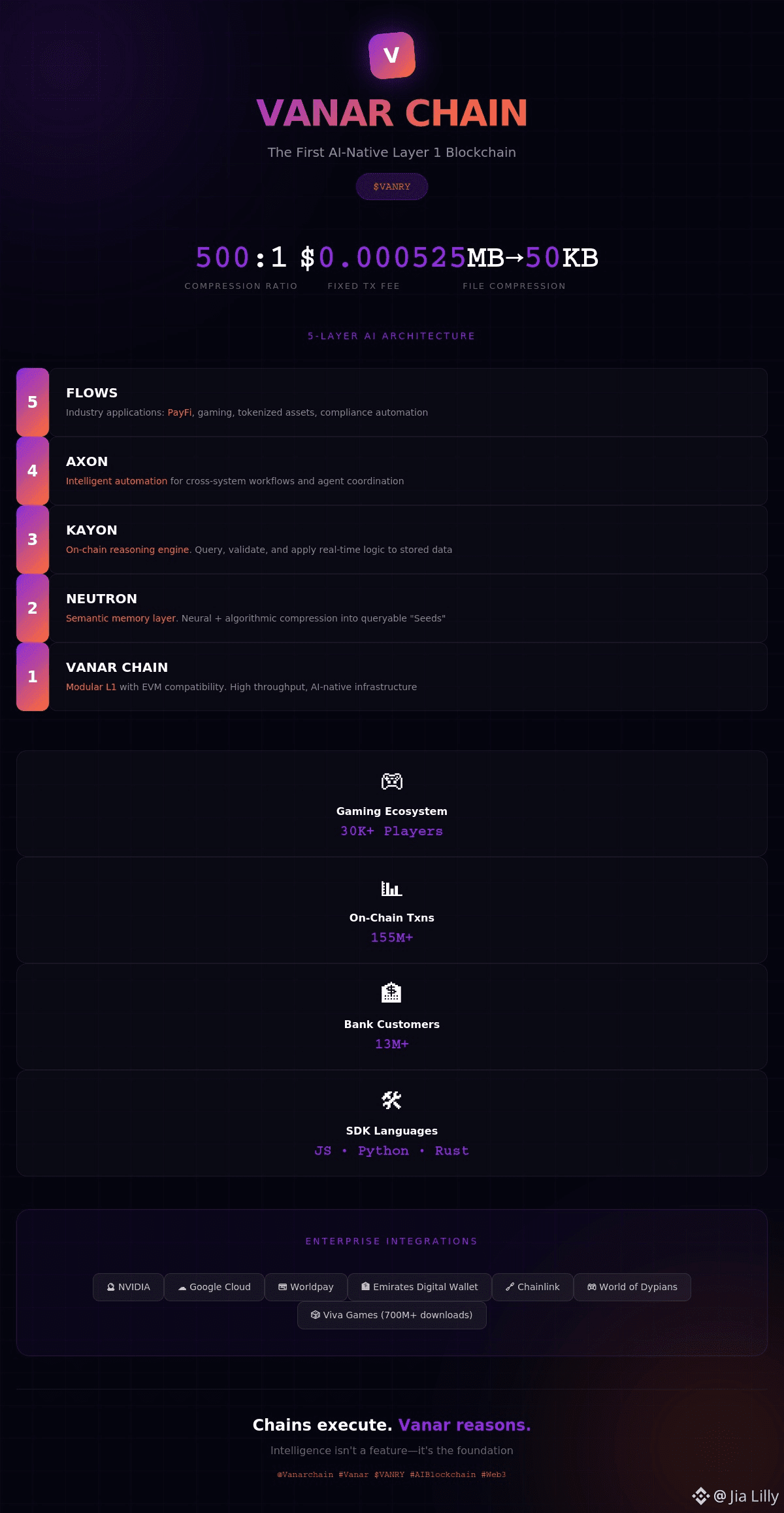 The compression isn't magic it's a combination of neural structuring, semantic embedding, and cryptographic proofs that preserve what matters while shrinking file sizes by up to 500x. The system understands context, learns from each compression, and optimizes for new formats automatically.
How Kayon Enables On-Chain Reasoning
Storing data on-chain is step one. Making that data useful for AI applications is step two.
Kayon functions as Vanar's decentralized intelligence engine. It reads Neutron Seeds, understands their contents, and enables smart contracts to query and act on that information in real-time.
This isn't ChatGPT bolted onto a blockchain. It's structured AI logic embedded into the chain itself, processing information through natural language queries and automated decision-making.
Practical applications include:
DeFi Risk Analysis: Kayon can evaluate lending positions, collateral ratios, and market conditions in real-time, triggering automated responses to changing conditions.
RWA Compliance: For tokenized real-world assets, Kayon can verify documents, check compliance requirements, and apply regulatory logic without human intervention.
Agent Interactions: AI agents operating on Vanar can query Kayon for context, retrieve memories stored in Neutron Seeds, and make coordinated decisions across ecosystem boundaries.
The combination creates something unique: a blockchain where data isn't just stored but understood, where smart contracts can reason rather than merely execute.
The MyNeutron Application
Theory is nice. Working products matter more.
MyNeutron is live and operational. Users can upload files documents, images, conversations from ChatGPT or Claude and generate semantic memories that persist across AI platforms.
The problem it solves is one any heavy AI user recognizes: context dies when you switch tools. Your conversation history with Claude doesn't transfer to ChatGPT. Your Google Docs don't inform your AI assistant. Every interaction starts from zero.
MyNeutron creates a universal memory layer. Upload your context once, anchor it on Vanar Chain for permanence (or keep it local for control), and carry that intelligence across any AI system that integrates with the protocol.
For individuals, this means more efficient AI interactions. For developers, it means building applications on a foundation of persistent, portable intelligence.
Enterprise Integrations That Matter
Vanar's partnership announcements read differently than typical crypto project PR because they involve operational infrastructure rather than promotional relationships.
NVIDIA Integration: Vanar leverages NVIDIA's CUDA-accelerated AI stack for computation-heavy operations. This isn't a logo on a website it's enterprise-grade AI infrastructure powering actual processing.
Google Cloud Partnership: BCW Group runs validator nodes using Google Cloud's renewable-energy infrastructure, processing over $16 billion in fiat-to-crypto transactions across their network. The same infrastructure now supports Vanar's AI operations.
Worldpay Connection: The global payments giant integrates with Vanar for settlement infrastructure, enabling Neutron Seeds to be minted and settled on enterprise-grade payment rails.
Emirates Digital Wallet: Owned by 15 primary banks in the Middle East with access to 13+ million customers, EDW adopted Vanar for mainstream speed, security, and efficiency. This represents real institutional adoption in a significant geographic market.
The Gaming Ecosystem
Vanar's gaming infrastructure gets less attention than its AI capabilities but represents substantial operational adoption.
World of Dypians, a 2,000 square kilometer metaverse available on Epic Games Store, runs on Vanar with over 30,000 active players and 155+ million on-chain transactions. The game integrates AI-powered NPCs that adapt to player behavior, demonstrating Vanar's AI capabilities in a consumer-facing application.
Vanar provides gaming-specific infrastructure:
Unreal and Unity APIs for easy blockchain integration
Micropayment support optimized for in-game transactions
Metaverse social modules for 3D interaction spaces
NFT minting tools abstracted for non-crypto-native developers
Quest engines for gamification and engagement loops
Viva Games Studios, with 700+ million mobile game downloads and titles for brands like Disney and Hasbro, brings their portfolio to Vanar's gaming ecosystem. This isn't speculative it's operational games with existing audiences.
Token Utility Beyond Speculation
$VANRY's utility structure ties directly to Vanar's AI products rather than existing purely for speculation:
Gas Fees: Every transaction on the network requires VANRY, with fixed fees around $0.0005 low enough for high-frequency operations but meaningful at scale.
AI Tool Subscriptions: Starting Q1 2026, advanced features in Neutron and Kayon require VANRY tokens for access. This creates direct utility demand tied to product usage.
Staking Rewards: Validators stake VANRY to secure the network and earn rewards from transaction fees and inflation.
Token Burns: Certain operations burn VANRY, creating deflationary pressure as network usage increases.
The structure attempts to align token value with actual platform adoption rather than pure speculation. Whether it succeeds depends on whether Vanar's AI products gain meaningful traction.
The PayFi Expansion
Vanar's roadmap includes aggressive expansion into what they call "PayFi" bridging blockchain payments to global commerce.
The Q1 2026 PayFi ecosystem expansion targets tokenized real-world assets with compliance-ready infrastructure. Kayon's query capabilities enable real-time compliance checking, making regulated asset tokenization more practical than on chains without native intelligence.
This positions Vanar for institutional use cases where compliance isn't optional—regulated securities, real estate tokenization, cross-border payment settlements that must satisfy multiple jurisdictions simultaneously.
Quantum Resistance Claims
Vanar makes claims about quantum encryption R&D that deserve scrutiny. Ashraf stated at the Vanar Vision conference that "the technology we're building is quantum encrypted" and designed for when quantum computing can "crack traditional keys."
These claims are forward-looking rather than currently verified. Quantum-resistant cryptography is an active research area, and actual quantum computers capable of breaking current encryption remain years away. Vanar's quantum claims should be understood as research direction rather than present capability.
What Makes Vanar Different
The distinction between Vanar and other "AI blockchains" comes down to architectural integration versus feature bolting.
Chains that add AI features after the fact face fundamental limitations. Their consensus mechanisms weren't designed for AI workloads. Their storage systems can't handle the data requirements. Their execution environments can't support the continuous operation that autonomous agents require.
Vanar built around these requirements:
Storage designed for AI-readable semantic objects
Execution environments supporting persistent agent operation
Consensus optimized for high-frequency, low-cost transactions
Native inference capabilities embedded in validator nodes
Whether this matters depends on whether AI agents become significant blockchain users. If the future is human users clicking buttons on DeFi interfaces, Vanar's architecture provides marginal benefits. If the future involves autonomous systems operating continuously across ecosystems, Vanar's foundation becomes essential.
The Market Reality
VANRY trades around $0.008 with roughly $20 million market cap small by crypto standards. Trading volume is modest. Market attention has largely moved elsewhere.
This disconnect between technical innovation and market valuation is common in crypto. Projects with genuine differentiation often underperform during phases dominated by speculation on simpler narratives.
The question for Vanar isn't whether the technology works evidence suggests it does. The question is whether the market will recognize the value before, during, or after AI agents become mainstream.
Vanar presents a specific thesis: AI-native blockchain infrastructure will matter as autonomous agents become significant economic actors.
If you believe AI agents will operate at scale across digital ecosystems within the next few years, Vanar's early positioning could prove valuable. The technical foundation exists. The enterprise partnerships are operational. The product suite is live.
If you believe AI agents remain speculative or that general-purpose chains will adequately serve their needs, Vanar's premium for specialized architecture provides little benefit.
The market will eventually reveal which thesis proves correct. Until then, Vanar continues building infrastructure for a future that may or may not arrive on schedule.
