
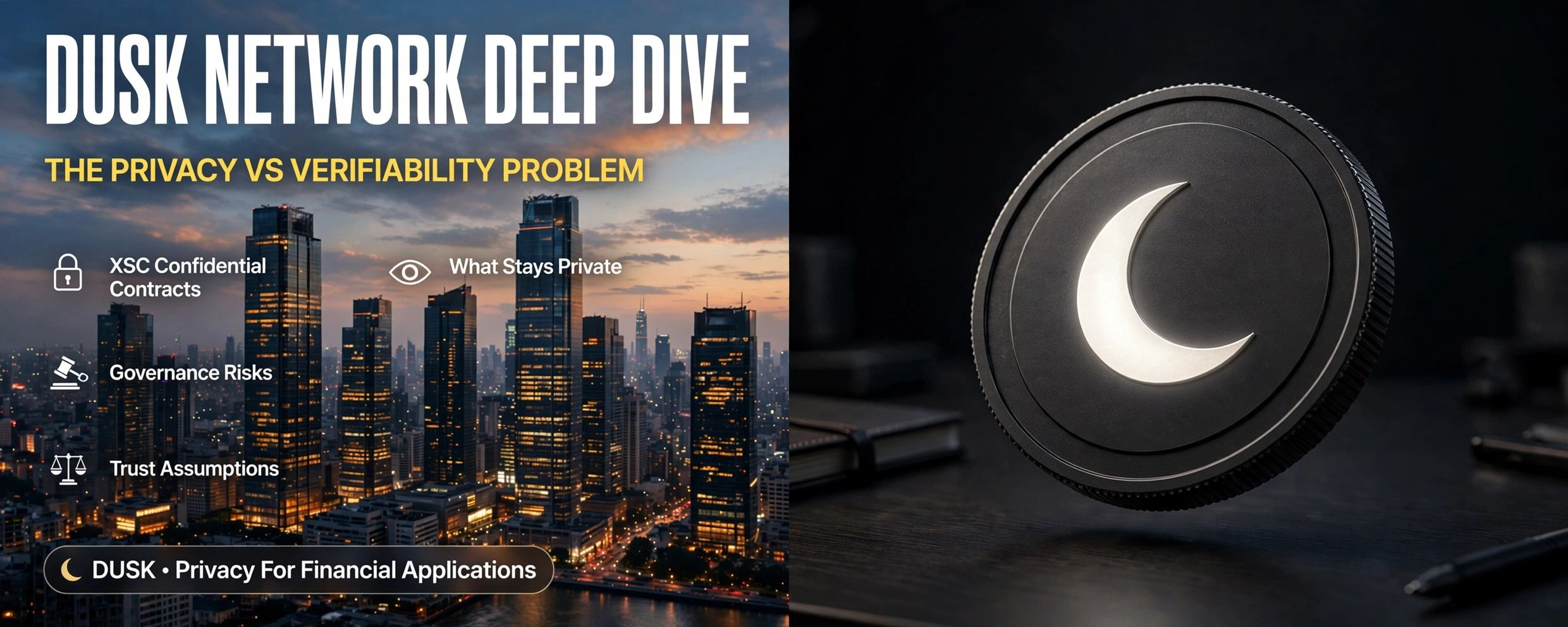
After spending last night back in the $DUSK Dusk Network documentation, I realized I had been oversimplifying what "privacy blockchain for financial applications" actually means.
On the surface, Dusk is described as a Layer-1 blockchain purpose-built for financial use cases, powering confidential smart contracts and the Confidential Security Contract (XSC) standard. That sounds clean and straightforward. In practice, it's a much harder engineering problem.
The core tension is this
how do you keep things confidential while still making them verifiable across a decentralized network?
My initial assumption was the standard one — privacy means hiding transaction data. But as you go deeper into how Dusk approaches it, more nuanced questions come up.
What precisely stays private? Is it the sender, the receiver, the amount, the logic inside the contract itself, or all of the above under certain conditions? And on the other side, what must remain visible for the network to function? Validators still have to reach consensus, prevent double-spending, and enforce the rules of the XSC standard. That means they must be able to verify that something is correct without necessarily seeing what that something is. That is where zero-knowledge proofs and other cryptographic commitments carry a lot of weight, but it also raises the question of trust assumptions.
If Dusk truly succeeds as infrastructure for regulated financial applications, stability matters. DeFi protocols, tokenized securities, and institutions building on XSC need predictability. So how should changes to the underlying privacy mechanism be governed? Any upgrade to the proof system, the transaction model, or the compliance features could introduce new cryptographic assumptions or change the guarantees for applications that are already live.
It’s a delicate balance between evolving the privacy tech and preserving trust for builders who depend on it.
I don't think the docs are meant to answer all of this on their own — a lot of it is still my interpretation after reading through. But that's honestly what makes Dusk more interesting to research than most L1s. It's not just another fast chain. It's trying to solve privacy, verifiability, and regulatory compatibility at the same time, which is inherently full of trade-offs.
For those who have studied Dusk at a deeper level, I’m curious how you evaluate the XSC approach. Where do you see the biggest trade-offs on decentralization and long-term security?