

Brazil has managed something unusual in crypto: it built a $318.8 billion on-chain market while remaining strangely easy for the global industry to overlook. Over the twelve months to June 2025, Brazilian wallets and platforms received $318.8 billion, nearly a third of Latin America’s activity. Yet São Paulo rarely commands the same conference-stage attention as Dubai, Hong Kong, or Singapore. That changes on October 30, 2026. The deadline is not merely an administrative date. It is an institutional reckoning.
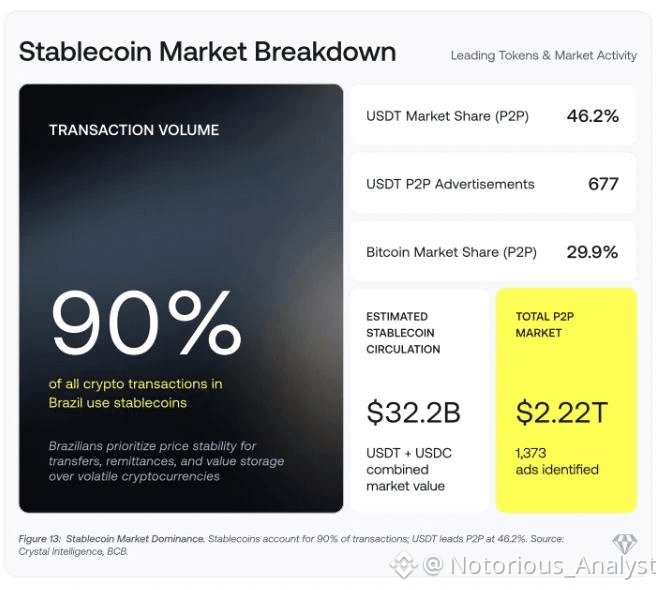
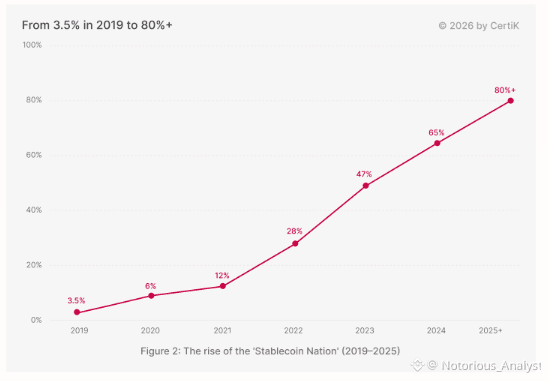
The reason is scale. Brazil is not regulating a speculative niche. It is regulating a financial market already embedded in the economy. Federal Revenue filings show R$1.58 trillion in crypto transactions between August 2019 and December 2025, with R$1.13 trillion in stablecoins. Stablecoins have represented more than 80% of monthly volume since 2023. When four out of five reais in crypto pass through an instrument pegged to a foreign currency, this stops being a narrow consumer-protection exercise. It becomes a monetary policy, foreign exchange, and cross-border supervision problem. That is why the Central Bank of Brazil, not simply a market regulator, sits at the center of the framework.
And the Central Bank has made its philosophy unmistakable: the Proof Shift.
Under IN 704, independent technical proof became part of the authorization dossier. IN 701 requires incumbent financial institutions entering virtual assets to submit technical certification from a qualified independent firm, covering asset segregation, third-party technical capacity, incident recovery, AML/CFT and security controls, and listing policies. Then IN 739 raised the bar again: SPSAV authorization applications must include a reasonable assurance report from a CVM-registered audit firm, prepared under NBC TO 3000, attesting to the effectiveness of AML/CFT and sanctions controls. The filing deadline is October 30.
That is a profound change in the market’s burden of proof. A company can no longer say its controls exist; an independent party must establish that they exist and work. The report’s sequence is brutally practical: gap assessment, remediation, technical testing, then assurance. Each step takes time. A dossier is no longer paperwork. It is evidence.
The capital requirements make the message even harder to misread. Depending on category, SPSAVs face minimum capital of R$10.8 million to R$37.2 million. They also need governance, segregation of client assets, cybersecurity, business continuity, AML/CFT controls, a dedicated physical office and other requirements associated with supervised financial institutions. The report’s blunt characterization is the right one: an SPSAV is a financial institution in everything but name.
There is a legitimate objection. Brazil has compressed an enormous regulatory build-out into less than twelve months between the final rules and the filing obligation. Veirano Advogados describes the authorization process as a highly coordinated exercise spanning governance, AML/CFT, cybersecurity, operational risk, technology, accounting and regulatory work. ABcripto has also objected to the simultaneous strain of tying up capital, people and technology while absorbing additional operational restrictions. That anxiety is not imaginary.
But it is not a persuasive argument for preserving the old standard.
CertiK’s Hack3d H1 2026 data records $1.32 billion lost across 344 incidents in the first half of 2026. Wallet compromise alone accounted for $444.5 million across 33 incidents; phishing added $366.3 million. More importantly, the two largest attacks, Kelp DAO and Drift Protocol, were driven not by smart-contract bugs but by operational-security and infrastructure failures involving keys, RPC and multisig governance. The market has already paid the bill for trusting declarations where verification was needed.
This is the hard reality Brazil is forcing into the open: security cannot remain a marketing promise while the underlying financial infrastructure handles hundreds of billions of dollars.
The broader significance is bigger than Brazil. The report places its framework alongside MiCA, VARA and MAS and identifies the distinctive Brazilian edge: independent proof is required before authorization, not merely demonstrated later during supervision. That is a meaningful signal to every jurisdiction still deciding how much of crypto’s old operating model it is willing to tolerate.
And October 30 will not end the disruption. It will start the consolidation.

The report expects 2027 to bring professionalization, mergers and concentration as licenses become strategic assets. An authorized SPSAV, or an application already well advanced, carries value because it saves time and uncertainty. Foreign operators can acquire local businesses, work through authorized carriers, or exit. Companies unable to finance the capital floor or produce credible evidence will have fewer places to hide.
That is not regulatory overreach. It is what financial-market maturation looks like.
Crypto spent years competing on the ability to promise: promise decentralization, promise security, promise reserves, promise controls. Brazil is demanding something much less glamorous and far more important: prove it.
The Wild West ends when access to the financial system depends on independent evidence rather than marketing confidence. In mature markets, security stops being a footer on a website and becomes existential infrastructure. Brazilian platforms now have a simple choice: meet banking-grade standards, build on someone who does, or leave the value chain entirely.