
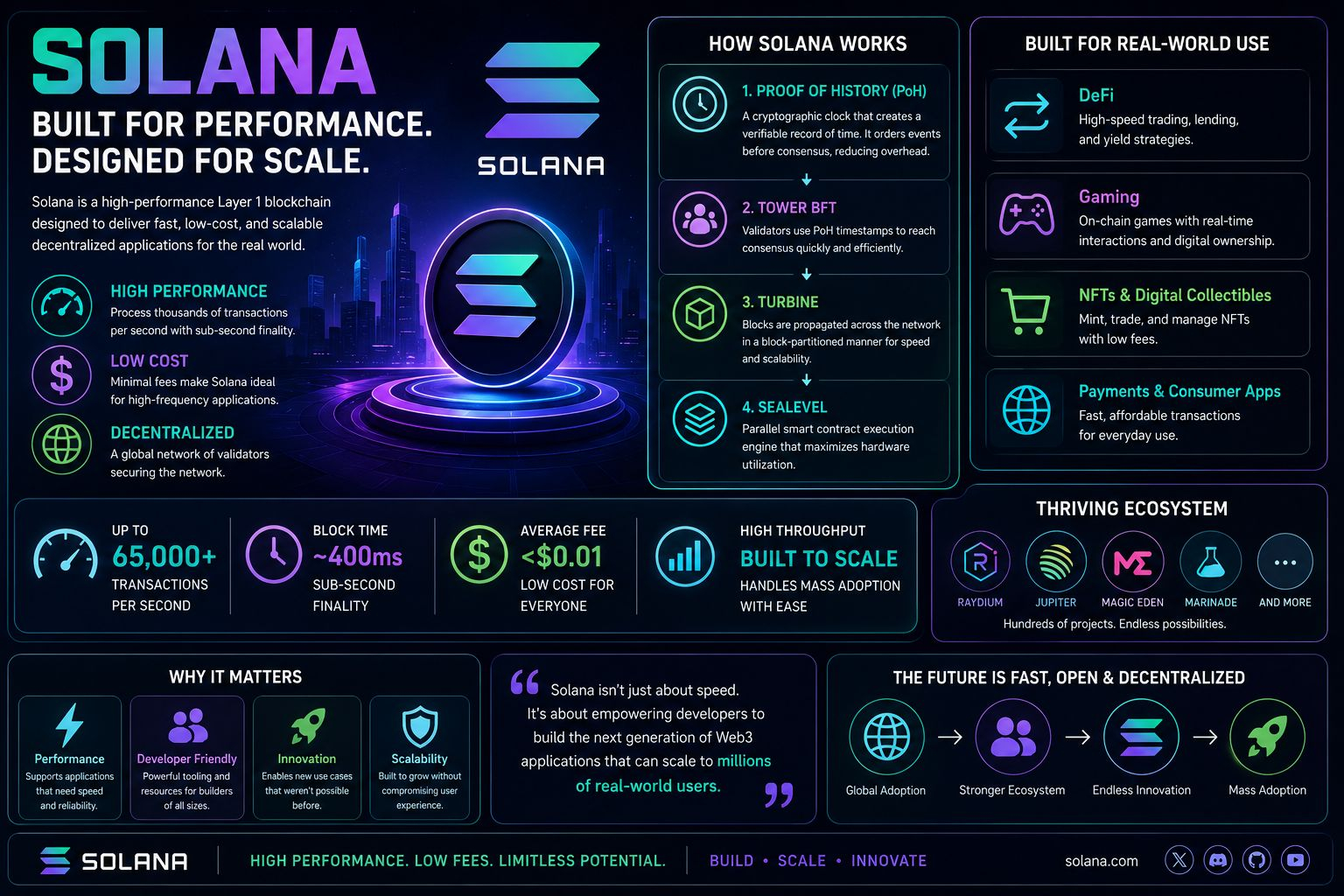
 When people talk about Solana, the first thing that usually comes up is speed. But after looking deeper into its architecture, I think the more interesting question is not simply how many transactions a blockchain can process—it is what developers can build when the underlying network is designed for high-frequency activity.
Solana takes a different approach from many blockchain networks by focusing on high throughput and low transaction costs within a single, high-performance Layer 1. Its architecture is designed to process large amounts of activity while maintaining a decentralized validator network, making it particularly attractive for applications where frequent transactions are important.
One of the concepts that makes Solana interesting is Proof of History (PoH). It works as a cryptographic clock that helps establish the ordering of events before consensus is finalized. Combined with Solana's broader consensus and execution architecture, this can reduce the coordination overhead that traditional distributed systems often face.
The practical impact becomes clearer when looking at applications. Decentralized exchanges can benefit from fast settlement, blockchain games can require frequent interactions, and consumer applications may need transactions to feel almost invisible to users. When transaction costs are low and confirmation is fast, developers have more freedom to design experiences that would be difficult to reproduce on slower or more expensive infrastructure.
But performance alone doesn't determine whether a blockchain succeeds. A network also needs reliable infrastructure, developer adoption, liquidity, security, and a strong ecosystem. Solana's growth has therefore been interesting not simply because of technical benchmarks, but because developers have continued experimenting with different categories of applications on the network.
Another important lesson is that blockchain architecture involves trade-offs. Optimizing for high performance requires careful decisions around hardware requirements, validator participation, network design, and decentralization. These considerations should be evaluated alongside speed and cost rather than ignored.
This is why I think Solana is useful to study even for people who aren't directly using the network. It represents one of the industry's attempts to answer a fundamental question: can a blockchain support applications with the responsiveness people expect from modern internet services while still preserving the properties that make decentralized networks valuable?
The answer is still evolving.
If Web3 is eventually going to reach millions of mainstream users, blockchain applications will need to become simpler, faster, and more affordable. Users generally don't care which consensus mechanism processes their transaction; they care whether the application works reliably.
Solana's approach shows that performance can be a major part of that equation, but it is only one piece of a much larger infrastructure challenge.
For me, the real test isn't whether Solana can process transactions quickly. It's whether developers can use that performance to create applications that people actually want to use.
Do you think blockchain adoption will ultimately be driven more by raw network performance or by the quality of applications built on top of it?