

Crypto trading usually attracts people because of the upside. Risk management forces me to think about the opposite side of the equation: what happens when I am wrong.
After watching crypto markets for long enough, I have become convinced that this is where the real difference between trading and gambling begins. Finding a good entry matters. Reading market structure matters. Understanding liquidity, momentum, narratives, and macro conditions matters. But none of those things can protect an account if one bad decision is large enough to erase weeks of good ones.
I don't think the main objective of risk management is to avoid losses. Losses are unavoidable. The objective is to make individual losses financially unimportant.
That sounds simple, but crypto makes it surprisingly difficult.
The market trades around the clock. Leverage is easily available. A token can move 10% before someone trading a slower market would even consider that unusual. Bitcoin can look technically strong while smaller altcoins are quietly losing liquidity underneath it. A position can be profitable at midnight and stopped out before breakfast.
Because of that, I think risk has to be decided before I think about profit.
Suppose I have a $10,000 trading account. I see a setup that looks extremely attractive and put $3,000 into it. At first glance, someone might say I am risking 30% of my account.
Not necessarily.
Position size and actual trading risk are different things.
If my entry is $100 and my invalidation point is $95, I am risking roughly 5% of the position before fees and slippage. On a $3,000 position, that is approximately $150, or 1.5% of the entire $10,000 account.
That $150 matters much more to me than the $3,000 headline position size.
This is one of the simplest ideas in trading, yet I see it misunderstood constantly. I don't want to ask only, "How much should I buy?" I want to ask, "If this trade fails exactly where my idea becomes invalid, how much money disappears?"
Once I know that number, everything else becomes easier.
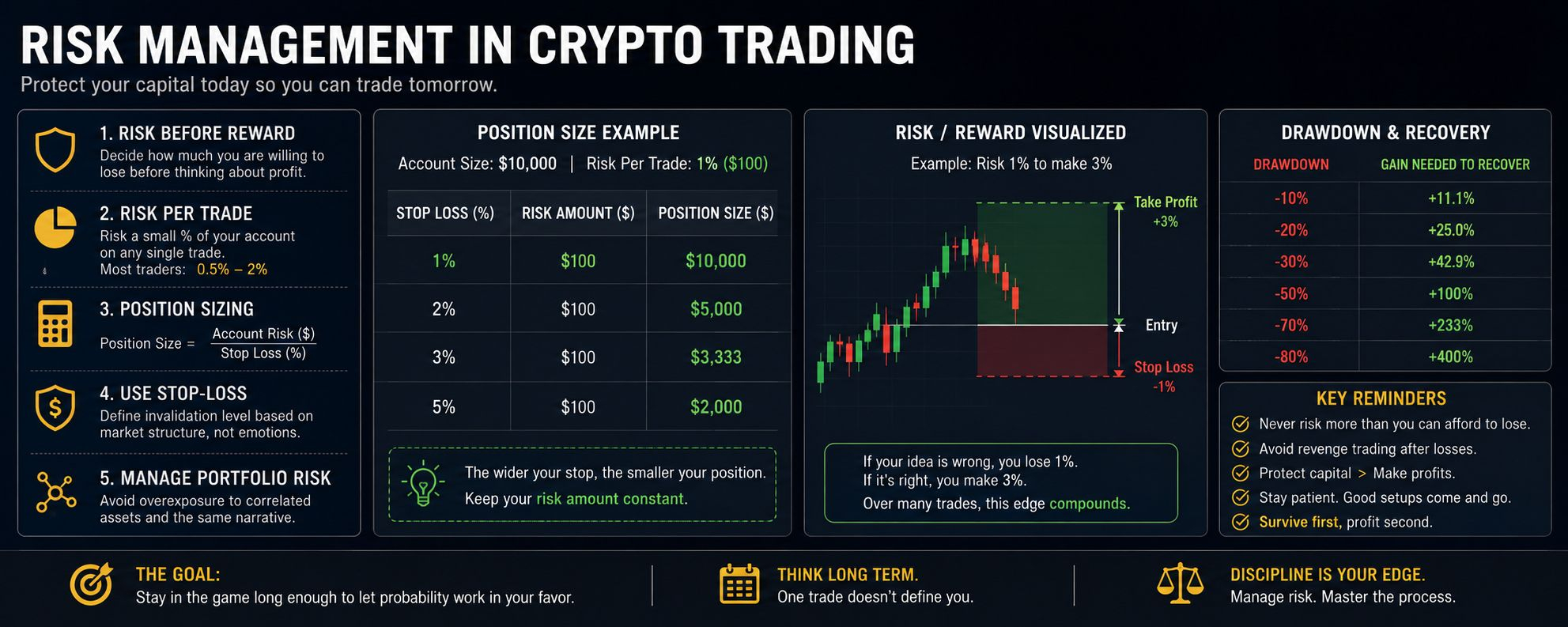
For example, imagine I decide that I am willing to lose $100 on one trade. My technical setup requires a stop 2% away from the entry.
Ignoring fees and slippage for simplicity, the position size would be roughly $5,000.
If the setup instead requires a 5% stop, the position should fall to around $2,000 to keep approximately the same $100 account risk.
This is why I don't like choosing a random position size and then forcing a stop-loss around it. The market structure should tell me where the trade is invalid. My risk tolerance should then tell me how large the position can be.
Reversing that process creates dangerous behavior.
A trader decides he wants a large position, realizes the logical stop would produce an uncomfortable loss, and moves the stop closer. The stop is no longer based on the trade thesis. It is based on how much pain the trader wants to feel.
That is not risk management. It is emotional accounting.
Leverage makes this problem more interesting because leverage itself is not the complete definition of risk.
A carefully sized leveraged position can sometimes have less account risk than an oversized unleveraged position. What leverage does is increase exposure relative to the capital committed, while also bringing liquidation mechanics, funding costs, volatility sensitivity, and execution risk into the picture.
That distinction matters.
If someone hears "5x leverage" and immediately concludes that the trader is risking five times more money, the picture is incomplete. I would rather know the position size, account equity, stop distance, liquidation price, and amount actually at risk.
The uncomfortable part is that leverage also changes behavior.
When every tiny candle creates a meaningful change in unrealized P&L, people begin managing money rather than managing the setup. They close winners too early. They widen stops. They revenge trade. They watch one-minute candles even though their original thesis came from a four-hour chart.
So even when leverage is mathematically manageable, it can become psychologically unmanageable.
That is a risk too.
Another thing I pay attention to is correlation.
Five open trades do not necessarily mean I have five independent ideas.
If I am long BTC, ETH, SOL, and several high-beta altcoins simultaneously, my portfolio may look diversified because the ticker symbols are different. But if all of those positions depend on crypto liquidity expanding and Bitcoin remaining strong, I may effectively be expressing the same directional bet several times.
When the market turns, correlations can suddenly become painfully obvious.
That is why I prefer thinking about total portfolio exposure rather than evaluating every position in isolation.
If I risk 1% on five highly correlated long positions, I cannot automatically tell myself that I only have 1% at risk. A broad crypto selloff could invalidate several of them almost simultaneously.
This becomes even more important during major macro events.
Inflation data, central-bank decisions, employment reports, geopolitical shocks, regulatory developments, exchange problems, or sudden liquidation cascades can move the market faster than a normal technical setup anticipates.
A stop-loss is useful, but it is not a contractual guarantee that I will exit at exactly that price.
If Bitcoin is trading at $60,000 and I place a stop around $59,500, a violent move could theoretically execute below my intended level because of slippage. In liquid markets under ordinary conditions the difference may be small, but during extreme volatility it can become meaningful.
This is one reason I treat my calculated risk as an estimate rather than a law of physics.
Then there is liquidation.
With leveraged futures, I never want liquidation to function as my stop-loss.
A stop says my market thesis was invalidated.
Liquidation says my margin structure failed.
Those are very different events.
If I need the exchange's liquidation engine to tell me that a trade went wrong, I have usually allowed the position to control me rather than controlling the position.
I also think risk-to-reward ratios are useful, but they are frequently abused.
A chart can be made to display almost any theoretical reward-to-risk ratio. I can put a stop 1% below an entry and draw a target 5% above it and call the setup 1:5.
That does not mean I have discovered a great trade.
The missing variable is probability.
Imagine one strategy wins 55% of the time with an average winner of twice the average loss. Another wins 15% of the time while targeting five times the average loss.
The second strategy has the more exciting screenshot. That does not automatically make it superior.
What matters is expectancy across a sufficiently large sample.
I think about it roughly as:
Expected result = (win rate × average win) − (loss rate × average loss).
A strategy that loses frequently can still be profitable if its winners are large enough. A strategy with a high win rate can still lose money if occasional losses are enormous.
This is why I don't judge a trading system from three trades.
Even a genuinely profitable strategy can experience a sequence of losses.
Suppose I risk 10% of my account on every trade and lose five consecutive trades. Because each loss occurs on a progressively smaller account, I would not lose exactly 50%, but I would still be down roughly 41%.
Recovering from that requires a gain of around 69% on the remaining capital just to return to the starting point.
That asymmetry is one of the most important things I have learned about risk.
If an account loses 10%, it needs about 11.1% to recover.
After a 25% loss, it needs about 33.3%.
After a 50% loss, it needs 100%.
After an 80% loss, it needs 400%.
The deeper the drawdown becomes, the harder recovery gets.
That is why survival matters more to me than maximizing every opportunity.
There will always be another chart. Another narrative. Another breakout. Another new token. Another bull market eventually.
Capital is what gives me the ability to participate in those opportunities.
This also changes how I think about losing streaks.
If I normally risk 1% per trade, I don't necessarily increase my risk after losing three times because I want the fourth trade to recover everything. That is exactly when emotional decision-making starts replacing statistical thinking.
If anything, a meaningful drawdown makes me more interested in understanding what changed.
Is my strategy simply experiencing normal variance?
Did volatility change?
Am I trading a range using a trend strategy?
Am I forcing setups because I want to recover losses?
Has market liquidity deteriorated?
Those questions are more valuable than asking which trade can make the money back fastest.
I also separate trading capital from money that has another purpose.
Rent money should not become futures margin. Emergency savings should not become an altcoin position because a chart looks attractive. Capital needed for a near-term obligation should not depend on whether Bitcoin holds support.
The market does not know why I need the money.
This sounds obvious until greed enters the room.
Crypto creates unusual psychological pressure because there is almost always an asset doing something spectacular. Even when my own setup is absent, social feeds can make it appear that everyone else is making money somewhere.
That creates FOMO, and FOMO is fundamentally a risk-management problem.
I start entering later.
I accept worse prices.
I increase size because I feel I missed the first part of the move.
I stop waiting for invalidation levels that make sense.
Eventually, I am no longer trading the market in front of me. I am trading my frustration about the move that already happened.
For me, one of the strongest risk-management tools is therefore the ability to do nothing.
Cash is a position.
Not trading is a decision.
Missing a rally does not damage my account. Chasing it with uncontrolled risk can.
I also pay attention to the difference between spot holdings and trading positions. A long-term Bitcoin allocation and a leveraged BTC trade may involve the same underlying asset, but they should not necessarily share the same risk framework.
A trader might exit because a short-term support level fails. A long-term investor might view the same decline as ordinary volatility because the investment thesis operates over years.
Problems begin when people switch identities after entering.
A short-term trade goes against them, so suddenly it becomes a "long-term investment."
A speculative altcoin collapses, so the original stop is abandoned because they now "believe in the project."
That transformation is often just loss aversion wearing a more respectable name.
I prefer deciding what a position is before entering it.
I also think every risk model has limitations.
Fixed percentage risk does not protect me from every scenario. Stop-losses can slip. Exchanges can experience problems. Stablecoins can depeg. Liquidity can disappear. Smart contracts can fail. Tokens can gap violently after unexpected news. A profitable historical strategy can stop working.
Risk management is therefore not about creating a world in which nothing bad happens.
It is about building an account that can absorb bad things without one event becoming fatal.
And that is ultimately how I judge my own risk.
Not by asking how much I can make if I am right.
I ask what happens if I am wrong five times in a row. I ask what happens if two correlated positions collapse together. I ask whether I can still think clearly after the loss. I ask whether I will have enough capital left to take the next genuinely good opportunity.
The longer I watch crypto, the less interested I become in traders who can produce one extraordinary winning screenshot.
What interests me is the trader who is still operating years later.
Markets will continuously offer opportunities to make money, but they will also continuously test how much risk I am willing to take to capture them. I cannot control which trade becomes the winner, how far Bitcoin moves tomorrow, or when the next unexpected event hits.
I can control how expensive being wrong is allowed to become.
And in a market where uncertainty is permanent, I think that may be one of the few genuine advantages a trader can build for himself.